
How does POLST work in clinical practice?
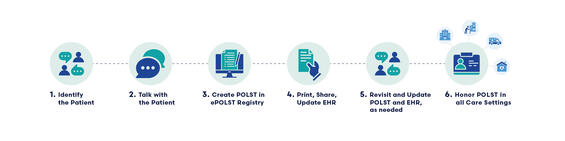
1. Identify
POLST is intended for individuals who:
- Have serious or advanced illness or frailty and
- May face a health emergency where they cannot communicate and
- Want to avoid certain treatments in an emergency.
| Patients with these medical conditions may benefit from POLST |
|---|
|
2. Talk
- Have a conversation with the patient about their prognosis, what to expect, and what matters most to them. Explore their goals for care and treatment preferences, especially in emergencies.
- Include the patient's health care agent and trusted people in this discussion, if the patient approves.
- Document the conversation in the EHR.
3. Complete POLST in ePOLST Registry
If the patient chooses to have a POLST, complete and sign the POLST with the patient in the ePOLST Registry.
4. Print, Share, Update EHR
- Print the POLST for the patient, confirm understanding, and explain that they should keep it somewhere accessible for EMS (e.g. refrigerator door). Let patients know how they may access the ePOLST Registry.
- Follow your organization’s policies to make sure POLST is accessible in the EHR and update code status and other relevant information.
5. Revisit and update POLST and EHR, as needed
- Revisit the conversation as the individual’s health status or goals of care change or with transfer of care to or from a hospital, skilled nursing facility, hospice, etc.
- Update the ePOLST Registry and EHR if changes are made.
6. Honor POLST in all care settings
The POLST medical orders should be followed wherever the patient is receiving care. Engaging the patient’s health care agent or guardian whenever possible before an emergency will help to avoid confusion and to ensure the patient’s choices honored.
Additional resources
- MassPOLST Digital Learning Modules available Fall 2026
- MassPOLST Call Center launches January 2027
- Hours of operation: Monday - Friday 9:00 am - 5:00 pm EST