
The members of the Art Commission respectfully submit their Annual Report for the year ending June 30, 2011. Despite the Commission’s long service to the Commonwealth, our task of imposing museum standards of care in a non-museum setting continue to be challenging. Since works of art and historic artifacts are installed throughout the public areas and on the grounds at the State House, we have developed a wide variety of policies and procedures to ensure these are properly maintained. Moreover, heightened attention to the preservation of this historic site, long a concern of the Commission, requires greater collaboration from us with qualified planners and contractors. This is in addition to the guidance and review we provide for proposed new acquisitions to the collection, and the public access to the collections we treat as a priority.
With all of this in mind, I am pleased to report that we now have legislative support to revise and update the Commission’s mandate, last amended in 1924. We anticipate that the bill will be filed in mid-summer by Representative Martha Walz, whose district includes the State House. This legislation will establish the position of State House Curator, increase the volunteer membership, and clarify the Commission’s expanded role in the preservation of the State House as well as the collections which commemorate almost 400 years of Massachusetts history.
The Art Commission was created in 1910 with a simple mission: to oversee the acquisition of new artworks for the Commonwealth’s rapidly developing collection at the State House. These responsibilities were further expanded in 1924 to include “custody and care” of the collection -- the foundation of General Laws chapter 6, section 20. No formal policies or preventive care programs were initiated, however, until 1984 when an Art Collections Manager was hired on a contractual basis, and the Commission initiated a comprehensive collections care and conservation program.
Throughout the twentieth century and now into the twenty-first, the collection has increased not only in size, but also in value. Although originally intended to be historical and commemorative, many of the artworks were created by leading American painters and sculptors. These now number over 300 individual works of art including paintings, two- and three-dimensional sculptures, wall murals, as well as historic artifacts, and significant architectural features and decorative arts. Additionally, they are housed in a landmark building which, as it ages, also requires specific care and oversight to preserve not only the envelope, but also the historic fabric and contents. As we have repeatedly stated over the years, a collection of this scope, age and value, requires, and will always require, permanent professional care and oversight. We look forward to the clarification that revised legislation will bring to our mandate.
Activities
This was a typical year in that along with all that we are responsible for, and those projects that we initiated, we also spent a great deal of time on activities that we did not anticipate, requiring vast amounts of time and effort. For a part-time staff and a volunteer board, I am proud to say that we met all of these challenges.
The Commission worked with the Governor’s office, House, Senate, BSB and DCAM staff on a wide variety of art and building issues. Over the past year, the Design Guidelines, established to insure proper review process for all State House restoration, care and maintenance activities, were finalized; following completion of the roof project, the Great Hall was renovated, and the design process for the interior restoration of the House Chamber was initiated.
The following are examples of on-going projects for collections care and public outreach:
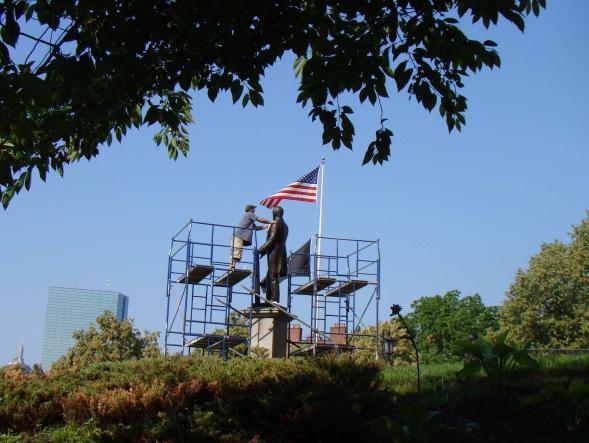
- Exterior Sculpture Maintenance. Annual maintenance of the bronze monuments is necessary to protect them from the combined effects of acid rain, pollution, and salt air, which cause corrosion of the metal, deterioration and damage to the patina, and eventually irreversible damage to the original modeling. Conservators from Daedalus, Inc., Watertown, completed year four of a five year contract in June 2010 and reported that the statues, including the Daniel Webster (1865) and Horace Mann (1859), two of the oldest public monuments in Boston, remained in good condition due to this annual care, precluding costly, in-depth treatment.
- Monitoring. All objects are regularly monitored for damage or change in condition. The entire collection is inspected and surface dusted semi-annually. As it has for many years, the Commission was responsible for conducting annual condition inspection of the paintings on loan from the Museum of Fine Arts, Boston.
- Handling and display: The Art Commission assisted the State Library by facilitating the display of the plaster busts on a two month rotating basis. The Art Collections Manager also assisted the Senate in redesigning and reinstalling the collection of portraits of presidents of the Senate in the Senate Reception Room in preparation for a new acquisition. She also advised on procedures for documenting conservation work.
- Research Inquiries – During the course of the year, hundreds of requests from around the world were addressed for information and photographs of objects in the art, flag, and Grand Army of the Republic collections, as well as guidance on art related matters.
- Radio interview. The Massachusetts Commission for the Blind invited the Art Collections Manager to participate in an informational series on the history of the State House and highlights of the collections for impaired listeners. The spots were aired in conjunction with those provided by Carl Richardson, the State House ADA Coordinator.
- Tours. The Art Collections Manager is often called upon for tours of the building and collections. Among this year’s guests were the Senate staff, the Senate Art Committee, the Massachusetts chapter of the American Institute of Architects, and several legislators.
New Projects
Great Hall
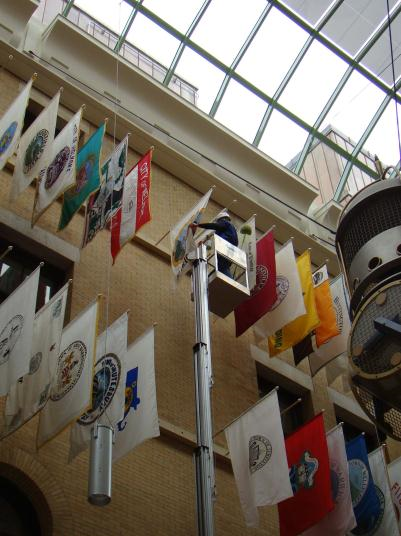
- Municipal Flags. Upon commencement of the renovation of Great Hall, the Commission recommended the cleaning of the municipal flags, many of which have been on display since 1994. Approximately 300 flags of different materials and methods of decoration, and of varying quality and condition, were removed from display in July and sorted by fabric, construction, and treatment requirements. 268 were sent in batches to Jean Palmer Cleaners, Woburn, where they were individually inspected and cleaned. Upon return, all flags were re-sorted for date of incorporation, and reinstalled in late December 2010.
- Great Hall Clock. The Commission contacted the National Time and Signal Corporation, suppliers to Ron Fischer, designer of the clock, for cleaning of the movement and replacement of the original motor. We also provided instructions for surface cleaning of the various metals from which the clock was fabricated, and directions for recalibration. The clock was installed in Great Hall in 1990 as part of the “1% for Art Law.”
- Stained Glass. The Commission also arranged for the evaluation of stained glass installations throughout the building for condition and treatment recommendations.
- Master Plan: Design Guidelines. Revisions were submitted and finalized in late October and distributed through BSB to the leadership, constitutional officers, and key tenants in December.
New Acquisitions
Not all proposals for new artworks and incoming loans for the State House meet the Commission’s criteria for acceptance. The board is careful in its deliberations and spends considerable time with the review process to ensure that such art works are appropriate to the State House, and are in good condition, and can be cared for within the limited resources of the Art Commission. Three proposals this year, one for a loan and two for the permanent addition to the collection, were, after lengthy research and review, rejected. A fourth, the portrait of Senate President Thomas F. Birmingham, by George Nick, was presented board for last minute review and was unveiled by the Senate in May. It is installed in the Senate Reception Room.
Commemorating the Anniversary of the Civil War
- Art of the Civil War at the Massachusetts State House. In recognition of the 150th anniversary of the first battles, the Art Commission produced a fully illustrated booklet highlighting over 35 works of art in the State House Art Collection that honor political, military, and citizen service, and the battle flags of the Civil War. The Commission is awaiting sponsorship to publish this book so that it may be available to State House tenants and visitors.
- Grand Army of the Republic Memorial Room Library. Originally the Massachusetts department headquarters, the “GAR” Room – room 27 of the State House, serves as a memorial room to the association of Union veterans of the Civil War. Holdings include an extensive library of GAR records and publications that have never been catalogued. The Commission was fortunate to engage Ayda Pourasad, recent graduate of the Simmons College Graduate School of Library Science, to inventory the volumes and lay the groundwork for an on-line catalogue.
Art Commission members
I regret to report that in June two of the members, Katherine “Kitty” Winter and Cecily Morse, resigned in response to notice from the Governor’s Office on Boards and Commissions that there were two pending appointments to the Commission. Both members had long experience in public art and gave generously of their time. Kitty was first appointed by Governor Weld in 1992, and was a faithful and supportive member for almost twenty years. Cecily was appointed by Governor Romney in 2005, and drew on her art conservation background and ability to offer unique points of view, further insuring the fairness of our discussions. I speak for the rest of us in expressing our appreciation to them and wishing them well. I anticipate that the new members and an anticipated expanded board will want to follow in their steps with the same dedication and commitment. Those remaining are to be commended for their expertise, wisdom, and good cheer.
I continue to have the pleasure, however, to acknowledge the professionalism and creative efforts of our Art Collections Manager, Susan Greendyke Lachevre. She is ever resourceful in meeting the demands of the many stakeholders at the State House, while keeping true to the work of the Commission. Neverthe-less, I remain frustrated and surprised that she continues to serve under a yearly contract without benefits (this is her 27th year), when the work she does is so essential to the preservation of the Art Collection and the historic building. I am hopeful, however, that in the coming year the legislature and the governor will wisely support the revisions to the Commission’s mandate and establish a permanent position of State House Curator.
This has been a year of change for us, reflecting our increased responsibilities, and I expect that there are more challenges ahead for us. I welcome your interest and support for the Commission, as well as your questions.
Sincerely,
Paula Morse
Chair