
The members of the Art Commission respectfully submit their Annual Report for the year ending June 30, 2013. We are pleased to note that after years of effort, our 1910 mandate (MGL chapter 6, sections 19 and 20), last revised in 1924, has been updated and included in the Outside Section of the Fiscal 2014 Budget, and may be signed by Governor Patrick in July. This legislation will assure that the Commission will continue to bring informed, independent advocacy and expertise to the care of one of the country’s oldest public collection. Housed in a building of great historical significance, hundreds of works of art, including paintings, two- and three-dimensional sculptures, and wall murals, created by leading American painters and sculptors, as well as priceless artifacts that commemorate over four centuries of Massachusetts history, will be maintained and displayed according to the best practices of the museum profession.
Legislation – Background and Progress
Since 1984 the Art Commission has met the challenges of curating a public museum collection in a non-museum setting with preventive care and conservation programs, and the hiring of an Art Collections Manager (ACM) on a contractual basis. This has meant that our single professional staff person has implemented the directives of the volunteer board for twenty-nine years without receiving any benefits. During this time we have developed formal policies and procedures that are in accordance with the codes of ethics and standards for practice of the American Alliance of Museums and the American Institute for Conservation of Historic and Artistic Works. Moreover, in recent years, our advisory role on building restoration projects at the State House has greatly expanded due to both the preservation expertise and institutional memory provided by this office.
In early 2013 we received both legislative and administrative support for the re-submission of H3956 (a petition), which creates the position of State House Curator, adds two new members, and updates and clarifies our current responsibilities for not only the care of the State House Art Collection but also the historic building in which it is housed. After a public hearing in early April, H 3002 (formerly H3956) was reported out favorably in May by the Joint Committee on Tourism, Arts and Cultural Development. In June, however, the bill’s language was included in the Outside Section of the Senate budget recommendation, which then was adopted by the Conference Committee. We are most appreciative of this support and the encouragement we have received from so many.
Merger of the Bureau of State Office Buildings with the Division of Capital Asset Management and Maintenance
The merger in October 2012 of BSB and DCAMM was designed to affect economies and strengthen opportunities for collaborative work on state buildings. It also resulted in the creation of the Bureau of the State House – a smaller agency with the tightly focused responsibility for the management and oversight of the State House. Placed under BSB, through which it has received its funding and administrative support since 1990, the Art Commission continues to work closely with the Superintendent and State House staff on a daily basis to insure the proper care of both the contents and the historic fabric.
State House Projects
A significant portion of the Art Collections Manager’s time is spent participating in State House building projects, offering guidance and archival research for design and planning. This year, these have included studies for renovation of both Gardner Auditorium and the House Chamber. We also provide physical assistance in the implementation of programming. The upgrade of the State House fire detection and notification system, implemented by DCAMM, necessitated the removal of nearly every painting installed in the public corridors and many offices, and further protection of several permanently installed memorials. Paintings were removed, stored, and reinstalled by the Art Commission in phases between August 2012 and May 2013. For the restoration of the Ashburton Park doors (December 2012), the ACM consulted with the Acting Superintendent, DCAMM project managers, and specialists from Stuart Dean on the re-patination of the three bronze double-doors, with the aim of restoring the original subtle toning and brushed finish.
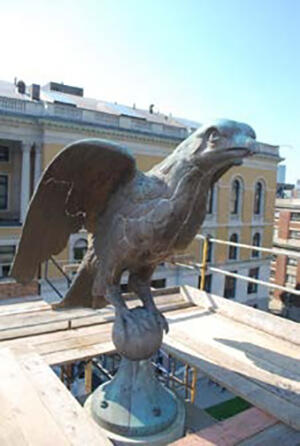
Figure 1
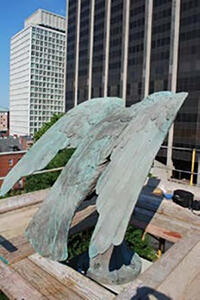
Figure 2
Collections Care
Beacon Hill Monument
In response to increasing concern over the stability and state of conservation of the eagle expressed by the Art Commission, last treated in 1990, the bronze eagle and the granite Beacon Hill Monument with original Bulfinch slate tablets were conserved by Daedalus, Inc. of Watertown, from September 12 to October 9. The Art Commission, BSH, DCAMM, J.K. Scanlon general contractors, Simpson Gumpertz and Heger, engineers, and Daedalus Inc., conservators, all participated in the project to assure the safety and conservation of the monument. Engineers inspected and found the eagle’s 1990 armature to be secure. The bronze eagle showed advanced corrosion, however, especially on the upper horizontal planes, talons, and orb. (Figures 1 and 2)
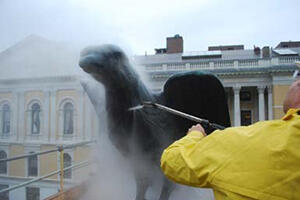
Figure 3
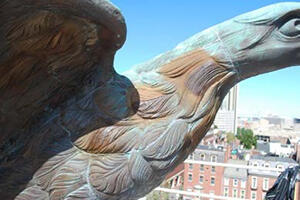
Figure 4
Nonetheless, due to the heavy casting, the bronze was in far better condition than expected. The eagle was cleaned of decades of grime, remnants of the old hot wax coating, and loose corrosion products that were building on the exposed metal. (Figure 3) . The bronze was completely re-patinated after tests were reviewed for color (Figure 4), and welding seams refilled and in-painted. The eagle was then waxed to protect it from the elements.
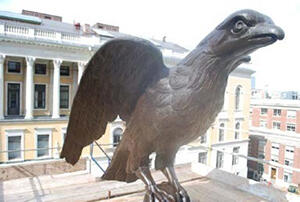
The granite monument and the slate tablets were cleaned with high pressure water and mild detergents which removed the heavy greenish cast caused by oxidation of copper inclusions in the granite that had washed down over the monument for the past 110 years. The eagle was placed on the Art Commission’s long range schedule for maintenance, insuring that it will receive structural inspection and more frequent care.
Exterior Sculpture Maintenance
Annual maintenance of the bronze monuments is necessary to protect them from the combined effects of acid rain, pollution, and salt air, which cause corrosion of the metal, deterioration and damage to the patina, and eventually irreversible damage to the original modeling. Due to this diligent program of care, conservators from Daedalus, Inc. continue to report on the good condition of all the statues and exterior bronze plaques and were able to deliver this year’s maintenance services under budget. Surface grime and mortar issues were addressed on several of the monument bases in order to keep them in good repair as well.
Our five-year maintenance contract for exterior sculpture maintenance will expire this fiscal year. The bid for a new multi-year contract was issued on June 24; proposals will be due in late summer in the hope that we can continue with this crucial preservation program.
Worcester G.A.R. Civil War Flags
Custody of 14 colors previously owned by the Worcester G.A.R. was transferred in November to the State House Battle Flag collection. Due to the timing of this transfer during the transition period of BSB/BSH, the Art Collections Manager facilitated this transfer on behalf of the Superintendent.
Monitoring
All objects both on display and in storage are regularly monitored for damage or change in condition, and the pubic collection is inspected and surface dusted semi-annually. This year, however, the maintenance schedule was not sufficient to keep up with the buildup of brick and plaster dust from the fire notification and lighting upgrade projects, and the entire collection had to be dusted at least every two months. As it has for many years, the Commission was responsible for conducting annual condition inspection of the paintings on loan from the Museum of Fine Arts, Boston.
New Acquisitions
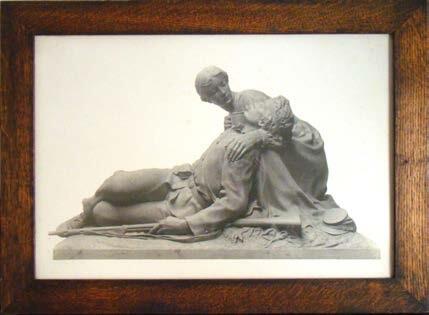
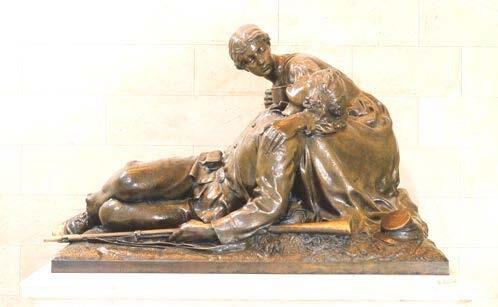
The Art Commission was the recipient of an original gelatin print photograph of the clay model of the Civil War Army Nurses Memorial, made by Bela Lyon Pratt in 1912. This important image documents how faithful the final bronze remains to Pratt’s original vision for the monument. We express our appreciation to Cynthia Kennedy Sam, granddaughter of the sculptor, for her generous donation.
Public Outreach
The Art Commission is contacted regularly by scholars, publishers, cultural institutions, educators, family researchers, and public entities regularly for information on objects in the State House collections. Among the more interesting projects for which the Art Commission has provided images and other assistance are the PBS series “Saving the Oceans” and Frontline’s “The Choice,” the Freedom Trail Foundation’s new smart-phone app for the Granary Burying Ground, and the National Gallery of Art’s exhibit on the 54th Massachusetts regiment. The Commission continues to provide research and images for use in the on-going observances of Civil War history and anniversaries.
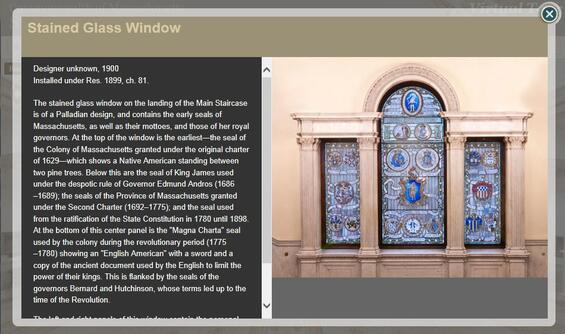
The Art Collections Manager addressed over 150 individual inquiries and requests for information. Many of these inquiries were prompted by access to the Legislature’s Virtual Tour, for which we made selections and provided the narrative content. Launched last year, the tour highlights fifty important works of art and artifacts in the State House, further demonstrating the Art Commission’s need for its own comprehensive web-site.
Strategic Plan 2013-15
We plan to revisit both the Commission’s By-Laws and our current Strategic Plan if the Commission’s legislation is revised. Nonetheless, our goals remain committed to:
- Reaffirming the role of the Art Commission and its relationship with the executive and legislative branches
- Stabilizing the Art Commission’s financial situation
- Sustaining excellence in collections care and historic site maintenance and preservation
- Providing greater access to and interpretation of the State House Art Collection
Art Commission
Members and staff
This year the Art Commission members have been resourceful in implementing the policies and programming of the Commission and I wish to thank them for their service. Moreover, they have been unwavering in their belief that the Commonwealth would be well served if our legislation was updated. We would then have two additional members, which, for a five-member volunteer board, would be most welcome. The Commission has enjoyed its independence from interest groups and political factions. This seems essential as we seek to make the art at the state house more representative of those who live in or visit the Commonwealth.
In anticipation that our 1924 legislation will be amended, I join the board in recommending that Susan Greendyke Lachevre, our Art Collections Manager, be appointed the first permanent State House Curator. There are few who can match the breadth of her experience and the depth of her historical memory, let alone her dedication, in caring for the Commonwealth’s art collection and the historic preservation of the State House. She is wise and creative in dealing with the many requests from scholars and researchers as well as the various tenants of this historic structure in all matters relating to art, all the while maintaining the best practices of a museum professional. Like the present board she serves, I hope she has the opportunity to continue in the work that she does so well.
As always, I welcome your interest and support for the Commission, as well as your questions.
Paula Morse
Chair