
On behalf of the members of the Art Commission, I respectfully submit our Annual Report for the year ending June 30, 2015. As a volunteer board with broad experience in public art and architecture, accessibility and historic preservation, we bring an independent perspective to the care and display of the collections at the State House and the building, a unique role that we are honored to perform. We are now preparing our third Strategic Plan with a new Mission Statement that will underscore our role in promoting the virtues of public service, so well reflected in the art and artifacts on display throughout the capitol.
The close working relationship we enjoy with the Superintendent and staff of the Bureau of the State House (BSH) and the Division of Capital Asset Management and Maintenance (DCAMM) continues. The board acknowledges the support we receive from these agencies, and appreciates their understanding of the challenges we face in maintaining museum standards in this non-museum public setting.
Renovations, restoration and upgrades are perennial activities at the 200+ year-old capitol. Recently, this has involved significant work in several important suites that drew upon the expertise of both the board and the Curator. Notable among these were the completion of the Executive Suite, with three floors of rooms dating from 1798 to 1917, and the State Library, with an 1895 main Reading Room that was once hailed as one of the most beautiful spaces in Boston. This year we also sat on study and design teams planning major renovations to the Senate Chamber and Gardner Auditorium. All of these will be discussed in this report
Architectural Renovations
Executive Suite
As noted in our previous Annual Report, many of the activities involved in the renovation of the Executive offices spanned the close of FY2014 and the first months of FY2015. The Art Commission remained heavily involved in the finishing phases of this project, particularly in designing and overseeing the reinstallation of the governor’s portraits in the Reception Room and restored Council Chamber. The project gave us the opportunity to conserve many of these paintings for the first time since their acquisition, as their removal from such a prominent location has proven difficult in the past. The expanded installation, with improved lighting, is indeed impressive.
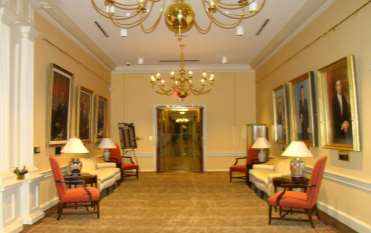
In the Governor’s Office, the twelve-arm Cornelius and Baker gasolier (c. 1855), with its complex arrangement of figural groups and decorative elements, highlighted through a combination of metals and surface treatments, was restored by the Williamstown Art Conservation Center, and rewired and fitted with new etched-glass globes. The crystal chandelier in the Council Chamber, c. 1929, and the large brass chandelier in the inner stairwell were also dissembled, cleaned, and re-wired with energy efficient bulbs with great success. All fixtures were reinstalled by the end of the summer. New carpets and an elegant blend of new and historic furnishings completed the restoration of the Executive Suite.
State Library
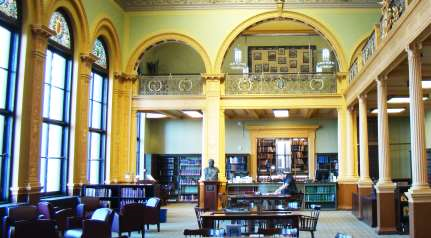
The Curator also represented the Art Commission on the BSH/DCAMM team overseeing the dramatic restoration of the main reading room and balcony areas of the State Library. Investigation into the original colors and finishes of the walls, particularly the flat and decorative plaster, revealed a palette of greens, yellows and ochres that play dramatically against the stained glass windows and are fully in keeping with architect Charles Brigham’s decorative scheme for the State House extension.
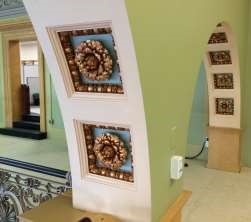
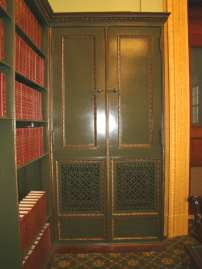
Adding to this rich yet coordinated interplay of surfaces are the treatments of the coved archways, and deep green and bronze colors of the metal bookcases that were discovered under layers of overpaint. New seating arrangements and technology upgrades accommodate the visitor while providing a comfortable luxurious space for work and research. The elaborate plaster cornices, and the ceiling, exposed to reveal gilded fleur-de-lis in relief against a light blue background, remain hidden under a wash of dull gray paint, while waiting funding for their restoration.
Time capsule
The Curator participated on the team that designed the investigation, removal, conservation and reinternment of the 1795/1855 time capsule and its contents in the cornerstone of the State House. The project originated in the mid-1980s by the BSH Engineer who discussed the possibility with the Curator and others, of locating the time capsule within the Bulfinch building. Since that time, advances in technology allowed for the scientific investigation of the stones and location of the 1855 box with great accuracy. Our work focused primarily on research into its history, compiling documentation, and defining the services and expertise that would be required for proper handling and conservation of the time capsule once it could be removed from the cornerstone. Due to its age, contents, and undetermined condition, we strongly recommended that the contract be awarded to object and paper conservators, both with access to a full-service scientific laboratory for examination and analysis. The team met regularly to review progress by conservators at the Museum of Fine Arts, Boston, and recommendations of the State Archivist/Secretary of State for re-encasement of the contents and replacement in the cornerstone. The time capsule was reinterned with full Masonic ceremonies on June 17 – Bunker Hill Day. The project was fully documented with all records archived with the Secretary of State Archives Division, and DCAMM.
Senate Chamber
The State House team also met regularly to review and revise the 2009 study for the renovation and mechanical upgrades for the Senate Chamber, Lobby, and Reading Room (formerly called the Reception Room) within the 1798 Bulfinch portion of the building. Board member and preservation architect Christopher Hussey accompanied the Curator to these deliberations. Many needs, including accessibility and accommodation of Senators and staff, were reviewed and balanced with preservation of the historic fabric. Apart from myriad HAVC and architectural needs, the Senate spaces are adorned with art, artifacts, and historic furniture, all of which will require specialized care. The study is in its final stages of assessment.
Gardner Auditorium
The study for the overhaul of Gardner Auditorium also migrated into the design phase during the last fiscal year, with focus on providing greatly improved accommodation for the thousands of visitors to this space each year. Nearly every aspect of this heavily used room warrants upgrade or improvement in access and egress, seating, sight lines, HVAC, acoustics, lighting, and restroom facilities, as well as a wide range of cosmetic and technology deficiencies, some of which have not been addressed in decades. Due to the long distance of the auditorium from Ashburton Park, the only accessible entrance to the State House, attention was also given to potential redesign of the General Joseph Hooker entrance to provide universal access not only to Gardner, but to all visitors, while mitigating impact on the building envelope or grounds. We look forward to this very different but equally important project for the capitol.
Transition
The Curator assisted the Superintendent and the transition team appointed by Governor Patrick to provide information and guidance to the incoming administration by supplying information on the scope, policies, and programming alternatives for the collections at the State House and particularly for objects on display within the Executive Suite. Assistance was provided on the evening of the inauguration by installing portraits from the collection chosen by the Governor (John A. Volpe) and Lt. Governor (Argeo Paul Cellucci) in their offices, and rotating the portraits in the foyer. Three portraits, the Samuel Adams, John A. Andrew, and Leverett Saltonstall, were installed in the Governor’s Council Chamber shortly after. The Commission is currently working with the administration and curators at the Museum of Fine Arts, Boston to fine-tune the selection of paintings on loan to the Executive Suite. We thank the MFA for their continued generosity in allowing us to display such fine works of art from their collection in addition to our own.
New acquisitions
Governor Deval Patrick donated his portrait, painted by Simmie Knox, 2014, to the State House Collection on January 4. The painting was unveiled at the Grand Staircase and installed in the Reception Room of the Executive Suite that evening. It is catalogued as object number 2015.1. Governor Patrick also donated approximately 85 items to the “Gifts to the Governor” collection maintained by the Art Commission on behalf of the governor’s office. The collection was formed in 1996 to archive items received by the governor that symbolize administrative priorities, commemorate special events, or reflect personal interests. These gifts are routinely circulated through the executive offices upon request.
Governor Patrick also donated approximately 85 items to the “Gifts to the Governor” collection maintained by the Art Commission on behalf of the governor’s office. The collection was formed in 1996 to archive items received by the governor that symbolize administrative priorities, commemorate special events, or reflect personal interests. These gifts are routinely circulated through the executive offices upon request.
Conservation
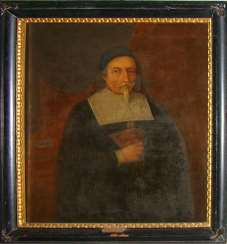
Governor John Endecott portrait, c. 1665, artist unknown
Endecott was Governor of the Massachusetts Bay Colony, serving many disconnected terms in office from 1629 to his death in 1665. This is one of only about forty known surviving 17th century American paintings. The portrait had descended through nine generations and was bequeathed to the Commonwealth in 1936. It was received in to the State House Art Collection in 1941 but displayed only briefly because of its deteriorated condition. This year, the Art Commission was able to have the painting conserved thanks to the generosity of William T. Endicott, and the Endecott/Endicott Family Association, which contributed matching funds in recognition of the 350th anniversary of the Governor’s death in 1665.
The contract for portrait analysis and conservation was awarded to John Hartmann, Carlisle, Pennsylvania, in summer 2014, with the understanding that the painting’s historic significance and problematic condition merited serious attention and prudent decisions. In October, Mr. Hartmann arranged for X-rays to be taken at Massachusetts General Hospital employing the latest in imaging technology. These revealed underlying compositional elements that heretofore had not been visible. The painting was then transported to Hartmann’s studio in Pennsylvania where, in early November, Richard Wolbers, scientist at the University of Delaware, Winterthur Museum, performed a paint analysis and confirmed a great deal of later overpaint and numerous layers of varnish. Moreover, he noted that the canvas had an orange imprimatura rather than a white priming layer, and that the remaining original paint had a limited palette and a granular composition that suggested that the artist “was not academically trained or still learning his craft at the time of the execution of the painting.” As Mr. Hartmann cleaned, it became increasingly evident that there was considerable loss under the opaque dense overpaint that would present significant challenges.
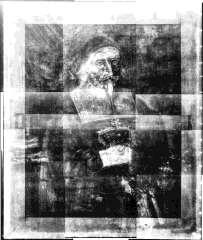
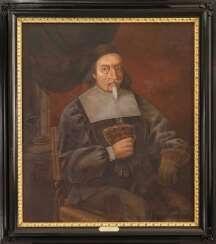
Thorough investigation of the remaining traces of paint, coupled with hours of research and repeated examination of the valuable x-rays slowly exposed outlines and details that were considered in the reconstruction of the composition. The portrait now is notable for changes to the subject’s posture, his clothing, and the additional depiction of the 17th century leather chair once owned by Governor Endecott
(now in Doric Hall). Instead of the typical cleric’s or jurist’s black robe, added sometime in the late 17th or early 18th century, the Governor wears a blue buttoned doublet with dark brown breeches. His left gloved hand and the paneled base of the column, exposed in the X-rays, have also been restored. Thanks to the encouragement and support of the Family Association, we can now plan for limited display of the painting.
Statue Maintenance
Exterior sculpture continues to be maintained by Daedalus, Inc., of Watertown. All bronze monuments and plaques on the State House grounds are cleaned and waxed annually by professional sculpture conservators to preserve the protective acrylic barrier coating on each. Annual treatment of bronzes, particularly in an urban environment, is critical to resist repeat corrosion of the metal and the preservation of sculptural detail that distinguishes each. The Art Commission has been preserving the State House sculptures on a regular basis since 1987; conservators report regularly on the beneficial effects as well as the cost-savings of this on-going program.
Public Outreach
The portrait of Anson Burlingame, c. 1855, former Ambassador to China, on loan to the New York Historical Society from September to May, was featured in their well-received exhibit Chinese American: Exclusion/Inclusion.
As usual, the Curator handled a great number of requests from researchers, students and scholars for photographs and information about the history of the State House and the art and artifacts collection. She also gave guided tours to legislators, scholars and visitors, offering an insider’s view to the capitol and how the collection has evolved.
The Commission and the Curator
The present Commission, still with two vacancies, meets on a monthly basis except in the summer, deliberating in the most cordial manner. Our mandate, revised in 2013, is clear and the State House Curator, our one staff person, appears to be in perfect harmony with our policies. Our task is made even easier because of constant interactions with staff of BSB and DCAMM, who depend on her institutional memory as well as her professionalism. As this Report illustrates so well, her responsibilities range from assisting design surveys to overseeing the installation of art throughout the State House; as liaison between the Art Commission and other stakeholders at the State House, she is without equal.
Our board is well versed in historic preservation and collections care, but these days they are increasingly concerned that we reach out to a wider audience. For this we are looking ahead for new ways to make the art collection and the State House more accessible. We are in the midst of preparing a Strategic Plan for 2016-2019. This will include developing an app for an accessible visual tour of the art in public spaces at the State House. We also hope to expand the historical context for the Legislature’s Virtual Tour which is presently available online. In addition, we look forward to gaining support for a publication that illustrates and interprets the history of the State House and the formation of the State House Art Collection. This will be the culmination of many years of research and writing, and the assembling of historical photographs and documentary archives.
Sincerely,
Paula Morse
Chair