
On behalf of the members of the Art Commission, I respectfully submit our Annual Report for the year ending June 30, 2017. During this time, our advisory role in the preservation of historic spaces at the State House became the primary focus for the State House Curator. Most note-worthy was her participation in the design development phase for the restoration of the Senate Chamber. Her oversight of works of art, as well as historic furnishings and architectural and decorative objects, is discussed below. The Commission contributed with their own expertise and in their support of her efforts.
New installations both temporary and permanent were located in public spaces. The Commission encourages such efforts to make the State House and its collections more available to the public. The new mobile app, with a launching expected in the fall of 2017, like the online legislative Virtual Tour, will enhance the experience of visitors as well as those at home with a greater appreciation of the beauty of the historic building and the significance of the art collection. The fully accessible app includes maps, and turn-by-turn directions and text to assist all visitors in navigating the building.
The Commission takes this opportunity to once again extend its appreciation for the collaboration and assistance of Superintendent Tammy Kraus and the staff of the Bureau of the State House, as well as the cooperative effort of the staff of the Division of Capital Asset Management and Maintenance (DCAMM). The myriad tasks of the Curator, our one staff person, are possible in part because of them.
Collections
English Blue and White Transferware Ceramics
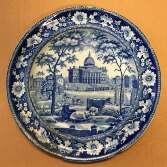
Four examples of English transferware were given to the Art Commission by the Massachusetts Historical Society in honor of William L. Saltonstall, former state senator (1967-1979) and trustee and fellow of the MHS, and are now placed on the third floor near the office of the Secretary of State. A John Rogers plate (pictured at left) and a Minton tile, both 19th century, depict early views of the Bulfinch State House from Boston Common. Two others, souvenir plates from the late 19th and early 20th centuries show the State House with elaborate border panels of noteworthy Boston landmarks. MAC2016.2-5
Timothy Holland Chair from former House Chamber
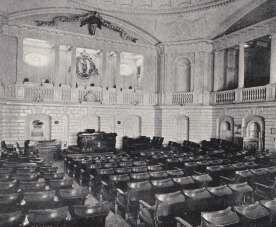
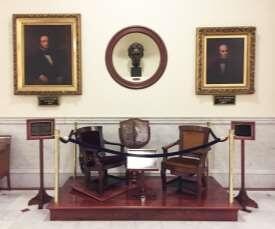
As noted in last year’s Annual Report, the State House received a most interesting and valuable donation of a chair from the 1868 House (current Senate) Chamber. Seat 204, the ”Holland” chair, is named for Representative Timothy F. Holland of Roxbury, its last occupant. It was part of the suite of furniture manufactured by Haley, Morse & Boyden of Boston, reportedly from surplus mahogany procured by the Commonwealth during the Civil War. When the House moved to new chambers in the Brigham extension of the capitol in 1895, the legislature passed a Resolve allowing representatives to purchase the surplus chairs. Number 204 was acquired by Representative Holland and descended to his grandchildren, George and Marianne Holland, who donated it in 2014.
The chair underwent conservation to repair damage, clean original upholstery, and restore original finishes. Upon its return, House carpenters constructed a handsome platform on which to display the chair, complete with angled pedestal, to mimic the sloped floor on which it originally stood, and stand for the particularly rare and fragile “summer” seat. The chair is now on display outside the House Chamber along with the “Monitor 8” chair, part of the same suite. Together they restore a lost piece of State House history.
“Holland Chair”
This is part of the suite of furniture from the former House (current Senate) Chamber from 1869 until 1895. Haley, Morse & Boyden, of Boston, manufactured the chair, reportedly from surplus mahogany procured by the Commonwealth during the Civil War. The suite was installed following a large scale renovation of the room in 1869. The arms were fashioned from pre-cut gun butts, and fitted together to form a continuous row of theater-type seating. The right arm of this chair is shaped, however, indicating that it was an aisle seat. Writing surfaces, storage baskets, shelves, and small drawers were supplied at each station to assist representatives, who, at the time, did not have individual offices at the State House. Of note are the interchangeable seats: a “winter” seat with its original burgundy velvet upholstery and a particularly rare and fragile “summer” seat that retains much of its original caning.
Hooker Entrance Welcome Presentation
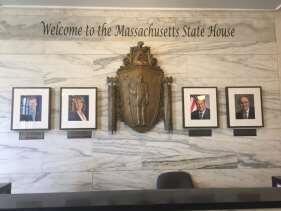
The dramatic, Art Deco-style bronze of the state seal was originally created for the entrance of the former State Registry Building, constructed in 1932 at 100 Nashua Street. Close examination reveals the forward tilt of the relief for display over the massive front doors.
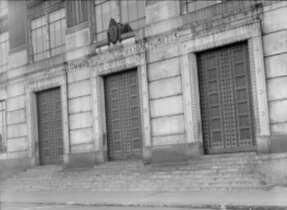
The 50 inch-tall seal was salvaged when the building was razed. Although it had suffered from decades of exposure to the elements, and required conservation treatment and repatination, the seal was otherwise found to be in good structural condition. It was incorporated into a new display in the Hooker Entrance along with framed photographs of the Governor, Lieutenant Governor, Senate President, and Speaker of the House to welcome visitors to the capitol.
Massachusetts Balance Scales
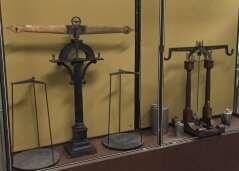
These precision, or equal-arm, balances, each from the 1840s, had been stored at the State House for many years. Henry Plympton fabricated the balance from Plymouth, while that from Fitchburg was made by the Howard and Davis Company. Although each firm specialized in the meticulous nature of precision instruments, Edward Howard and David Porter Davis eventually received the contract from the Commonwealth to supply the state standards to most towns. These instruments not only determined weight but also ensured that other scales used by businesses in towns and cities were accurate. They are now displayed on the 4th floor, next to the Legislative Document Cabinets.
Institutional Loans
The Art Commission is especially appreciative of the Museum of Fine Arts’ decades-long, annual loan to the office of the Governor. This year the museum trustees generously approved twelve paintings by American artists, depicting portraits, as well as sea and landscapes, for installation throughout the Executive suite.
Exterior Sculpture Maintenance
Daedalus Art Conservation, Inc., of Watertown, sculpture conservators, in the final year of their five-year contract, cleaned and maintained all of the exterior bronze sculptures and plaques. Happily the state’s commitment to this annual program has been the best insurance against the deterioration of metal sculptures caused by acid rain, sea air, and the pollutants of an urban environment.
Architectural Renovations
Senate Chamber and Lobby Renovation and Restoration
The Curator and board member Christopher Hussey, a preservation architect, have attended regular meetings throughout the study and design phase of this project. As part of the state house team, they work with the architects, preservation consultants and the Senate on design development and finalization of bid specifics for the renovations.
In preparation for renovations that will begin in early summer, the Curator supervised the removal of nine portraits of former Senate presidents from the Senate Reading Room. These paintings were then reinstalled on the 4th floor corridor outside room 428, with the exception of the oversize portrait of Calvin Coolidge, which was placed in the office of Senate Counsel. This temporary display has proved to be extremely popular with both the legislators and the public, especially as the lower ceilings and brighter lighting of the hallway show off the paintings to great advantage.
The advice of the members of the Art Commission was sought in the determination of the most appropriate color scheme and carpet pattern for the Senate Chamber; fortunately there is historical evidence that helped in the selection. The Curator also identified furniture in the Chamber and Reading Room as well as the Senate Lobby that will require more specific care and preservation; she will be working with the architects and contractors and their preservation specialists to examine and refine proposed treatments and finishes of not only the furniture, but also the stained glass, lighting, and other elements of the historic envelope. In addition, the Curator began her oversight of the conservation of nine marble busts and pedestals located in the niches of the Senate Chamber, with the hope that most of these will be on temporary view after they have been cleaned.
Education/Outreach
President Kennedy Centennial exhibit, Doric Hall
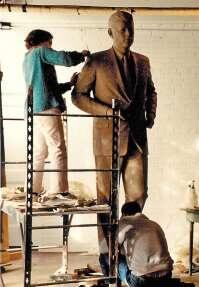
To honor the 100th anniversary of John F. Kennedy’s birthday on May 29, 1917, the Art Commission created an exhibit on the history of the memorial statue of the president at the State House. Installed in Doric Hall from May 2 – June 16, 2017, the exhibit traced the nationwide competition for an artist, selection of the proposal submitted by Isabel McIlvain, and the creation, installation, and unveiling of the statue May 29, 1990 on the West Wing Plaza with documents and photographs of the four-year project. This was supplemented by an exhibit of photographs of the president and his family taken throughout his life that was arranged and installed by the John F. Kennedy Library Foundation.
State House Mobile App
In September, the Curator and Chair completed their contributions to the legislature’s mobile app, having contributed to the design, selected images, and written all the narrative and descriptive text. Our collaboration with the office of Legislative Information Services and the State House ADA Coordinator has helped make this possible. The app includes some 63 objects in 12 historic spaces, corridors, stair halls, and legislative chambers as well as the state house grounds. The app is expected to be launched in the fall of 2017.
Tours and research assistance
The Curator gave a number of tours for State House personnel and visitors, from 2017 German Marshall Fund Fellows from nine European countries to the Medford AP History class. She also made available images for publication in a variety of media posed by museums, film companies, scholars, genealogists, and building tenants, and answered general inquiries about the collections from the public.
Members
I am happy to report that in August two new members were appointed to the Art Commission by the Speaker of the House, filling the remaining vacancies of our seven member board. Both Donna DePrisco and Dawn Mahoney have significant experience and advocacy in public art. Donna is a former trustee of the Boston Public Library, the Museum of Fine Arts, and the Catholic Charitable Bureau, and is a current member of the Massachusetts Foundation for the Humanities. She is a well-known jeweler in the greater Boston area. Dawn, a painter and teacher of art in Winthrop, has been a member of the Winthrop Art Association since 1979, and has served as their president and director of their festivals.
The other members continue to bring to our deliberations their deep concerns and sage counsel about the preservation and display of the Commonwealth’s State House Art Collection and the historic building. Their independent views and individual perspectives guarantee lively and thoughtful discussions that are certainly appropriate in a building that has been the scene of so many spirited conversations in the past.
Finally, my usual heartfelt thanks to Susan Greendyke Lachevre, State House Curator, for all that she does for the Commonwealth and for doing all of that so well. Knowing her has been for me a source of wonder and a constant delight.
Sincerely,
Paula Morse
Chair