
On behalf of the members of the Art Commission, I respectfully submit our Annual Report for the year ending June 30, 2018. We continue to enjoy and benefit from the support and encouragement we receive from Tammy Kraus, Superintendent, Bureau of the State House, and her entire staff, as well as selected staff of the Division of Capital Asset Management and Maintenance with whom we work on major restoration and maintenance projects. For many years, it has been our privilege to participate in the full-scale renovation of the most important spaces at the State House. Last summer, the Senate Chamber and Lobby Restoration and Renovation Project moved from the design to the construction phase of work. With the Chamber reopening set for January 2019, we anticipate a full schedule in the coming six months. Once again, it has been gratifying to serve on a team of staff, architects and preservation contractors and consultants dedicated to achieving the fine balance between essential upgrades and the sympathetic preservation of the historic space and its contents.
Attention to our other building-wide responsibilities, however, did not lapse. Collections care and interpretation for wider audiences remain a priority among our activities and are also addressed herein.
Senate Chamber and Lobby Renovation and Restoration Project
The Senate Chamber, located under the dome of the Bulfinch capitol, and its lobby, are now almost two-thirds through a comprehensive renovation with completion due in time for the opening of the next legislative session. Outdated mechanicals including electrical, HVAC and fire-protection, a wide range of improvements to accessibility, and technology upgrades have all been addressed in conjunction with the complete restoration of the historic fabric, including badly needed wood and plaster repairs, and conservation of furniture and fixtures in accordance with preservation guidelines. Legislators, staff and visitors also will benefit from improved lighting, acoustics, re-defined workspaces, and accessible seating on both the floor and in the public galleries.
Weekly construction meetings and team walk-throughs were held to review the complicated work required of many sub-specialties, ranging from the restoration of the rusticated panels on the lower levels, and columns and balusters in the galleries, to the different eras of plaster in the tympani at the ceiling. Visits to and 2 frequent consultation with off-site contractors including furniture, lighting and stained-glass conservators were required by many members of the team to insure proper and timely care of these pieces.
Each aspect of the project has impacted not only the wide array of architectural features and fixed furnishings, but also artworks within and surrounding the Chamber. The Curator oversaw the removal, and temporary relocation, storage and/or conservation of a number of artworks.
Portraits
The portraits of twelve recent governors were removed from the Governor’s Reception Room to storage in August for safety while demolition and reconstruction work took place in the Senate gallery above. In their place, the Art Commission installed canvas-print reproductions created from high resolution images, and framed them with thin gold mats as liners. It is expected that we will replace the original portraits in the late autumn. As previously reported, ten portraits from the Reading Room, while not directly impacted by the construction, were reinstalled by the Curator on the fourth floor so that they could remain on view during the temporary closing of this area.
Marble Busts
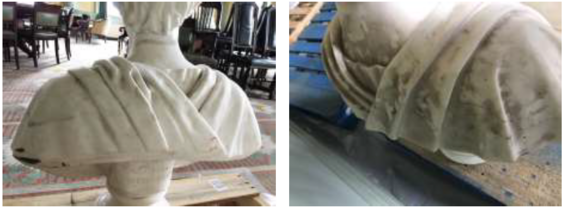
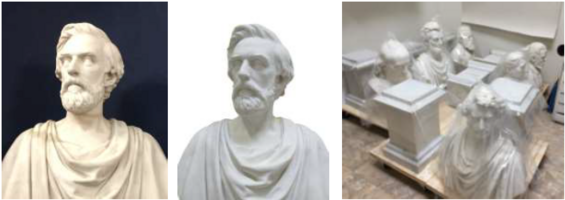
All marble busts and their pedestals were sent to a professional sculpture conservator where they were cleaned of decades of dust, dirt, grease and paint spatter. Minor chips and losses were repaired and mounting pins inspected in preparation for reinstallation in the Chamber. These included such luminaries as George Washington, the Marquis de Lafayette, Benjamin Franklin, Abraham Lincoln and Charles Sumner.
Eagle and banner
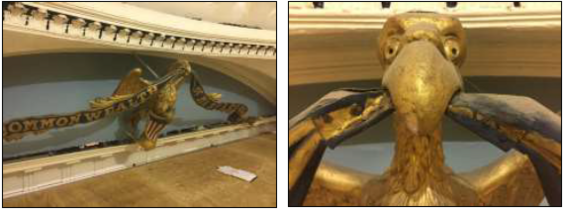
Due to its fragility, the late 18th century gilded eagle was left in place for treatment from the staging. Testing by Sean Fisher, principle, Robert Mussey Associates, confirmed that the eagle had several coats of oil gilding over its original gold leaf. This surface gilding, as well as the painted shield in the eagle’s claws and gold orb, were cleaned and consolidated where necessary, but found to be in overall good structural condition. During the conservation, Fisher discovered an initial signature “W. H. 1791” on the underside of the eagle’s tail. Further research is being conducted in the hope of learning the identity of the carver.
The painted and oil gilded “Commonwealth” banner was removed from the eagle’s beak and taken to Mussey Associates’ studio in Hyde Park, where it was tested for paint history, surface cleaned, consolidated and documented. Once it was reinstalled in early summer, the hinge plates holding the banner in the eagle’s beak were reinforced to insure a solid grip.
State Seal
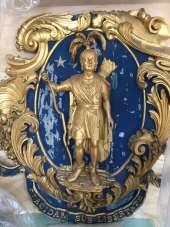
The gilded and polychromed Massachusetts Seal, installed in 1847, was also removed to Mussey Associates for care. The seal suffered from improper mounting that restricted natural expansion and contraction of the wood slats from which it was constructed, causing breaks in the seams. Although most of the oil gilding that had been applied over gold leaf was found to be quite stable, several coats of blue paint in the background of the seal were failing from improper bonding, and actively flaking. The seal will be treated over the summer months with removal of this flaking paint down to the first stable layer (an intermediate ground layer) and repainted - with a similar medium-blue that will match the color detected during testing. The installation mechanism will also be reexamined and hardware likely replaced to preserve the relief after it is replaced in the gallery above the rostrum.
Also among the polychromed items are two late 19th century clocks installed at the balconies in the front and rear of the Chamber. Dirty, heavily over-painted in the past, and with broken motors, the clocks will be carefully restored and repainted with architecturally appropriate colors.
Future (later 2018) projects include restoration and re-upholstery of the rostrum chairs and loose furniture from the Chamber and Lobby, cleaning of the Reading Room drapes that have been stored to keep them from further dust deposit during construction, and developing a program for the display of the historic muskets (Captain Parker’s fowler and the British “Brown Bess”) from the Battle of Lexington. New ventilation ducts prevent them from being installed in their usual locations in the Chamber.
Senate Committee on Culture and Diversity
In February, the Curator and Chair were invited, along with other cultural and museum advisors, to meetings conducted by Senate President Chandler to make recommendations for portraying the diversity of the citizens of and visitors to the Commonwealth, particularly women and people of color. It was agreed by all that the Chamber and Lobby restoration provides an exceptional opportunity for new installations and interpretations, as well as the possibility of commissioning new works of art that will reflect all the state’s history.
Collections
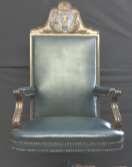
Governor’s chair
An upholstered mahogany swivel desk chair with the seal of the Commonwealth emblazoned on the shaped crest has been added to the State House art collection. The chair is similar to one that appears in 1930s photographs of the executive suite. Gift of Jane C. Saltonstall to the State House Art Commission, June 5, 2017. The chair was placed in the governor’s ceremonial office in September. Inv. No. MAC2017.01.
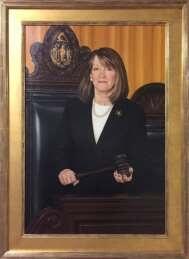
Senate President Portrait
Former Senate President Therese Murray, of Plymouth, unveiled her portrait at a reception in Great Hall, November 2, 2017. The painting, which was reviewed by members during several visits to the studio of artists Warren and Lucia Prosperi, in Southborough, was inspired by a favorite photograph of the senator taken when she was elected to the position – the first women to lead either branch of the Massachusetts General Court. At her request, Murray is depicted standing on the Senate rostrum in front of the president’s chair, with its carved and gilded state seal, holding the gavel she used to steer Senate sessions for seven years. The symbolism was intentional. "I hope that as young women and girls pass by it, it sends a message that nothing can and should ever hold you back from your dreams. . . . I want . . . all boys to see this portrait and understand that leadership is not about gender but an individual's desire to make a difference." Inv. No. 2017.1
Institutional Loans
Ten paintings, all landscapes by American artists, continue to be generously loaned to the office of the Governor by the Museum of Fine Arts for installation throughout the executive suite. This arrangement with the museum is of long-standing, and many governors and their staffs, as well as countless visitors, have enjoyed the opportunity to have such fine art hanging in their work place.
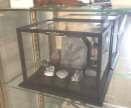
Mineral Display
An educational display of local Massachusetts stones and fossils was presented by the Connecticut Valley Mineral Club on June 20, 2018 and installed in Doric Hall. Inv. No. MAC2018.01
Exterior Sculpture Maintenance
Daedalus Art Conservation, Inc., of Watertown, sculptor conservators, completed the final year of their fiveyear contractual agreement with the Commonwealth to clean and maintain all of the bronze monuments and plaques on the State House grounds. This annual preservation effort means that once again all were found to be in good condition, with only routine treatment required. A new RFR for five to seven years will be issued during the summer months for sculpture care and maintenance services to commence during FY’19. Several objects will be added, including the Liberty Bell, for which plans are being developed to relocate it to a more accessible and convenient location.
Vault
A new elevator has been installed as part of the comprehensive elevator replacement project at the State House. In addition, new environmental systems and HVAC upgrades for the State Library and BSH/Art Commission vaults are now complete and synced with the Control Center. Data may now be read and collected from a number of monitoring stations within DCAMM and BSH, with staff meeting regularly to discuss the parameters for operation of the new systems, flexibility in levels that can be maintained, trend reports, and protocol for reporting and emergency notification.
Curator
In addition to the Art Commission’s care and preservation responsibilities, the Curator continued to respond to requests from scholars, cultural institutions and the general public for information and images of objects in the State House Art and Flag collections that supplement research, publication and educational displays around the world. Additionally, the Curator received visitors and researchers to the Grand Army of the Republic Memorial Room, room 27, where she assisted them with historical and genealogical research on Massachusetts veterans of the Civil War.
Among the tours and talks given by the Curator during the year were: a history and accessibility presentation with State House ADA Coordinator Carl Richardson to the Marshall Memorial fellows in March; a “snapshot” presentation on the art collection to the Human Resources Department as part of their cultural and artistic perspectives program; and a talk at the career discussion/luncheon program for the annual Girl Scouts Day.
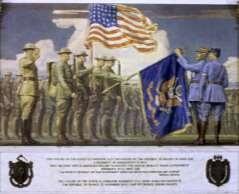
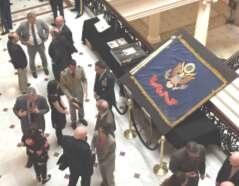
The original flag of the 104th Infantry with croix de guerre was placed on temporary display for the Massachusetts National Guard’s centennial observance of the battlefield ceremony at Boucq, France on April 26, 1918. The National Guard celebration was held in front of the mural, painted in 1927, located on the third floor, in the presence of Adjutant General Keefe, the French Attaché of Military Affairs, many national guardsmen and women, as well as descendants of several soldiers who participated in the campaign at Aprémont and who were also recognized by the Republic of France with individual medals. 6 In June, the Curator also spoke on the 18th century portrait of Governor Endecott as part of the Russell Memorial Lectures at the Museum of Medical History and Innovation, Massachusetts General Hospital, on the contribution of scientific investigation to the conservation of art work.
Members
Happily, the members continued to bring their wide-ranging expertise and thoughtful perspectives on public art and its preservation and presentation to the discussions of the board. They were in harmony with the views and practices of the Curator, which made my role easy and pleasurable.
Each year as I conclude the Annual Report of the Art Commission, I pay homage to Susan Greendyke Lachevre, the State House Curator and our only staff member. Any successful implementation of policy and procedures that the Art Commission proposes has been due to her amazing communication skills and ability to follow-through on a demanding number of responsibilities.
Respectfully submitted,
Paula Morse
Chair