
I respectfully submit the Annual Report of the State House Art Commission for the year ending June 30, 2020. From the fiscal year beginning July 1, 2019 until the State House closed on March 12, 2020 because of the COVID-19 pandemic, the Art Commission and the State House Curator attended with their usual dedication to their advisory roles and curatorial responsibilities. Since then, the Curator has carried out a wide range of collections and outreach activities, often remotely, that will be highlighted in this report. The State House Art Collection has great historical significance and requires regular care and attention according to the highest of museum standards, whether or not there is public visitation and accessibility at any time.
I wish to begin by acknowledging the on-going support we always receive from Tammy Kraus, Superintendent of the State House, and her staff. This assistance from the Bureau of the State House (BSH) ranges from moving and installing art objects and sharing accessibility issues to guidance on the submission of scopes of work for conservation projects. The Curator also participates with BSH and the Division of Capital Asset Management (DCAMM) in planning major building projects that affect the historic spaces, identifying needs and assisting in developing specifications.
As of June 2020, the Art Commission still had the two vacancies on its seven-member board that are appointed by the Senate President. This presents an excellent opportunity for the board to become more inclusive and representative of the rich diversity of Massachusetts residents. As volunteer members since 1910, the board has always brought an independent voice to its deliberations. A recent update to our Acquisitions Guidelines, moreover, specifies that our criteria for selection include promoting a history of the Commonwealth that honors and celebrates inclusiveness and equity.
Care of the Collections
During the year that included the pandemic shutdown, the Curator was able to make regular visits to inspect the art and artifact collections both on display and in storage. Objects remain in good condition, exhibiting only the normal seasonal changes due to minor fluctuations in the building environment.
In July 2019, Daedalus Art Conservation conducted cleaning and maintenance of all bronze monuments and plaques on the grounds. This annual care included washing each sculpture of accumulated dirt and settled pollutants, inspection and retouching of their protective “Incralac” coatings, and reapplication of a clear paste wax that serves as a barrier layer between the acrylic and acidic environment. This program has ensured that even our oldest monuments, those honoring Daniel Webster (1859) and Horace Mann (1865), no longer suffer the effects of damaging corrosion processes. The next scheduled treatment is for late summer 2020.
Storage area environments were continually monitored via daily Control Center reports and onsite inspection. Moreover, upgrades and maintenance of systems, including replacement of critical fire protection equipment, were finalized in October, and semi-annual testing of fire detection and notification systems was conducted as usual in December and again in June 2020. Further systems evaluation was conducted at that later date with recommendations for additional upgrades in FY’21.
In February, the Chair and the Curator initiated the annual inventory of all art objects in collection and in storage. Locations were confirmed and all objects inspected for their condition and possible conservation needs.
The Curator continued to facilitate the handling and monitoring of artworks on loan from the Museum of Fine Arts, Boston for installation in State House executive offices. She also directed the handling, protection, or storage if necessary, of art objects for safety during building projects and special events.
As part of the forthcoming water infiltration project, the Curator also worked with BSH and DCAMM to finalize specifications to relocate two monuments on the front grounds of the State House from their current, inaccessible installation locations to sites that will allow regular viewing by the public. In particular, the John F. Kennedy Memorial statue will be moved with its original base from the West Wing Plaza onto the West Lawn, closer to Beacon Street, where it can be seen year round. A 1950s replica of the Liberty Bell, installed on the Bulfinch portico for decades, will be relocated after it receives professional off-site conservation. The water infiltration project also will address outstanding masonry concerns of several statue bases.
Lastly, additional large-format images of flags from the collection were procured through BSH for display in Memorial Hall. This completes the project to replace all eight reverse mounted images, which provide a history of each flag. These will be installed when it is safe for BSH crews to work inside the cramped display niches.
Additions to the Collection
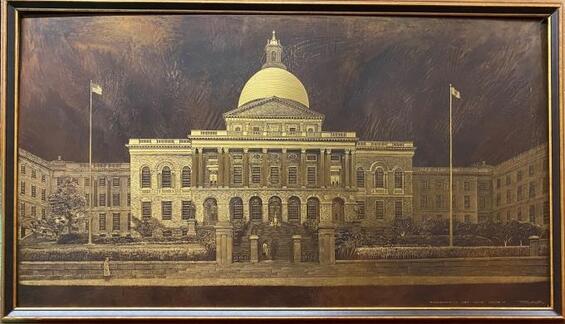
A 1984 etching on brass of the Massachusetts State House, one in a series of fifty state capitol buildings by Robert Allen, of Seattle, was donated to the State House Art Commission by the estate of Lionel D. Jolly of Edmonds, WA, through Theresa Jolly Holt, executrix. Mr. Jolly had commissioned the series from the artist, and in 2001, bequeathed each etching to its respective state capitol collection. Due to the arrival of this gift in February 2020, the etching was received and provisionally accepted by the Curator until such time as the board convenes again, when they can accept the donation in person. MAC2020.1
Tours and public outreach
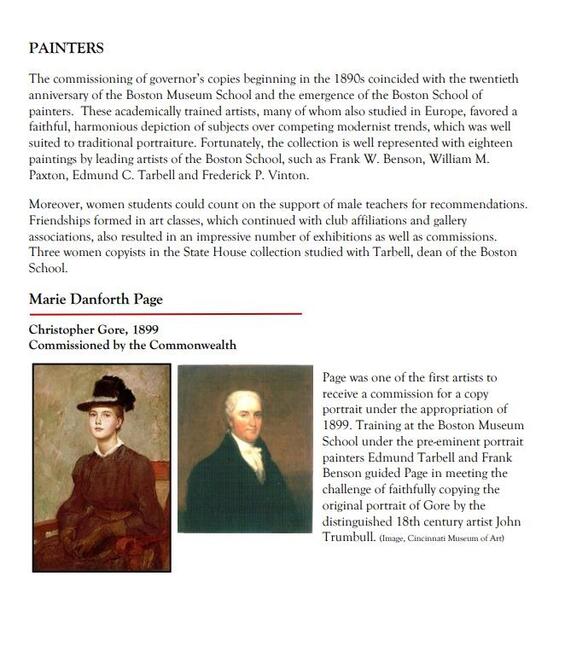
In March, in recognition of the 100th anniversary of the passage of the 19th Amendment to the US Constitution, which gave women the right to vote, the Art Commission prepared a double-sided handout listing all women depicted in artworks in the State House collection. This was distributed to offices and visitors at the State House and remains available at our office. The Chair and Curator also completed an illustrated booklet, Women Subjects, Women Artists, which documents the history and significance of women represented at the State House. (A page is shown at the left.) The pandemic has unfortunately delayed its printing, but a copy of the manuscript will be formatted for our website. Due to the present, small percentage of female honorees at the State House, we anticipate that Women Subjects, Women Artists, one in a series of themed publications produced by our office, will undergo many editions as more women are recognized for their contributions to life in the Commonwealth and the nation.
Until March, the Curator had the opportunity to give tours about the history of the State House building and the collections for what has become an ever-expanding audience of visitors. Early in the year, she delighted in hosting seven “MLK Scholars” during their research project sponsored by the Museum of African American History. Students studied enlistment rosters and learned about the flags of the 54th regiment as they prepared to give presentations on selected veterans of the regiment at the Robert Gould Shaw Memorial opposite the State House.
Requests for presentations to groups such as the Doric Docents, the Massachusetts Foundation for the Humanities, and the Chilton Club, plus meetings with individuals representing cultural and accessibility outreach institutions including Sara Minkara from Empowerment Through Integration, and organizers from the Massachusetts National Guard Museum, continued to be honored with pleasure.
Finally, the Curator continued to address a wide range of research inquiries and requests for images from the collection for publication, scholarly and personal use. As usual, there were always a number of proposals for memorials pending. It is worth noting, moreover, that with the closing of the State House, it became vital for the Curator to be in daily contact with those in charge of building maintenance and security in order to address issues in an efficient and proper manner. Indeed, now that working from home is becoming the norm, upgades to her equipment, vpn access and other technology upgrades will be welcome.
The Art Commission
The board has been generous and patient, and I look forward to the time when we can all meet again at the State House. I know they share my admiration for Susan Greendyke Lachevre, State House Curator, who continues with the same high level of service and commitment to the Commonwealth’s art collection. Her good cheer, no matter the difficulties in communicating with the public and the State House personnel during the pandemic, set a harmonious tune that others would do well to emulate. Of course, if you have any questions about the collection or the role of the Commission, please contact our office.
Sincerely,
Paula Morse
Chair
State House Art Commission