
The members of the Massachusetts Art Commission respectfully submit the Annual Report for the year ending June 30, 2010. The Art Commission is charged under General Laws chapter 6, sections 19 and 20 with the care and custody of the State House Art Collection on behalf of the Commonwealth of Massachusetts and its citizens. The collection of paintings, sculptures, plaques and wall murals commemorates almost 400 years of Massachusetts history, and contains objects dating back to the seventeenth century. Original artifacts and significant architectural and decorative arts enhance this unique collection within the historic building. Additionally, the Commission oversees the Commonwealth’s Battle Flag Collection on behalf of the State Superintendent.
The Commission has been without an annual appropriation since 2003. Since that time we have worked closely with the Bureau of State Office Buildings, our parent agency, to seek ways, as volunteers with a single contracted staff person, the Art Collections Manager, to fulfill our responsibilities. We have repeatedly stated that a collection of this scope, age and value, installed in a non‐museum setting, requires, and will always require, permanent, professional care and oversight. We reiterate our call to establish a position of State House Curator.
In addition to daily curatorial responsibilities, the Art Collections Manager is more and more called upon to assist with projects involving the historic building and assessing the ways in which work might affect the collections. In the past year, she worked with the State Senate to care for its holdings while assisting consultants in researching its architectural history, and with BSB and DCAM on the State House Master Plan and the subsequent Design Guidelines which will insure that all renovation and rehabilitation projects undergo the careful scrutiny required to preserve the historic fabric of the building and its contents.
This year marks the conclusion of the Commissionʹs Strategic Plan 2007‐2010. As we prepare for the future, in addition to providing permanent oversight of the collections, we will continue to seek legislative and administrative support in order to revise and update the Commission’s legislation (last amended in 1924) to reflect the vastly increased scope of our responsibilities. This will also include raising the number of members from five to seven, and establishing staggered terms. We will continue to advise the governor not only on artistic matters but also on the historic preservation of the State House, and describe the process of adding new works of art to the Collection in greater detail.
We are mindful that the public deserves greater access to the collections. We have drafted our website, highlighting the fine arts and battle flags collections with photographs and historical analysis, and await its implementation.
Collections Care
The Art Commission continues to oversee and care for all artwork on display through‐out the building and in storage. This includes a program of annual cleaning and preventive maintenance of eight bronze statues and eight bronze plaques on the State House grounds so that they may remain protected from the effects of our coastal, urban environment. Sculpture conservators from Daedalus, Inc., Watertown, performed this annual treatment in June 2010, reporting to the Art Commission that the program of continual upkeep of these monuments, some of which are among the oldest in Boston, has proven crucial to their preservation by stemming the corrosion process that erodes and eventually causes permanent loss of modeling. We extend our appreciation to the John F. Kennedy Memorial Commission for the gift of $1,379 toward the care of the Kennedy statue under this program.
Several ornate 19th century frames from the collection were conserved by Sue Jackson of Harvard Art, Harvard, MA. Frames belonging to the portraits of Senate Presidents Benjamin Pickman, Horace Mann in the Senate Reception Room, as well as Governor Marcus Morton, were cleaned, and much missing decoration was recast, adhered and regilded. We acknowledge with gratitude a donation from Robert B. Severy, Weymouth, MA of $3,325 toward this project, and thank him for his continued support of the Art Commission’s conservation programs.
The Art Collections Manager also oversees loans from other cultural institutions to the State House, and wishes to thank in particular the trustees of the Museum of Fine Arts Boston, the Rockwell Museum, and the National Museum of African‐American Art for the continued loan of paintings to the Executive Suite.
Acquisitions
The portrait of Governor Mitt Romney, by Richard Whitney, was unveiled at the end of FY’09, and installed in the foyer of the Executive Suite in July. Governor Romney’s is the 87th portrait of a chief executive to be added to the collection.
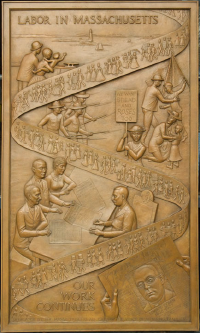
The Massachusetts Labor plaque was unveiled by the Massachusetts AFL‐CIO on September 24, 2010. Authorized under Acts 2002, ch. 491, this plaque pays homage to Labor Leader Edward Cohen and celebrates the history and achievements of the labor movement in the Commonwealth. Four larger panels highlight the importance of the immigrant labor force, the “Bread and Roses” textile workers strike of 1912, the signing of landmark labor legislation into law, and the death of Cohen who was killed in the executive suite in 1907 by a gunman intending to assassinate the governor.
The panels are created by a helix populated by marchers from 31 labor events, illustrating not only the struggle and protest often associated with labor, but also the progress and achievements of the labor movement on behalf of working families. The plaque is installed on the third floor, near the entrance to the Governor’s office in honor of Cohen.
Outreach
Research and assistance with art‐related matters continues to be a significant part of our work. Each year the Art Collections Manager addresses scores of requests from visitors, cultural and educational institutions, scholars, and independent researchers about the Art, Flag, and GAR Memorial Room Collections, and provides photographs for reproduction in publications, as well as for personal use. This year, we granted permission to use images from the collection in several educational exhibitions, including one at the Federal Reserve Bank of Boston on economic growth and development, and another at the Museum of London on piracy!
The office also assists building tenants on a wide variety of art matters. Of particular interest this year was the Senate Historic Study, mentioned earlier. The Art Collections Manager met regularly with architects and preservation consultants, regarding goals and results of findings, provided copies of earlier studies and reports, and researched the Senate’s collection of artifacts and their display in Senate spaces from the 19th century through the present day. We also accommodated exploratory work by directing the removal and storage of marble busts and Revolutionary War‐era artifacts, and hiring a textile conservator to remove, stabilize, and store three fragile flags from the War of 1812 and World War I.
The Art Collections Manager provides tours of the Art Collection for study groups. This year she hosted American history teachers from across the country as part of the NEA’s “Teaching America” program (Salem State University, coordinators.) in July, and the Copley Society’s “Young Collectors” group on two evenings in November. She also received an invitation to lecture at the State Library as part of its “Bag Lunch History” series in April.
Art Commission Board
There were no changes in the membership of the Art Commission. Once again I speak for the Board in extolling the solid virtues of our dedicated Art Collections Manager Susan Greendyke Lachevre. As this fiscal’s year drew to a close her yearly contract had still not been renewed, which underscored all the more the need to create a permanent position of State House Curator. (A contract, her 27th, has since been signed.) As we have come to expect, Susan brings to her responsibilities a high level of commitment and expertise, a standard that should be a prerequisite for all those who follow her.
The members and I welcome opportunities to explain the work of the Art Commission.
Respectfully submitted,
Paula Morse
Chair