
About the bridge reconstruction
The Beades Bridge is named after Dorchester native, World War Two veteran, and Massachusetts State Senator, John J. Beades. Though safe for all users, the bridge has reached the end of its useful lifespan and the design for a new bridge is underway.
The Beades Bridge carries the Department of Conservation and Recreation’s (DCR) Morrissey Boulevard over the entrance between Dorchester Bay Basin and Boston Harbor in the Savin Hill neighborhood of Boston. While the road it carries is owned by DCR, the Beades Bridge itself is owned, operated, and maintained by the Massachusetts Department of Transportation (MassDOT) Highway Division. In 2024, it carried approximately 53,000 vehicles per day.
The bridge was built in 1927 with a four-lane cross-section, two lanes going north towards downtown Boston, and two lanes going south towards Neponset Circle, Mattapan, Quincy, and Milton. This was expanded to a six-lane cross-section with one northbound and southbound lane added in 1953. The bridge was identified by DCR’s predecessor agency, the Metropolitan District Commission (MDC) as in need of reconstruction in 1998, and in 2002, DCR carried out a $9.1 million rehabilitation of the structure.
Despite the relatively recent rehabilitation, Beades Bridge shows its age in all of its parts. Its superstructure is in poor condition and the movable span which opens and closes to allow for the passage of boats is heavily deteriorated. The operating machinery which lifts the movable span dates from 1927 and 1953. It is substantially corroded from a lifetime of work in a seaside environment. As recently as December 2023, the bridge became stuck in the open position causing significant traffic congestion and delays.
MassDOT is at the beginning of designing a new Beades Bridge. The agency knows that any new bridge should:
- Improve safety for all users
- Provide a reliable crossing of Dorchester Bay Basin
- Capture roadway stormwater
- Reduce the number of supports in the water
- Be raised above future flood levels
- Maintain access for recreational boaters
MassDOT has found that two possible bridge types can meet these goals, a new double leaf bascule bridge, similar to today’s Beades Bridge, and a fixed bridge (one unable to open and close), providing 30 feet of vertical clearance between mean high water (MHW) and the bottom of the bridge for the passage of recreational boats.
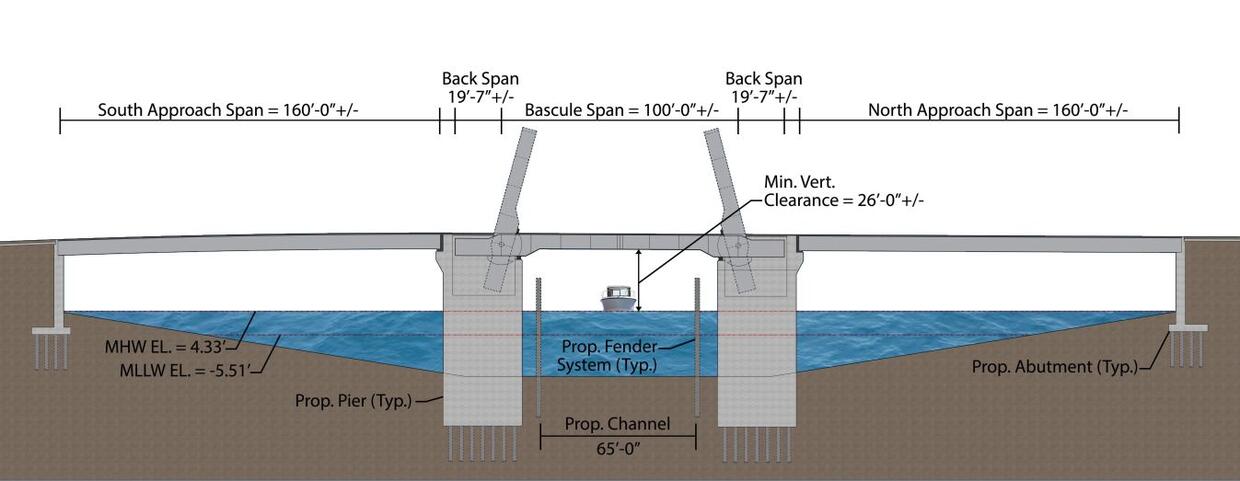
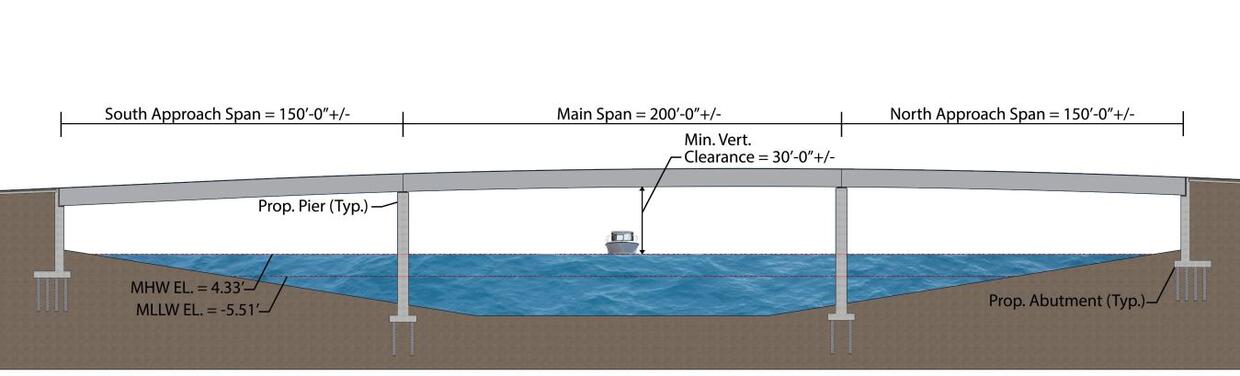
An initial comparison of these two bridge types across a range of factors is presented here:
| Factors | Fixed Bridge | Movable Bridge |
|---|---|---|
| Can improve multimodal travel conditions while handling future traffic | X | X |
| Will require a temporary bridge during construction | X | X |
| Can reduce the number of supports in the water and improve water quality | X | X |
| Anticipated construction cost | X | |
| Construction duration and impacts to motorists and navigation | X | |
| Anticipated lifecycle cost (includes maintenance and staffing for movable bridge) | X | |
| Unlimited vertical clearance for vessels | X | |
| Disruptions to cyclists, motorists, and pedestrians from vessel passage | X | |
| Potential loss of vertical clearance over 75-year service life due to sea level rise | X | |
| Requires additional coordination with United States Coast Guard | X |
The decision as to which type of bridge will be chosen has not been made yet and public input is an important factor in how MassDOT proceeds. The input of all bridge users, whether they are boaters, cyclists, motorists, or pedestrians, as well as abutters, is welcomed and we invite you to be part of the public process.
A robust public process
MassDOT held an initial public information meeting to introduce the design process to the community on December 16th, 2025. Before our next public meeting, we invite you to reach out with existing issues a new bridge can address.
Interested parties are strongly suggested to sign up to receive project emails. When our next meeting is scheduled, an alert will be delivered directly to you, and you will be automatically enrolled for construction progress reports when work begins.
List of documents
-
Open PDF file, 10.55 MB, MassDOT meeting presentation - Boston 12/16/25 (English, PDF 10.55 MB)
-
Open PDF file, 553.77 KB, Beades Bridge reconstruction fact sheet (English, PDF 553.77 KB)