
What Happens at a Hearing?
Hearings can last anywhere from an hour to an entire week or longer, depending on the subject of the hearing. Hearings follow a trial format but are less formal.
Before the hearing formally begins, the magistrate will often ask if there is any “housekeeping” or anything that needs to be discussed to make the hearing go more smoothly. Tell the magistrate if any of your witnesses have scheduling limitations, if you have problems with the exhibits (yours or the other party’s), if you need to break at certain times for medical reasons, or anything else that might affect the flow of the hearing.
Hearings have most of the following steps, although some of these steps can be skipped:
- Beginning – The magistrate typically welcomes the participants and reads procedural information into the record. The magistrate formally admits documents into evidence as exhibits.
- Opening statement – Each party may quickly explain its position in the case and say what it believes it will prove with evidence. The opening statement is not evidence. The party who asked for the hearing typically will be asked to make its opening statement first, and the other party will follow. You don’t have to make an opening statement, but it can help the magistrate understand your position.
- Presentation of evidence – In most cases, the party who is asking that something be done has the burden of proof and must show by evidence (such as testimony and documents) that it is entitled to what it is seeking. Usually, this party presents its evidence first, followed by the other party or parties. See the section Evidence.
- Witnesses – As part of the presentation of evidence, each party may call witnesses, who are placed under oath or affirmation (in other words, they swear to tell the truth, or affirm that they will be providing testimony under the penalties of perjury). One by one, witnesses first answer questions from the party who called them (direct examination) and then may answer questions from the other party (cross-examination). The magistrate may also ask questions. In some circumstances, witnesses may be required to wait outside the hearing room until they are called to testify.
- Exhibits – Before the hearing, you will receive an order requiring the parties to inform the magistrate and each other about the exhibits that the parties will be asking the magistrate to consider. You should also bring copies of your exhibits to the hearing.
- Please note that you can contact the opposing party(s) before the hearing to determine whether you can agree on the exhibits to be introduced at the hearing. Whether you reach agreement or not, any proposed exhibits of 5 or more pages should be page-numbered.
- Objections – Any party may object to questions, testimony, or exhibits. An objection must have a legal reason. The magistrate will either “sustain” the objection (which means the testimony or exhibit won’t be considered when deciding the case) or “overrule” the objection (the evidence can be considered).
- Closing argument – At the end of the hearing, each party may summarize what the evidence shows and argue why the magistrate should recommend a decision in that party’s favor. The closing argument is not evidence.
- Typically, the magistrate will ask if the parties would like to make closing statements or submit post-hearing briefs that describe each party’s arguments and supporting sources. Depending on what the parties request, the magistrate may close the record after the closing arguments are made, or the parties may be instructed or invited to submit post-hearing briefs.
What is the Burden of Proof?
The party who must prove its claims is said to have the burden of proof. In hearings at DALA, the party with the burden of proof must show the facts by what is called a “preponderance of the evidence.” This means the party with the burden of proof must show that a fact is more likely true than not true. Cases at DALA are not criminal cases. Because of this, the burden of proof in hearings at DALA is never the criminal standard of “beyond a reasonable doubt.”
Who Has the Burden of Proof?
Most of the time, the party that sends the case to DALA—in other words, the individual or business challenging the agency decision—must meet its burden of proof to win. However, in some cases, the agency will have the burden of proof. When it is not clear who has the burden of proof, the magistrate will look at the case and decide which party has the burden of proof.
May I Bring Witnesses to the Hearing?
Yes, you may bring witnesses to testify for you. Witnesses should have personal (that, is first- hand) knowledge about the case. Before the hearing, you will receive an order requiring the parties to exchange the names of their witnesses and to provide information about the witnesses’ expected testimony before the hearing so that the parties can prepare. In those cases, if you don’t provide the information, your witnesses may not be allowed to testify.
If your hearing is in person, simply have your witnesses appear at the hearing location at the time and date for the hearing. Contact your witnesses before the hearing and have them arrange their schedules so they can arrive on time and be prepared to participate in the hearing. You may also request that a witness appear virtually.
May I Bring Documents as Evidence?
Yes. Be sure to bring copies for the magistrate and all other parties. Pay attention to any orders that require you to list or exchange the exhibits you intend to offer into evidence before the hearing. If there is an order like that, and you don’t list or exchange the exhibits, you might not be allowed to use them at the hearing.
Please remember to put page numbers on documents you want to use as evidence, if they are five pages long or more.
What Should I Call the Magistrate at My Hearing?
You should call the magistrate “Magistrate” or “Your Honor.”
What Should I Wear to the Hearing?
There is no dress code for hearings at DALA, but we ask that you respect the occasion by dressing appropriately. Many people choose to wear business clothing to hearings, but you do not need to buy business clothing if you do not already have it.
Where Will My Hearing Be Held?
Many hearings are held at DALA’s Malden office, which is located at 14 Summer Street, 4th Floor, Malden, MA 02148. However, virtual options are also available. Before your hearing is scheduled, you will have the chance to request where it will be held—at DALA’s office, fully remote, or with certain witnesses testifying remotely. In limited circumstances, you may also request an in-person hearing at a different location. The magistrate will decide whether to grant any requests about where and how the hearing should be held.
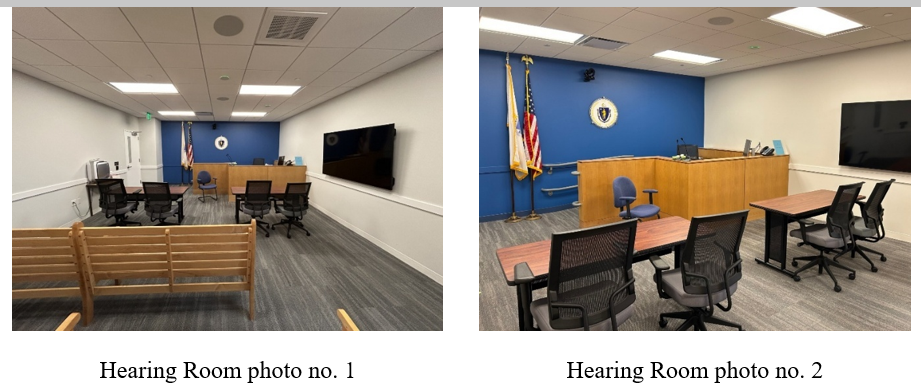
If it takes place in person at DALA’s office, the hearing will be held in a room like the one shown here. Please arrive early in order to become familiar with your surroundings.
Where Should I Park for a Hearing at DALA’s Malden Office?
There is parking in the building (14 Summer Street, 4th Floor, Malden, MA 02148) and at several nearby lots.
Is DALA’s Malden Office Accessible by Public Transportation?
DALA is located at 14 Summer Street, 4th Floor, Malden, MA 02148, which is across the street from the Malden Center T stop on the Orange Line.
What Happens if I Do Not Attend the Hearing or Do Not Participate in the Proceedings?
If you don’t show up for the hearing, your case may be dismissed or a default decision may be entered against you.
What if I Have an Emergency at the Last Minute and Can’t Attend the Hearing?
If you have an emergency on the day of the hearing, please call 781-397-4700 and explain the situation. Otherwise, if you have an emergency leading up to the hearing, file an emergency motion for a continuance (to request additional time) and notify the opposing party or parties. It is important to notify DALA of your emergency as soon as you can so that the magistrate can take appropriate action, if necessary.
Are Hearings Open to the Public?
DALA hearings are open to the public, except for a few kinds of hearings that the law makes confidential. However, anyone whose conduct interferes with a hearing may be removed from the room. With some exceptions, hearings may be recorded or photographed, but the person who wants to photograph or record the hearing must notify the magistrate before doing so. Also, a person’s recording or photographing must not interfere with the proceedings.
May I Watch a DALA Hearing?
If you would like to attend a hearing at DALA, please call ahead using (781) 397-4700. Please note that magistrates may determine that some hearings need to remain confidential, i.e., open only the magistrate, the parties, and the witnesses, but not the public.
How Will the Testimony Be Recorded?
The testimony will be recorded using digital audio-recording equipment, digital video-recording equipment, or a court reporter when one is arranged by the parties. Because of budget limitations, DALA does not provide court reporters.
How Do I Get a Copy of the Hearing Testimony?
A copy of the recording will be automatically sent by email to all parties.
Will the Magistrate Make a Decision on My Case at the Hearing?
No. In most cases, after the hearing, the magistrate will prepare a written final decision based on the evidence admitted at the hearing. A copy of the decision will be sent to you when it is issued.
After the Hearing
Will I Receive a Copy of the Magistrate’s Decision?
Yes. The magistrate will send a copy of the decision to the agency and all parties. The decision will be sent to the mailing address that appears in the filings in the case. You must inform the magistrate and the other parties if you change your mailing address at any time during the course of the case.
Can I Appeal DALA’s Decision?
Yes. In most cases, you may appeal a DALA final decision to the Superior Court. However, you should check the specific law governing the agency involved in your case to determine your rights to appeal, as you may be permitted and required to appeal to the agency itself or to another agency (e.g., the Contributory Retirement Appeal Board). If timelines are included in each agency’s specific laws, it is important to abide by them. Otherwise, you may lose the right to appeal DALA’s decision.