
- Executive Office of Housing and Livable Communities
Media Contact
Tara Smith, HLC Press Secretary
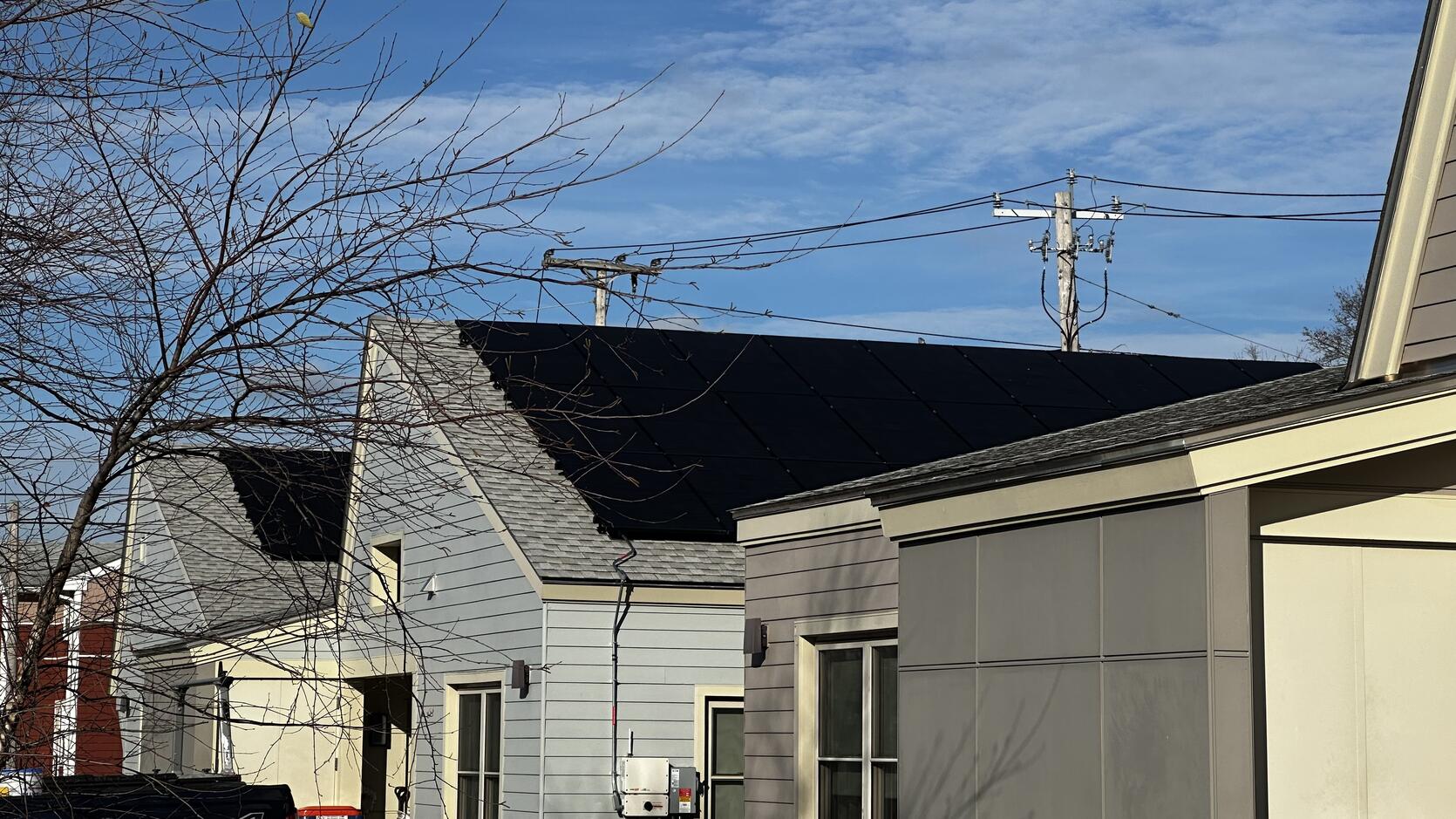
BOSTON — The Healey-Driscoll Administration today celebrated the New Bedford Housing Authority’s Westwood development as a model for the future of public housing in Massachusetts, showcasing modern, accessible homes paired with a new solar array that will lower energy costs and reduce greenhouse gas emissions.
During a visit to New Bedford Housing Authority’s Westwood Accessible Family Housing, Housing and Livable Communities Secretary Ed Augustus toured the energy-efficient family development and the rooftop solar array that was recently brought online under a Solar for Nonprofits program that helps local housing authorities procure clean power at a lower cost and keep those savings in their operating budgets.
“Our public housing communities are home to more than 70,000 families, seniors and people with disabilities across Massachusetts, and they deserve homes that are modern, efficient and dignified,” said Housing and Livable Communities Secretary Ed Augustus. “Westwood shows what is possible when we pair smart redevelopment with clean energy. The new solar array will save New Bedford Housing Authority hundreds of thousands of dollars over the next two decades – money that can stay in the budget to support maintenance, resident services and further upgrades – while also helping us meet our climate goals.”
Completed in 2018, the Westwood redevelopment replaced 30 functionally obsolete studio and one-bedroom units with 12 fully accessible family homes, including one-, two- and three-bedroom apartments. The buildings were constructed to be “solar ready,” with highly insulated envelopes and high-efficiency heating and cooling systems. The homes are heated with heat pumps, and domestic hot water is provided by efficient gas systems.
The New Bedford Housing Authority partnered with PowerOptions, an energy procurement organization that works with nonprofit and public sector entities to lower energy costs, and solar developer Sunwealth to install a solar array across the roofs at Westwood. Construction began in August 2024, and the system is now fully operational. Under the PowerOptions program, housing authorities can add onsite solar with minimal up-front cost and without having to own, operate or maintain the system. Instead, they pay a per-kilowatt hour rate that is lower than standard utility rates, locking in long-term savings that stay with the housing authority.
At Westwood, the solar array is projected to save nearly $370,000 in electricity costs over 20 years, savings that New Bedford Housing Authority will retain. Over the same period, the system is expected to reduce greenhouse gas emissions by an estimated 2,516 metric tons carbon dioxide equivalent – the equivalent of taking about 587 gas-powered cars off the road or the amount of carbon absorbed by roughly 2,525 acres of forest in a year.
The Secretary’s visit comes as the Healey-Driscoll Administration continues to implement the Affordable Homes Act, the largest housing investment in state history. The law authorizes more than $5 billion in capital spending for housing statewide, including $2 billion in authorizations for capital improvements to state-aided public housing. The public housing capital authorizations in the Affordable Homes Act also allow up to $150 million to be used to support housing projects that help cut greenhouse gas emissions and move toward decarbonization. This includes installing heat pumps, building all-electric or net-zero homes, meeting Passive House or similar energy-efficiency standards and adding other green or climate-resilient features. These investments will help modernize the state’s more than 43,000 state-supported public housing homes, many of which face significant backlogs in deferred maintenance and repair needs.
In recent weeks, the administration has also launched additional investments to modernize public housing and lower energy costs. The Healey-Driscoll Administration awarded $20 million through the Climate Ready Housing program to upgrade about 1,000 homes, including units at the Boston and Needham housing authorities, with deep energy retrofits and decarbonization measures that will lower energy costs and cut emissions. In addition, the Administration announced construction starts on weatherization and heating efficiency upgrades, among other improvements, at 54 public housing authorities across Massachusetts over the summer. The work included window and door replacements and new heating systems to improve comfort and reduce winter energy bills.
Through the Affordable Homes Act and ongoing capital plans, the Executive Office of Housing and Livable Communities is supporting projects that improve building systems, increase accessibility, and add features like high-efficiency heating and cooling and rooftop solar to lower long-term operating costs.
“Public housing is an important safety net to support some of our most vulnerable residents, and we are committed to making these communities places residents can be proud to call home,” Augustus said. “From New Bedford to the North Shore and from Boston to the Berkshires, we are investing in safer, healthier, more energy-efficient buildings so that our public housing system is strong for the next generation.”
