
Download the State Cancer Plan
About the State Cancer Plan
The 2024 – 2029 Massachusetts State Cancer Plan (Cancer Plan or Plan) is a roadmap for reducing the burden of cancer in the state. The Plan provides a comprehensive approach for addressing cancer across the continuum, including prevention, early detection, treatment, survivorship, and palliative care. It is designed as a guide for statewide, local, and community efforts to lower new cases of cancer and death incidence and mortality while also addressing persistent disparities across the cancer continuum. As cancer impacts populations differently, this plan prioritizes populations that experiences disparities in cancer, such as people of color, people with disabilities, LGBTQIA+ people, and people living in rural communities.
The Cancer Plan is developed and implemented by the Massachusetts Comprehensive Cancer Coalition (MCCC or Coalition). The MCCC is comprised of a diverse group of partners, including representatives from clinical care settings, community-based organizations, public health organizations, government agencies, and academic research centers, as well as cancer survivors and their families, caregivers, and advocates, that all work together to achieve the Plan’s goals and objectives.
Leading with Race & Racism
When looking at cancer burden across Massachusetts, inequities persist among racial and ethnic population groups at each stage of the cancer continuum. For example, African American and Black men and people with prostates have the highest prostate cancer death rate as compared to other racial groups. These group differences cannot be attributed to individual behaviors, but rather bring to light inequities in opportunities to prevent, detect, treat, and survive cancer. Achieving health equity for all people means providing everyone with opportunities to achieve their best health.
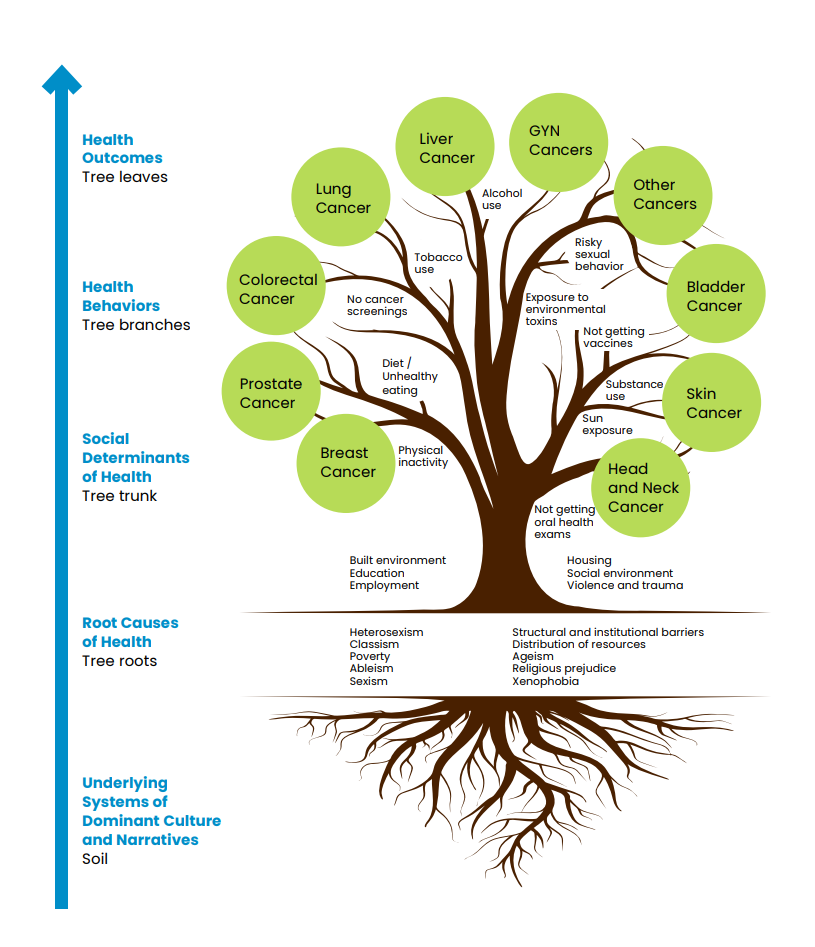
Major barriers to health equity stem from the social determinants of health (SDoH) — the community-wide social, economic, and physical conditions we experience where we are born, work, live, play, and age. As the following graphic shows, addressing the root causes that shape the social determinants of health is key. Addressing root causes means we must change the systems and structures that created the unhealthy conditions in the first place.
Other forms of bias, such as ableism, classism, heterosexism, sexism, and transphobia, also contribute to inequities and disparities in cancer outcomes. Each person has many aspects to their identity and can face multiple biases. When social biases intersect, inequities can be compounded and amplified.
Acknowledging that these inequities in cancer outcomes are driven by structural racism and social determinants of health, the Massachusetts State Cancer Plan seeks to address these inequities through a framework of leading with race and racism explicitly, but not exclusively. By leading with race and racism, we are acknowledging that the systems failing our residents of color and putting them at increased risk of cancer are failing all residents. Working on these inequities will improve the health of Massachusetts as a whole.
The State Cancer Plan
The 2024 - 2029 State Cancer Plan is organized by the 5 stages of the cancer continuum. Within each of these stages, the Plan sets out a specific goal, followed by objectives and strategies that are believed to be important to reaching that goal. Within the Cancer Plan, cross references are made to indicate aligned objectives and strategies across priority areas.