
Overview
In 1930, the Commonwealth of Massachusetts established the Board of Tax Appeals. The Board has jurisdiction to hear and decide appeals of decisions made by local and state taxing authorities. This board was created to provide taxpayers with a less costly and more convenient means of appeal, while relieving the Superior Court of responsibility for deciding tax appeals. The Board of Tax Appeals was replaced by the Appellate Tax Board (ATB) in 1937.
ATB is a quasi-judicial agency, and its purpose is to hear taxpayer (appellant) appeals for abatements of property taxes, personal property taxes, water bills, and motor vehicle excise taxes that have been denied by local boards of assessors (appellees). ATB also hears appeals by taxpayers regarding state taxes, including income tax, corporate and bank excise, use tax, and other related taxes. All of ATB’s decisions are binding on both the appellant and the appellee; however, decisions may be appealed to the State Appeals Court or the Supreme Judicial Court.
ATB has five commissioners, who are appointed by the Governor for six-year staggered terms. ATB is organizationally within the Executive Office for Administration and Finance, for administrative purposes, but is not subject to Executive Office for Administration and Finance control in conducting its adjudicatory function. It is located at 100 Cambridge Street in Boston, where the majority of hearings are conducted. However, for taxpayers and boards of assessors in areas farther from Boston, ATB members travel to cities and towns across the Commonwealth to hold hearings. In recent years, ATB has conducted more hearings virtually, which, ATB said, has made the appeal process more accessible and has increased participation. ATB received state appropriations (including retained revenue) of $2,340,167 and $2,432,745 for fiscal years 2023 and 2024, respectively.
ATB maintains a web presence on its mass.gov website, on which users can find information about upcoming and past proceedings, as well as forms and guides for residents interested in initiating an appeal.
Massachusetts Requirements for Accessible Websites
In 1999, the World Wide Web Consortium (W3C), an international nongovernmental organization responsible for internet standards, published the Web Content Accessibility Guidelines (WCAG) 1.0 to provide guidance on how to make web content more accessible to people with disabilities.
In 2005, the Massachusetts Office of Information Technology,1 with the participation of state government webpage developers, including developers with disabilities, created the Enterprise Web Accessibility Standards. These standards required all executive branch state agencies to follow the guidelines in Section 508 of the Rehabilitation Act amendments of 1998. These amendments went into effect in 2001 and established precise technical requirements to which electronic and information technology (IT) products must adhere. This technology includes, but is not limited to, products such as software, websites, multimedia products, and certain physical products, such as standalone terminals.
In 2008, W3C published WCAG 2.0. In 2014, the Massachusetts Office of Information Technology added a reference to WCAG 2.0 in its Enterprise Information Technology Accessibility Standards.
In 2017, the Executive Office of Technology Services and Security (EOTSS) was designated as the Commonwealth’s lead IT organization for executive branch state agencies. EOTSS is responsible for the development and maintenance of the Enterprise Information Technology Accessibility Standards2 and the implementation of state and federal laws and regulations relating to accessibility. As the principal executive agency responsible for coordinating the Commonwealth’s IT accessibility compliance efforts, EOTSS supervises executive branch state agencies in their efforts to meet the Commonwealth’s accessibility requirements.
In 2018, W3C published WCAG 2.1, which built on WCAG 2.0 to improve web accessibility on mobile devices and to further improve web accessibility for people with visual impairments and cognitive disabilities. EOTSS published the Enterprise Information Technology Accessibility Policy in 2021 to meet Levels A and AA of WCAG 2.1.
Timeline of the Adoption of Website Accessibility Standards by the Federal Government and Massachusetts
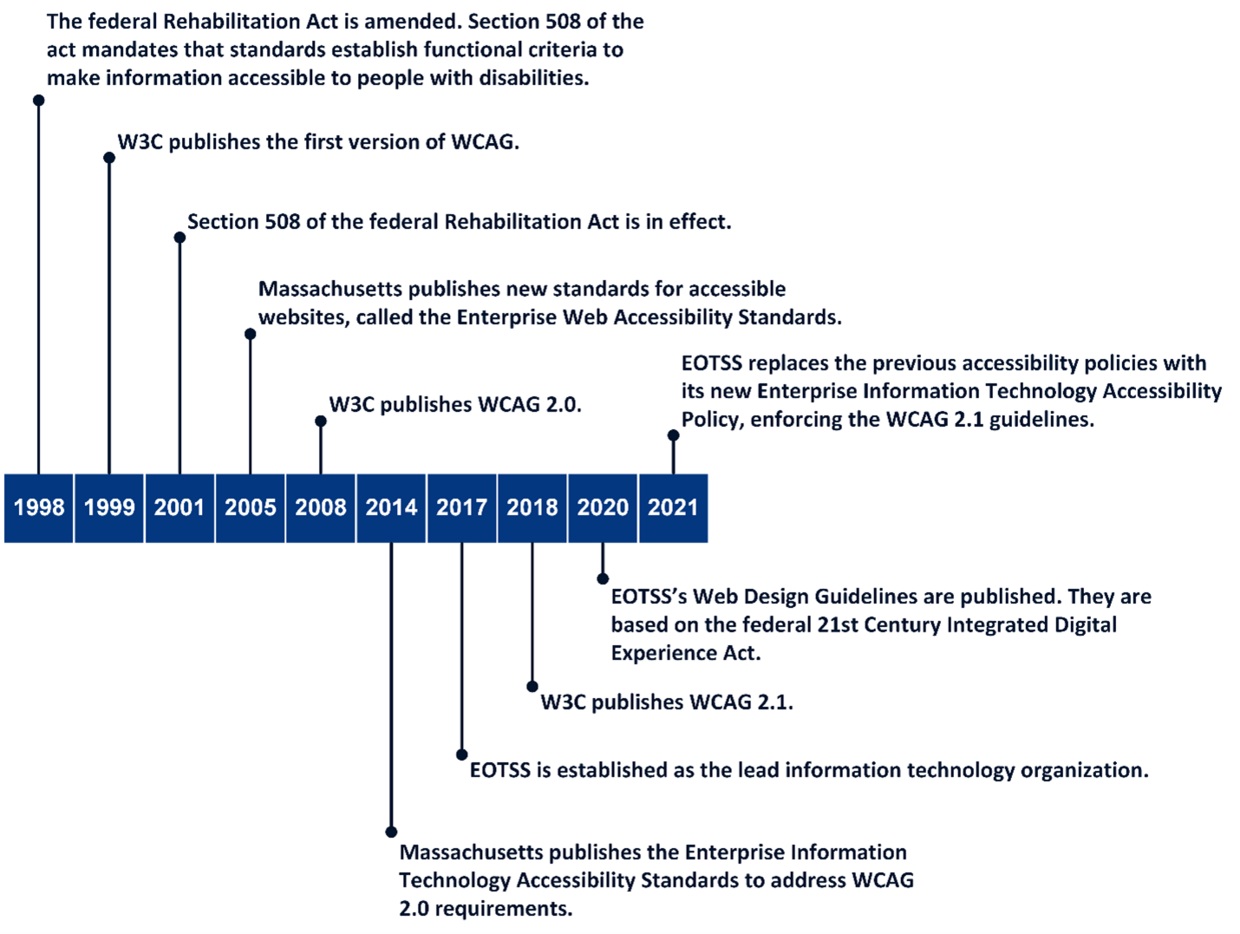
Executive branch state agencies must comply with EOTSS’s policies and standards. However, non-executive branch state agencies, such as ATB, must also comply with EOTSS’s accessibility policies and standards when using an EOTSS web domain,3 as established by EOTSS’s Website Domain Policy. Part of this policy states that any government organization using an EOTSS web domain must comply with EOTSS’s Web Design Guidelines, which were published in 2020 and were based on the federal 21st Century Integrated Digital Experience Act. This law helps state government agencies evaluate their website design and implementation decisions to meet state accessibility requirements.
Web Accessibility
Government websites are an important way for the general public to access government information and services. Deloitte’s4 2023 Digital Citizen Survey found that 55% of respondents preferred to interact with their state government services through a website instead of face-to-face interaction or a call center. Commonwealth of Massachusetts websites have millions of webpage views each month.
However, people do not interact with the internet uniformly. The federal government and nongovernmental organizations have established web accessibility standards intended to make websites more accessible to people with disabilities, such as visual impairments, hearing impairments, and others. The impact of these standards can be significant, as the federal Centers for Disease Control and Prevention estimates that 1,488,012 adults (26% of the adult population) in Massachusetts have a disability, as of 2022.5 Among the estimated 26% of the adult population, 14% reported having serious difficulty with cognition, 10% reported having serious difficulty with mobility, 6% reported having deafness or serious difficulty hearing, and 5% reported having blindness or serious difficulty seeing (even when wearing glasses).6 Examples of web accessibility measures include, but are not limited to, having captioning on videos to help people with difficulty hearing understand the contents of the video, having form fields describe what data needs to be input into them to help people who have cognitive difficulties, and ensuring that people can interact with a webpage using keyboard commands alone to help people who have difficulty with mobility.
How People with Disabilities Use the Web
According to W3C, people with disabilities use assistive technologies and adaptive strategies specific to their needs to navigate web content. Examples of assistive technologies include screen readers, which read webpages aloud for people who cannot read text; screen magnifiers for individuals with low vision; and voice recognition software for people who cannot (or do not) use a keyboard or mouse. Adaptive strategies refer to techniques that people with disabilities employ to enhance their web interactions.7 These strategies might involve increasing text size, adjusting mouse speed, or enabling captions.
To make web content accessible to people with disabilities, developers must ensure that various components of web development and interaction work together. This includes text, images, and structural code, users’ browsers and media players, and various assistive technologies.
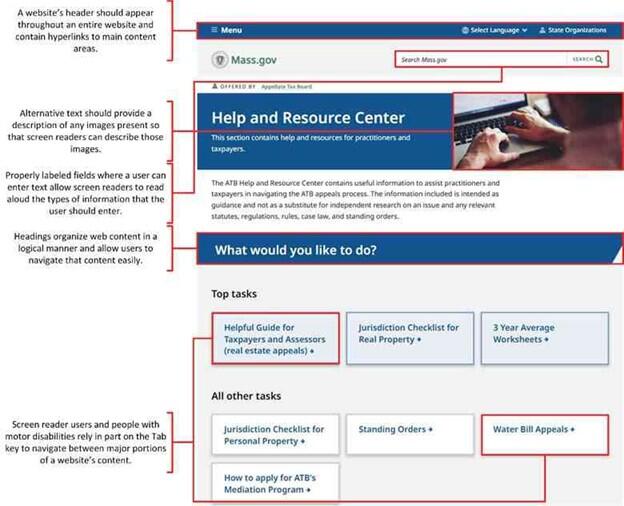
Accessibility Features of a Website8
| Date published: | November 3, 2025 |
|---|