
Overview
The University of Massachusetts Building Authority (UMBA) is an independent body politic, as well as a corporate and a public agency, and was created by Chapter 773 of the Acts of 1960, as amended. It was created to aid and contribute to the educational and other purposes of the University of Massachusetts (UMass) system. UMBA designs and constructs residence halls, dining commons, other buildings and structures, working capital, and tangible and intangible personal property for the use of the UMass system and its students, personnel members, their dependents, and other entities stated in the enabling act. UMBA serves UMass’s five campuses: Amherst, Boston, Dartmouth, Lowell, and the Chan Medical School. UMBA is governed by an eleven-member board of directors, whose members are appointed by the Governor. Five of the members must be trustees, and the two other members must be graduates from the UMass system.
The UMass President’s Office is responsible for developing a capital plan that prioritizes projects, identifies funding sources, and ensures that strategic and campus priorities are addressed.
UMBA has the authority to undertake the following activities:
- construct buildings or structures;
- acquire, modify, enlarge, reconstruct, remodel, or perform other work on any building or structure;
- acquire property from the Commonwealth through purchase, lease, or grant, which may include real or personal property, easements, or rights;
- provide and install furnishings, furniture, machinery, equipment, facilities, approaches, driveways, walkways, parking areas, or other structures;
- rent or lease any building, structure, or portions thereof, as well as any parking area that it owns;
- enter into contracts and agreements necessary to fulfill its responsibilities;
- apply for and accept grants or loans from the federal government;
- invest funds that it holds;
- manage the payment of principal and interest on obligations; and
- borrow, refund, or sell bonds and notes, which are payable solely from its revenues.
UMBA generates revenue through contracts with the UMass system for financial assistance, as well as for the management and provision of services related to capital projects. This includes interest income and interest subsidies from the US government related to the bonds that it issues. To finance its projects, UMBA issues bonds and notes, uses commercial paper, and draws from campus funds such as fundraising and donations, along with state funds from the Division of Capital Asset Management and Maintenance. The Commonwealth does not appropriate any state funding for UMBA, nor does it guarantee the bonds issued by UMBA for its building projects. UMBA’s operating revenues were $245 million for fiscal year 2023 and $257 million for fiscal year 2024. The operating expenses for the same periods were $183 million and $198 million, respectively, while outstanding bonds issued by UMBA were $3.4 billion each for both fiscal year 2023 and fiscal year 2024.
UMBA is located at 100 Carlson Avenue in Newton, and had 13 employees as of June 30, 2024.
Building Safety
Section E of the amended and restated primary contract entered into by UMBA and the UMass system, through the UMass system’s Board of Trustees, on May 1, 2019, states,
E. Other Obligations of the [UMass system] for Projects
The Trustees shall make available to the [UMBA] the services of officers and employees of and facilities in the [UMass system] for the performance of any and all activities with respect to the Projects as necessary to operate them in furtherance of the purpose of the [UMass system] and to maintain the Projects in good order and repair, as determined by the [UMass system]. . . .
The obligation of the Trustees hereunder to operate the Projects, keep them in good order and repair and maintain them shall include, but not be limited to, the furnishing of all supplies and materials needed or desirable for such operation, keeping in good order and repair, and maintenance, the making of all interior and exterior repairs to the buildings and structures included in the Projects and all repairs to other improvements and to equipment and furnishings included in the Projects, the maintenance of the Projects and the replacement, restoration and reconstruction of any structure, improvement or item of equipment or furnishings or portion thereof worn out, damaged or destroyed by whatever cause.
According to this primary contract, UMBA is responsible for managing capital projects across the UMass system’s five campuses. This includes construction, renovation, acquisition of buildings and land, as well as procurement of both tangible and intangible personal properties. Once a construction project is completed, it is handed over to the individual UMass system campus for maintenance and upkeep.
Additionally, UMBA hires an owner project manager (OPM), a designer, and a construction management firm to oversee all stages of the design and construction process. For each project, the OPM provides daily, weekly, and monthly reports to UMBA and holds weekly meetings throughout the construction period.
According to UMBA management, all UMBA projects are monitored and approved by various state and local inspectors. This monitoring includes building inspection in areas such as sheet metal, electrical, plumbing, and fire safety. These inspections are necessary before a project can receive its Certificate of Occupancy and Use. Each project is unique, but inspectors are on-site at various milestones during construction. On average, each project undergoes between 25 to 50 inspections.
According to Section 110.1 of Title 780 of the Code of Massachusetts Regulations (CMR), any construction or work that requires a permit must be open to inspection and remain accessible until approved by the building inspector. Before issuing a permit, the building inspector has the authority to examine any buildings, structures, and sites for which a permit application has been submitted. Additionally, the building inspector is required to conduct inspections during the construction process at necessary intervals to ensure compliance with regulations. When issuing the permit, the building inspector must inform the applicant of the required inspection points. Additionally, a final inspection is conducted once the permitted work has been completed.
According to 780 CMR 111.1, no building or structure may be used or occupied, and no change in the existing occupancy classification may occur, until the building commissioner, the inspector of buildings, or the state building inspector issues a Certificate of Occupancy and Use.
If the work completed under a permit requires a new Certificate of Occupancy and Use due to alterations of an existing structure, then a final inspection is conducted. If the completed work complies with the approved application, then the building inspector issues a Certificate of Completion. This certificate signifies that the work was completed in accordance with the provisions of the approved permit, and no further inspections are required.
Massachusetts Uniform Procurement Act
According to Section 1(b)(34)(e) of Chapter 30B of the General Laws,
Notwithstanding the provisions of any general or special law to the contrary, a governmental body may enter into a contract, in conformance with this chapter, for the construction and for services at a facility owned by a private party or parties, whether such facility will be located on public or private land for the disposal, recycling, composting or treatment of solid waste, sewage, septage or sludge without said contract being subject to the competitive bid process.
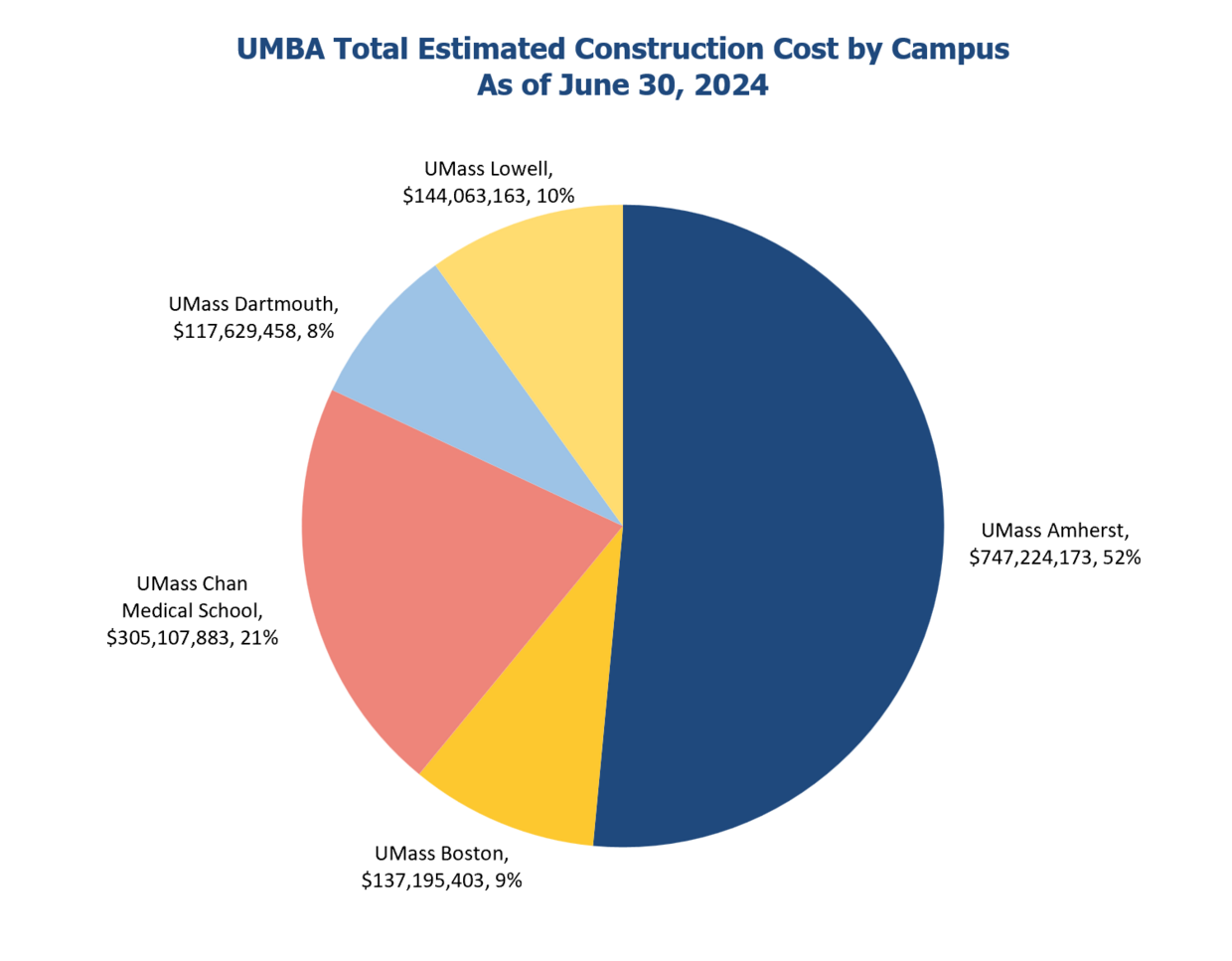
During the audit period, UMBA had a total of 30 construction projects at various stages, with an estimated total construction cost1 of $1.45 billion and a total project cost2 of $1.83 billion.
UMBA Total Estimated Construction Cost by Campus As of June 30, 2024
UMBA Total Project Cost by Campus As of June 30, 2024

UMBA management informed us that the capital project process starts with a UMass campus identifying the need for a capital project. After this, the project is incorporated into the UMass campus’s capital plan. This plan requires review and approval by the UMass system Board of Trustees before any UMass campus can proceed. Creating the capital plan involves prioritizing projects, determining funding sources, and ensuring that the projects align with strategic and campus priorities. UMBA works closely with the UMass system President’s Office and each campus to oversee UMBA-funded projects, as well as other projects listed in the plan that have an estimated construction cost of $10,000,000 or more.
Before a project gets a full approval vote from the UMass system’s Board of Trustees, UMBA performs a technical review. This review checks the project scope for feasibility and determines the accuracy of cost estimates. The project must receive two separate votes from the trustees: a preliminary vote and a full approval vote. Trustee approval is required to start or fund any capital projects that involve UMass system borrowing or that have costs $10,000,000 or more. For projects costing between $2,000,000 and $10,000,000, the UMass system president’s approval is needed. Capital projects under $2,000,000 are handled by the respective UMass campuses. Capital projects under $10,000,000, with no borrowed funds, are managed by UMBA and the respective campuses. UMBA is responsible for constructing UMass facilities and hires architects, designers, engineers, and construction companies to handle the design and building processes. Additionally, UMBA contracts an OPM to supervise each project from start to finish. The OPM is responsible for monitoring costs, managing the designer and contractors, making sure that the project stays on schedule, and providing regular progress updates to UMBA.
Project Procurement Using Design-Bid-Build
According to Subsection 2(D) of Section 44A of Chapter 149 of the General Laws, every contract for the construction, reconstruction, installation, demolition, maintenance, or repair of any building by UMBA that is estimated to cost more than $150,000 must be awarded to the lowest eligible bidder based on competitive bids.
In accordance with Section 44A 1/2 of Chapter 149 of the General Laws, UMBA is required to hire an OPM before entering into a contract for design services. The OPM functions as UMBA’s agent and consultant during all stages of planning, design, and execution associated with construction projects. These projects may include the creation, renovation, installation, demolition, maintenance, or repair of any public building. An OPM is required for projects with an estimated total cost of at least $1,500,000.
Moreover, Section 44B(2) of Chapter 149 of the General Laws states that all bids submitted for contracts are required to be accompanied by a bid deposit, which serves as a financial guarantee of the bidder’s commitment to the project. This deposit helps ensure that serious contenders present their bids, thereby promoting accountability and reducing the likelihood of frivolous submissions.
Furthermore, Section 44D(1)(a) of Chapter 149 the General Laws specifies that each bid must include a copy of a certificate of eligibility issued by the commissioner of the Division of Capital Asset Management and Maintenance. This certificate is crucial as it verifies that the bidder possesses the appropriate classification and capacity rating needed to successfully undertake the scope of work outlined in the contract. This requirement helps ensure that only qualified entities are considered for the project, thus safeguarding the integrity and quality of the public works being conducted.
Before issuing a request for qualifications (RFQ), the awarding authority must establish a prequalification committee to review and evaluate the submitted responses. The public notice and solicitation should be advertised in a widely circulated newspaper in the project area and in the Central Register.3 After responses are received, the prequalification committee selects at least three qualified general contractors to submit bids with quotes to fulfill the contract.
Project Procurement Using Construction Management-at-Risk Services
UMBA may use the construction management-at-risk delivery method4 for any contract related to the construction, reconstruction, installation, demolition, maintenance, or repair of a building estimated to cost at least $5,000,000.
According to Section 5 of Chapter 149A of the General Laws, UMBA must use a two-phase selection process in selecting a construction management-at-risk firm: (1) RFQs and (2) request for proposals (RFP). Before issuing an RFQ, UMBA establishes a prequalification committee to review and assess the responses received to the RFQ. UMBA provides public notice of the building project and invites responses from construction management-at-risk firms. Interested firms must submit a statement of qualifications in response to the RFQ. This public notice is advertised in a newspaper with general circulation in the area where the building project is located and in the Central Register.
Once the responses are received, the prequalification committee evaluates each statement of qualifications using the criteria specified in the RFQ. Only firms that achieve an acceptable rating proceed to Phase 2 and receive an RFP. The prequalification committee selects at least three qualified firms to receive an RFP. If fewer than three firms qualify, then UMBA readvertises the project. Once the prequalified firms are chosen, UMBA establishes a selection committee to review and assess the responses received to the RFP.
The RFP must include all the elements specified in the RFQ and require the submission of separate price and technical components as part of the proposal. Upon receiving the proposals in response to the RFP, the selection committee evaluates each submission based on the criteria included in the RFP. If the committee chooses to conduct interviews, then the selection committee may interview all construction management-at-risk firms that submitted proposals.
Further, the selection committee ranks the proposals based on their evaluations. The committee’s decision is final and not subject to appeal, except on the grounds of fraud or collusion. The committee must begin negotiations with the highest-ranked construction management-at-risk firm. If the selection committee determines that the negotiations will not result in an acceptable contract for UMBA, then the committee terminates negotiations and begins discussions with the next highest-ranked firm. This process continues until an acceptable contract is reached with one of the prequalified construction management-at-risk firms. The list and ranking of the proposed firms are certified by the committee and made available as a public record after the contract is awarded.
According to Section 7 of Chapter 149A of the General Laws, each contract for a building project must use a cost-plus method with a guaranteed maximum price. This arrangement allows UMBA to maintain oversight by continuously monitoring and auditing all costs associated with the project. The construction management-at-risk firm does not receive any share of the savings that may arise between the final guaranteed maximum price and the actual final cost of the project. Each contract is secured by a performance and payment bond that covers the full amount of the guaranteed maximum price, issued by a surety company that is licensed to operate in the Commonwealth.
According to UMBA officials, for projects where at least 50% of the funds come from nongovernmental sources, UMBA may use an alternative finance and delivery method5 of procurement of design and construction of UMass system facilities.
Massachusetts Prevailing Wage Law
The prevailing wage law was created to ensure that all workers, including registered apprentices,6 who are engaged in public works projects are compensated at a minimum hourly wage set by the Department of Labor Standards, based on the workers’ job classifications. According to Section 27 of Chapter 149 of the General Laws, either the general contractors or the construction management-at-risk firms are required to obtain updated wage rates annually from the Department of Labor Standards. Employers such as contractors and subcontractors must submit payroll documents weekly to the OPM that contain the name, address, job classification, hours worked, and wages paid for each employee working on the project, which the employer certifies as accurate.
In line with the prevailing wage law, UMBA updated its contract with the OPMs. This update is required to maintain certified payroll records submitted by contractors on a weekly basis and to ensure that contractors comply with Massachusetts prevailing wage laws.
Under the OPM contract, the monitoring responsibilities include verifying the prevailing wage rate schedule obtained from the Massachusetts Executive Office of Labor and Workforce Development and the Department of Labor Standards. Furthermore, the OPM is responsible for providing (1) a monthly written analysis confirming that subcontractors are paying the appropriate prevailing wages and (2) a written statement of assurance in their monthly report to UMBA. During the course of our audit work, UMBA management informed us that contractors submit progress billings on a monthly basis. Once the progress billings are received from the OPMs and contractors, then the director of capital projects, the director of construction, the director of preconstruction planning, and the chief financial officer review the invoices for payment. UMBA processes these payments and records the transactions in its accounting application system. Additionally, UMBA contracts with independent compliance auditors to conduct audits of construction projects, assessing adherence to the terms and conditions specified in UMBA contracts, including compliance with the prevailing wage law.
| Date published: | December 18, 2025 |
|---|