
The Veterans Home at Holyoke (VHH), established in 1952, is a long-term care facility that provides healthcare services to eligible veterans in the Commonwealth.
VHH’s name changed in March 2023 from “Soldiers’ Home” to “Veterans Home” to be more inclusive of all branches of the military. Authorized by Chapter 115A of the Massachusetts General Laws, VHH historically operated within the Department of Veterans’ Services, which was organized under the Executive Office of Health and Human Services (EOHHS). As of March 2023, VHH is now under the Executive Office of Veterans Services. According to its website, VHH’s mission is “to provide the highest quality personal health care services to Massachusetts veterans with dignity, honor, and respect.”
VHH operates a healthcare facility that once consisted of two buildings. After the audit period, the domiciliary building was demolished to make way for the construction of a new home. The estimated cost of the new building is $482.7 million, and the estimated completion date is summer 2028. Currently, the main building has 128 long-term care beds. VHH provides services for veteran healthcare, hospice care, on-site dental, and outsourced programs.1
VHH’s day-to-day operations are overseen by a superintendent who is appointed by the board of trustees. Since March 2023, the superintendent has served as the administrative head of VHH and reports to the Secretary of Veterans Services. The superintendent is tasked with ensuring that facilities, personnel, operations, and finances are well managed and that a high quality of care is maintained. VHH is fully accredited by the Joint Commission, a private organization whose mission is to continuously improve healthcare for the public, and VHH is inspected annually by the US Department of Veterans Affairs.
VHH received $26,858,194, $28,329,371, and $29,734,881 in state budget appropriations for fiscal years 2021, 2022, and 2023, respectively.
COVID-19 at VHH
In spring 2020, at least 76 military veterans who lived at VHH died of COVID-19, the deadliest COVID-19 outbreak at a long-term care facility in the country. These deaths prompted multiple investigations, terminations and resignations, regulatory reforms, and lawsuits. The Commonwealth’s Office of the Inspector General (OIG) conducted an investigation for the period May 2016 through February 2020. This investigation was based on a complaint that OIG received about the leadership of the superintendent of VHH who was in charge leading up to and during the initial phases of the COVID-19 outbreak in VHH. OIG conducted an initial investigation and determined that there were issues concerning the oversight and management of VHH. As a result, the Commonwealth’s OIG adjusted its scope of work to include the oversight, governance, and management structure of the home, as well as the hiring and supervision of the superintendent. The Office of the Governor also requested that an independent study be conducted that focused on the COVID-19 outbreak that led to the deaths of veterans at VHH. The report, titled “The COVID-19 Outbreak at the Soldiers’ Home in Holyoke,” dated June 23, 2020, highlighted errors and failures of leadership that likely contributed to the elevated death toll during the outbreak.
The former superintendent was hired to be the superintendent of VHH in 2016. At that time, Section 71 of Chapter 6 of the General Laws stated the following:
[The] board of trustees shall have the management and control of said home. . . . In the management of and control of said home as aforesaid, said board of trustees shall (1) adopt, issue and promulgate reasonable rules and regulations governing . . . said home, and (2) appoint a superintendent. The superintendent shall be the administrative head of the home.
Section 71 of Chapter 6 of the General Laws stated that the board of trustees had the sole authority to appoint the superintendent. The law did not require the superintendent to maintain licenses or have specific qualifications when it came to running a long-term care facility. Additionally, this law did not require the board to cede authority of appointment to the Governor, though the Governor ultimately decided to appoint the former superintendent. As stated in the OIG’s “Holyoke Soldiers’ Home May 2016 to February 2020” report, dated April 29, 2022,
The Board did not have the staff, resources or expertise to conduct a competitive hiring process. Rather than actively working with [EOHHS], [the Department of Veterans Services] or an outside staffing agency to support the Board’s own hiring process, the Board allowed the governor and [EOHHS] staff to manage the process and appoint the new superintendent.
According to OIG’s “Holyoke Soldiers’ Home May 2016 to February 2020” report and the meeting minutes from the board of trustees meeting held on March 18, 2016, the board conducted interviews. It then sent its top three recommendations for superintendent to the Office of the Governor to interview and appoint the new superintendent. Responsibility was given to the Secretary of EOHHS, and only one candidate was interviewed from the three candidates the VHH board of trustees recommended for consideration.
The law giving the board of trustees the power to appoint the superintendent changed in March 2023, and the board of trustees can now only nominate a candidate for the superintendent position. The final decision to appoint a superintendent rests with the Secretary of Veterans Services. This new law outlines the licenses and qualifications that a candidate needs in order to be appointed superintendent. Section 14(a) of Chapter 115A of the General Laws states,
Each state-operated veterans’ home shall have: (i) a superintendent as its administrative head, who shall report to the secretary of veterans’ services; and (ii) a deputy superintendent, who shall report to the superintendent. The superintendent for each state-operated veterans’ home shall be:
(i) licensed as a nursing home administrator pursuant to section 109 of chapter 112; and (ii) a veteran or have experience with management of veterans in a nursing home or long-term care facility. The superintendent shall be appointed by the secretary of veterans’ services and may be removed by the secretary without cause.
During the period June 2019 through March 2020, there was no licensed, certified nursing home administrator on staff. The then-superintendent did not have his certified nursing home license, and the deputy superintendent position had been vacant since June 2019. The previous deputy superintendent, hired in January 2017, was a licensed nursing home administrator, but they resigned in June 2019.
The former superintendent was relieved of duty in October 2020. One of the leading contributing factors to his dismissal was his lack of medical and technical expertise. In addition, the absence of a deputy superintendent and the absence of a statutorily mandated executive director of veterans homes and housing within the Department of Veterans Services (now the Executive Office of Veterans Services) were reported to have contributed to the cascading failures at the home. On March 30, 2020, the National Guard was mobilized to help alleviate staffing shortages and assist with VHH’s general operations. On the same day, the then-superintendent was placed on administrative leave, and an administrator from a neighboring hospital was appointed by the Secretary of EOHHS to provide oversight of the incident command center2 and day-to-day leadership/ operations of VHH.
An interim superintendent was appointed in January 2021. At this time, the board of trustees initiated a search through a talent acquisition firm. Two candidates were selected as top choices, and the primary candidate was selected in April 2021. According to the VHH board of trustees’ meeting minutes from August 10, 2021, this candidate declined the position. The second choice was brought on as administrator. The board of trustees attempted to work with the talent acquisition firm for the next year to hire a permanent superintendent. However, after a lack of promising progress over the year, the board of trustees ended its relationship with the talent acquisition firm and decided to appoint the interim superintendent to the position of superintendent. Additionally, according to the VHH board of trustees’ meeting minutes from November 8, 2022,
Obviously the governance legislation is changing the appointment authority for the superintendent of the Holyoke Soldiers’ Home but that change is not going to happen until March of 2023 so we are sticking with the current statute and the current statute is clear that the board of trustees appoints the superintendent to the Home so it is within the authority of the Holyoke Soldiers’ Home Board of Trustees to appoint a superintendent.
In addition, according to the VHH board of trustees’ meeting minutes from November 8, 2022, the vote for appointing the current superintendent was 4-2. During that meeting, two board members expressed that they felt that this was an overextension of the board’s powers because the board of trustees was losing the ability to select the superintendent in four months. The rest of the board ceded this fact; however, because the current superintendent received the appropriate license for the position and had been performing in the role successfully, the four board members believed that he had proven his ability to continue performing the job, according to the meeting minutes.
Board of Trustees Members During the Audit Period
| Board Members* | 2020 | 2021 | 2022 | 2023 |
|---|---|---|---|---|
| Kevin Jourdain | Yes | Yes | Yes | Yes |
| Christopher Dupont | Part of the year | No | No | No |
| Cindy Lacoste | Yes | Yes | Part of the year | No |
| Isaac Mass | Yes | Yes | Yes | Yes |
| Cesar Lopez | Part of the year | No | No | No |
| Carmen Ostrander | Yes | Yes | Yes | Yes |
| Sean Collins | Yes | Yes | Yes | Yes |
| Gary Keefe** | Yes | Yes | Yes | Yes |
| Mark Bigda | Yes | Yes | Yes | Yes |
* Board members in bold were on the board of trustees for the entire audit period.
** Gary Keefe left the board of trustees after the audit period.
The same six board members highlighted in the table above who served for the entire audit period serve currently, five board members remain in their positions since the COVID-19 outbreak, and all served at some point during the audit period, which started July 1, 2020.
In July 2020, a lawsuit was filed by the families affected by the events of the COVID-19 outbreak, and in May 2022, the state agreed to pay a settlement of $56 million to these families. The settlement was split between the estates of veterans who died before June 23, 2020 and veterans who were ill with COVID-19 but survived. The Office of the Governor and each named defendant sought and retained independent counsel to represent their interests in this matter. Additionally, VHH’s board of trustees retained independent legal representation because the Attorney General was already investigating the incidents that occurred in the home. The Attorney General’s investigation created a conflict related to the Office of the Attorney General’s ability to represent VHH’s board of trustees.
As a result of the events that occurred during the COVID-19 pandemic at VHH, we deemed these significant management and safety failures to be high risk and wanted to highlight for the reader the issues and changes that occurred during this time.
Staffing Ratios
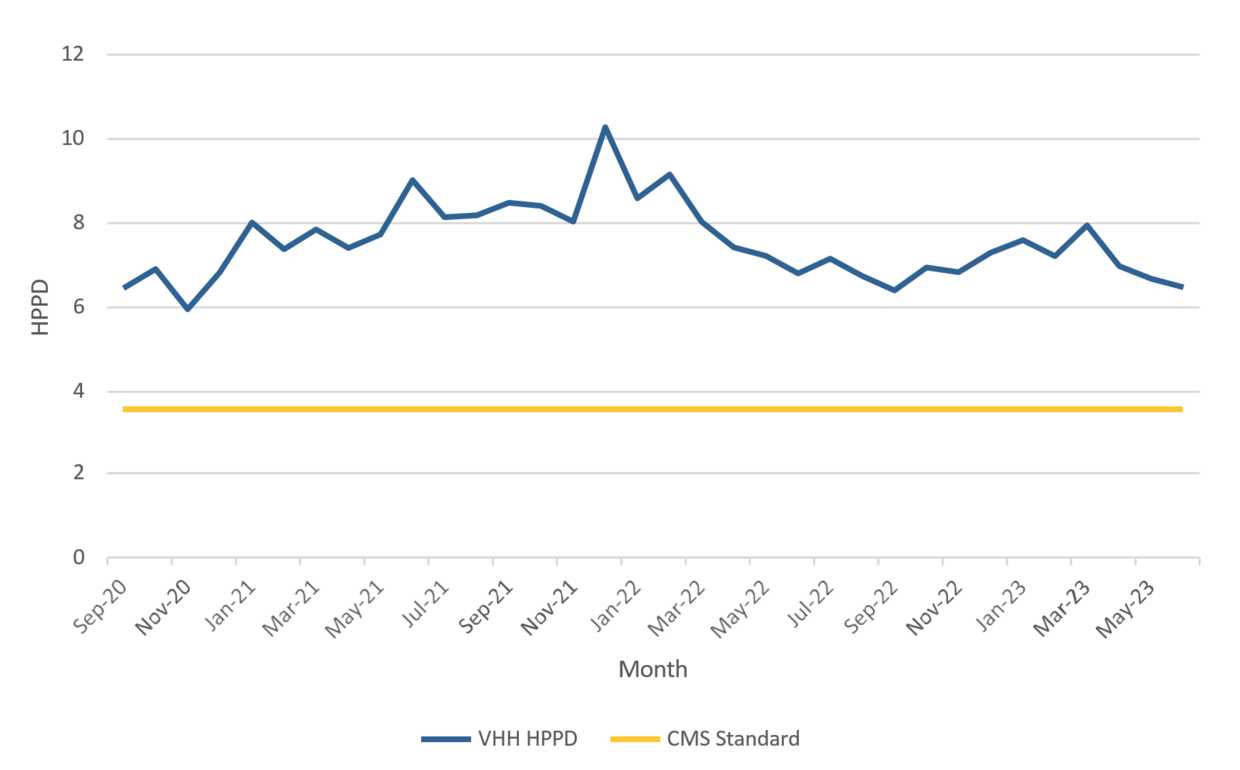
There have been a number of reports including “COVID-19 Outbreak at the Soldiers’ Home in Holyoke” from Mark W. Pearlstein; the Commonwealth’s OIG’s report titled “Holyoke Soldiers Home, May 2016 to February 2020”; and a previous audit (Audit No. 2017-0065-3S), issued December 14, 2017 by the Office of the State Auditor, which all looked into staffing levels at VHH because of multiple complaints of low staffing and concerns about veteran safety. In order to make sure this high-risk concern was addressed, our auditors researched staffing ratios in Massachusetts and other states. In addition, we held several interviews with upper management; nursing staff members; and the director of nursing, who is responsible for scheduling, to understand how VHH staffs each unit and shift. We collected staffing reports, variance reports, and daily rosters for the audit period. After compiling all the documentation, researching regulations, and reviewing past audit reports, we determined that there is a low risk that VHH is not meeting the federal staffing ratios. Below are the average hours per patient day (HPPD)3 by month at VHH compared to the Massachusetts requirements of 3.58 HPPD set forth in Section 150.007(B)(2)(d) of Title 105 of the Code of Massachusetts Regulations (CMR).
Average HPPD by Month
Intentional Rounding
We looked at intentional rounding to examine staffing levels and veteran safety. Intentional rounding is the practice of professional nursing staff checking on veterans regularly throughout the day and providing necessary care. The Journal of Geriatric Medicine reported that intentional rounding reduces falls in long-term care facilities by 36%. In addition, VHH’s NSG-113 Intentional Rounding Policy states the following:
a. Research supports purposeful, scheduled Veteran rounding as a best practice in providing safe, effective Veteran care as it reduces Veteran falls and decreases hospital acquired pressure ulcers. In addition, research shows that overall Veteran experience improves and call light use decreases as Veteran needs are met in a timely manner.
b. Best practice evidence recommends hourly Veteran rounding as an effective process that anticipates Veteran needs and allows those needs to be met in an efficient and timely manner. This proactive approach results in improved Veteran safety and enhances the Veteran experience.
VHH’s NSG-113 Intentional Rounding Policy sets the requirements for the rounding performed by its licensed professional nursing staff members, with the goal of enhancing veteran safety. VHH’s policy acknowledges that intentional rounding enhances veterans’ experiences and quality of life while simultaneously helping to reduce falls and minimize the need for veterans to call for nurses because their needs are met in a timely manner. Intentional rounding requires licensed professional nursing staff to check on veterans’ four Ps, according to VHH’s NSG-113 Intentional Rounding Policy, which are listed as follows:
i. Pain — Does the Veteran have pain?
ii. Personal Needs — Do you need to use the bathroom? Recommend taking the Veteran to the bathroom if condition permits.
iii. Position — Assist Veteran into a new position that is comfortable.
iv. Possessions — Move personal possessions within reach of the Veteran (phone, call light, trash can, water pitcher, over bed table, etc.) and ensure the area is clutter free.
These checks are scheduled every hour between 6:00 am and 10:00 pm and every two hours between 10:00 pm and 6:00 am, during typical sleep time. Professional nursing staff members can increase rounding depending on the veterans’ individual needs. Rounding is documented on VHH’s Intentional Rounding Log at the time the rounds occur by the person who performs them. Intentional Rounding Logs are kept on veterans’ closet doors for easy access.
Incidents/Occurrences
VHH uses its “Admin-041 Incident/Occurrence Report Policy” to report incidents/occurrences that occur during a work shift. According to this policy, “Incident/Occurrence Reporting is a process in which occurrences that affect any person on the premises, including veterans, employees, physicians, visitors, students, or volunteers and are inconsistent with routine facility operation or veteran care are documented.” Some examples of incidents/occurrences include veteran falls, abuse/neglect, medication errors, and missing items.
According to Section I of VHH’s “Admin-041 Incident/Occurrence Report Policy,” the purpose of an incident/occurrence report is:
PURPOSE: To provide accurate and timely documentation of all incidents, to:
- Review and evaluate episodes which are inconsistent with the Soldiers’ Home in Holyoke (SHH) mission or routine operations, as well as those that jeopardize the safety of veterans;
- Improve the safety of veterans and staff;
- Correct isolated untoward events;
- Identify trends and patterns;
- Improve quality of care and Facility operations;
- Provide channels of communication to the Facility administration for legal and risk management purposes;
- Comply with Incident/Occurrence Reporting requirements established by regulatory agencies;
- Review analyze and report sentinel events as required by the Joint Commission (TJC) and the Department of Veteran’s Affairs.
All incidents are to be recorded on an incident/occurrence report and then added to an incident log. A veteran care coordinator or supervisor reviews and signs off on the report. The report is then forwarded to the quality manager, who determines any trends or problem areas that need improvement.
Nurse Training
As a requirement of employment at VHH, nurses are required to maintain appropriate licensure through continued education and training. This helps determine that the staff members in charge of caring for veterans have the required training necessary for their line of work and ensure veteran safety. VHH Safety Fairs are one way the home ensures veteran safety. VHH conducts safety fairs on an annual basis to ensure that nursing staff members receive necessary training. These Safety Fairs cover a wide range of topics, for example, infection prevention, veteran rights, safety of veterans, harassment training, workplace injuries, security, and facility emergencies.
Records Management System
VHH currently uses hardcopy medical records for its veterans. In addition, older records are kept in the health information management system office or at an offsite storage facility after four years.
According to 105 CMR 150.013(C), “all facilities shall maintain a separate, complete, accurate and current clinical record in the facility for each resident from the time of admission to the time of discharge. The record shall contain all medical, nursing and other related data.”
VHH and the Veterans Home at Chelsea entered into a joint contract with a vendor on March 4, 2022 in an effort to make all medical records electronic. The vendor reported to leadership at VHH that, as of May 2024, it had finished scanning medical records at the Veterans Home at Chelsea and had moved to scanning medical documents at VHH.
Emergency Operation Plan
VHH has an emergency operation plan (EOP) that outlines actions to take in case of a manmade or natural disaster or other emergencies that present imminent danger of death or serious physical harm of a veteran. This plan also helps address the medical and physical needs of its staff members and veterans during an emergency. VHH’s EOP establishes the procedures, responses, and infrastructure required to maintain safety for all of VHH’s staff members and veterans. The EOP addresses four phases of its management processes, specifically, mitigation, preparedness, response, and recovery. The EOP was developed by the VHH leadership team and the safety committee, which includes medical staff members and local public safety and emergency management teams (e.g., the local fire department). Each staff member is trained on their specific role and responsibilities during an emergency, which helps VHH staff members provide a safe and dignified response to emergencies. Given the recent tragedy that occurred at Gabriel House in Fall River, in which 10 residents of an assisted-living facility perished in a fire, this topic is especially relevant. There are now increased efforts across Massachusetts to ensure that every assisted living residence is prepared to respond to emergencies and protect residents’ safety.4
COVID-19 Expenditures
In March 2021, the American Rescue Plan Act of 2021 established the Coronavirus State and Local Fiscal Recovery Funds in order to respond to the pandemic and its economic effects. These funds could be used to respond to shortfalls in the budget because of the COVID-19 pandemic. VHH followed spending guidelines from EOHHS. EOHHS had regular check-in meetings with VHH on American Rescue Plan Act funding. Approximately $2.9 million was allocated to VHH and was loaded directly into the Massachusetts Management Accounting and Reporting System. VHH management stated that this funding was spent on standard expenses.
| Date published: | January 14, 2026 |
|---|