
Background
Battery energy storage systems (BESS) are lowering costs and improving energy reliability across the country. These projects yield significant economic benefits by optimizing electric grid operations, reducing the cost of meeting peak demand, avoiding the need for additional transmission and distribution investments, and balancing the electric grid during times when supply and demand are not aligned. BESS are critical to meeting growing electricity demand cleanly and efficiently and reducing greenhouse gas emissions. BESS absorb and store electricity generated by sources like wind and solar, and then discharge that electricity later to meet customer demand. BESS also improve the resilience of the electric grid by continuing to supply power during emergency situations in many circumstances. All of these attributes help ratepayers and the economy at large by reducing electricity costs and improving reliability.
Due to their many benefits, BESS are becoming increasingly common in Massachusetts and around the country. According to the federal U.S. Energy Information Administration, U.S. battery capacity increased 66% in 2024, and is poised to set new records in 2025. Over 80% of new electric generation capacity is expected to come from battery storage and solar, led by states like Texas. This growth creates opportunities for new job growth, investment in manufacturing, and can be a source of increased local property tax revenues in communities where it is deployed.
Most BESS utilize lithium-ion batteries to store energy. Lithium-ion batteries have high energy density, meaning that they pack a lot of power in comparison to their overall volume. This is why they are used for so many consumer devices, such as laptops, phones, electric bikes, and electric vehicles. When used, charged, and stored properly, lithium-ion batteries are safe. In the rare case of a fire or other incident at a BESS, fires can be very difficult to extinguish and can reignite after suppression. Because of this, the Commonwealth has adopted numerous codes, standards and best practices to mitigate the risk of fire-related incidents at BESS installations.
References
- U.S. Energy Information Administration. “U.S. battery capacity increased 66% in 2024.” 2025
- Massachusetts Energy Storage Initiative (ESI) Goals & Storage Target. 2024 ES Target Reports
- NFPA, Energy Storage Systems (ESS) and Solar Safety
- US EPA, Battery Energy Storage Systems: Main Considerations for Safe Installation and Incident Response
Types of Battery Energy Storage Systems
Many types of grid energy storage are commercially available today, each of which have different methods of storing and dispatching energy. Some of these use electrochemical compositions (e.g., lithium-ion, lead-acid, sodium-ion, iron oxide, etc.), while others use thermal (e.g., sensible heat storage, latent heat storage, or thermochemical) or mechanical energy (e.g., pumped hydroelectric, compressed air, gravity-based storage, etc.). Nearly 97% of the energy storage being constructed in Massachusetts today are electrochemical BESS that use lithium-ion batteries. Lithium-ion batteries are a class of energy storage technologies that were first sold starting in the 1990s and have since become ubiquitous in consumer electronics such as mobile phones and laptop computers, electric vehicles, and BESS. Due to the heavy proliferation of lithium-ion batteries, all references to BESS in this document refer to lithium-ion BESS.
References
- 2024 Energy Storage Target Reports
- Nishi, Yoshio. “The Dawn of Lithium-Ion Batteries.” The Electrochemical Society Interface, Vol. 25, Iss. 71 (2016).
Purpose of FAQ
This FAQ is intended to help local decision-makers and community members answer common questions about BESS. Specifically, this FAQ addresses some commonly asked questions about grid connected lithium-ion BESS, with a particular focus on questions pertaining to fire safety, environmental impacts, and public health.
How will my community benefit from a BESS?
Communities across the state host energy infrastructure like BESS, making up our highly reliable electric grid. BESS, in particular, reduce the cost of meeting peak demand, avoiding the need for additional transmission and distribution investments, reducing wholesale energy supply costs, and improving reliability. BESS are critical to meeting and managing growing electricity demand. Unlike other forms of energy infrastructure, BESS do not emit significant pollution, and will ultimately help replace highly polluting peaker plants across the state. Communities may also benefit from added investment from developers through community benefits plans, tax revenue, and jobs to communities.
What can cause a BESS to catch fire?
During normal operation, a battery’s lithium-ion cells charge from and discharge electricity to the grid, which generates a small amount of heat that usually safely dissipates. However, if a battery is overcharged, short circuits, is defective or sustains mechanical damage, the heat may not dissipate and can cause the temperature inside the lithium-ion cells to rise uncontrollably beyond operational limits. This causes what’s known as a thermal runaway fire. There may also still be energy within the BESS after being involved in a fire and this so-called “stranded energy” may cause reignition of the fire hours, days, or weeks later.
Resources:
- Electric Power Research Institute, Insights from EPRI’s Battery Energy Storage Systems (BESS) Failure Incident Database: Analysis of Failure Root Cause, May 2024.
- Energy Storage Systems Safety Fact Sheet, National Fire Protection Association, Published February 2024.
- UL Research Institutes: What Is Thermal Runaway? Published August 24, 2021
- UL Research Institutes: What Causes Thermal Runaway? Published August 20, 2021
What is the likelihood that a BESS catches fire?
Many types of infrastructure, including BESS, come with some degree of risk that a fire incident could occur. BESS related fires are rare if designed with sufficient safety protections and are installed, operated, and maintained in a manner that maintains the system safely — as demonstrated by the many systems currently operating safely. In the Commonwealth today, there are over 6,000 grid connected BESS installations, ranging from residential to large-scale installations, with some BESS having first been installed nearly 10 years ago.
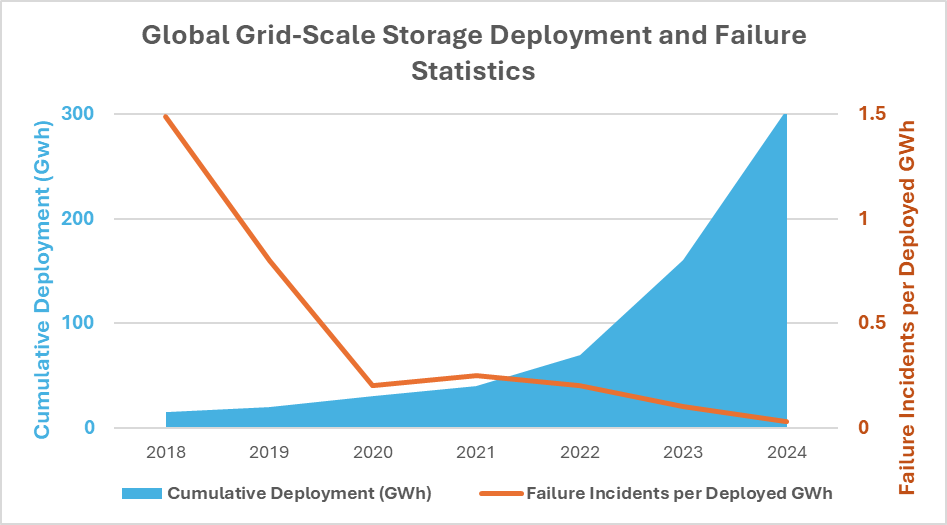
Additionally, data shows the safety record of BESS has improved significantly in recent years as the technology has matured, industry practices have improved and regulatory standards and codes incorporate learnings gained from experience. A comprehensive worldwide analysis by the Electric Power Research Institute found that the failure rate of utility-scale BESS decreased by 98% between 2018 and 2024 while the deployment of BESS greatly increased
Figure 1: Global Grid-Scale BESS Deployment and Failure Statistics
Lessons learned from earlier incidents when the technology was nascent have led to robust requirements and improved industry practices, which today inform the safe siting of BESS and emergency response procedures in the Commonwealth. For example, the Moss Landing facility in California, at which a large indoor BESS fire occurred on January 16, 2025, was designed to be located inside a 1950s era building that previously housed an old power generation facility. The facility was also unique in how it arrayed its battery racks and utilized a less common nickel-manganese cobalt chemistry as opposed to lithium-ion phosphate, which is more common and safer. Such a facility would not be permitted under revised codes and standards that exist today for installations within the Commonwealth.
Resources:
- Electric Power Research Institute, BESS Failure Incident Database. Accessed October 20, 2025.
- Fire & Risk Alliance, LLC and the American Clean Power Association, Assessment of Potential Impacts of Fires at BESS Facilities, 2025.
Are there any codes or standards in Massachusetts to mitigate the risk of fires at BESS installations?
Yes. There are robust standards and codes in place today to which all BESS constructed in Massachusetts must adhere. BESS that are installed, operated, and maintained in accordance with these standards should typically be operated without incident.
In Massachusetts, BESS must comply with 527 CMR 1.00: The Massachusetts Comprehensive Fire Safety Code, which is adopted by the Massachusetts Board of Fire Prevention Regulations (BFPR). This code is consistent with the national model fire code developed by the National Fire Protection Association (NFPA) NFPA 1, but contains some additional Commonwealth-specific standards.
The Massachusetts Comprehensive Fire Safety Code is updated every three years to reflect updates to NFPA 1 and NFPA 855. These updates to the fire code incorporate the latest lessons learned and evidence-based practices for new developments in energy systems such as BESS. It sets comprehensive fire protection criteria for BESS and other energy storage installations based on the technology used, the setting where the system is being installed, the size and separation of the containers or installations, and the fire suppression and control systems in place. NFPA 855 also reflects the current best practice for mitigating the risk of explosions and safely containing fires and applies to all lithium-ion BESS with a capacity larger than 20 kilowatt-hours.
In addition, all BESS constructed in Massachusetts must be listed with a Nationally Recognized Testing Laboratory to UL 9450 (Standard for Energy Storage Systems and Equipment) or an approved equivalent.
- NFPA 1, Fire Code
- NFPA 855, Standard for the Installation of Stationary Energy Storage Systems (2026)
- 527 CMR 1.00: The Massachusetts Comprehensive Fire Safety Code
Do BESS that catch fire emit toxic chemicals into the air?
While fire related BESS incidents are rare, the byproducts released during BESS fires have been found to be largely similar to those released during conventional fires (e.g., house and structure fires) with no contaminant concentrations beyond the immediate fire scene that posed a risk to public health.
Between 85-92% of the gas volume produced in BESS fires has been found to consist of hydrogen (H2), carbon dioxide (CO2), and carbon monoxide (CO). BESS may also emit volatile organic compounds (VOCs), or other trace gases depending on the battery chemistry and overall materials used in the construction of the BESS unit. The state of charge (i.e., how charged a battery is) at the time of a fire is a contributing factor in the proportion of different gases emitted, with a lower state of charge leading to higher CO2 and lower CO emissions, and a higher state of charge leading to the reverse. With these factors in mind, it is important to note that in some situations, unignited gases may create potentially hazardous conditions within and around the BESS room or container.
Air sampling from past BESS incidents across the United States found that no incident had contaminant concentrations beyond the immediate fire scene that posed a public health risk. Studies indicate that emissions are mostly confined to the immediate vicinity of the fire because the ignited gases resulting from a BESS fire become rapidly dispersed and diluted in the air to safe levels. However, the smoke emitted from fire incidents always presents a public health risk for the immediate fire scene and the appropriate emergency response measures should always be followed. In the event of a fire at a BESS facility, nearby residents and businesses should follow all instructions from fire officials, which may involve the evacuation of residents depending upon the scale of the fire, similar to emergency responses for other structural or industrial fires.
- C. Essl et al., “Comprehensive Hazard Analysis of Failing Automotive Lithium-Ion Batteries in Overtemperature Experiments,” Batteries, vol. 6, no. 2, p. 30, May 2020, DOI Foundation.
- Fire & Risk Alliance, LLC and the American Clean Power Association, Assessment of Potential Impacts of Fires at BESS Facilities, 2025.
- Energy Storage Systems Safety Fact Sheet, National Fire Protection Association, Published February 2024.
What emergency response steps are in place if there's a BESS fire?
In the rare case of a fire or other incident at a BESS, there are multiple layers of local, state, and federal emergency response procedures in place to reduce risks to public health, safety, and environment. In the event of a fire or spill at a BESS facility, the local fire department should be called immediately. Depending on the nature of the incident and the capabilities of the local fire department, additional firefighting resources may be required from neighboring communities. The fire response could ultimately require firefighters and apparatus from across the region through the Statewide Fire Mobilization Plan.
After the local fire department has been notified, MassDEP Emergency Response must be notified via the Emergency Response Hot Line (888-304-1133) within 2 hours of a release or spill of hazardous materials that meet MassDEP’s 2-hour reporting thresholds requirements. MassDEP Emergency Response personnel are available 24/7 to respond and help contain and assess spills/releases of oil or hazardous chemicals.
Following a battery fire or other release to the environment, the owner of the BESS is required to hire a Licensed Site Professional/response contractor to implement immediate response actions. As the circumstances require, response actions could include immediate containment or spill cleanup, as well as sampling of nearby soils, surface waters and groundwater for residual contamination. If contamination is found above regulatory limits, then further cleanup is required. If the owner/potentially responsible party is unwilling or unable to hire a contractor, MassDEP has the ability to activate one, and pursue cost recovery from the potentially responsible party. MassDEP also maintains on its website a list of licensed hazardous waste transporters who can provide transport and disposal services. The regulations governing these environmental response measures are known as the Massachusetts Contingency Plan.
Resources:
- Massachusetts Contingency Plan, 310 CMR 40.0000
- MassDEP, Environmental Emergency Response Program
- Massachusetts Statewide Fire Mobilization Plan
- MassDEP, Licensed Hazardous Waste Transporters
Can BESS that catch fire lead to chemicals leaching into the ground or groundwater, including aquifers and drinking water sources?
In past BESS fire incidents where environmental sampling was conducted, water and soil samples did not reveal hazardous contamination levels requiring remediation. Massachusetts regulations will require BESS to be built on pads that allow for the containment of materials preventing them from leaching into the soil below.
Due to the potential of water runoff from firefighting activities in these incidents, the consensus best practice today for response to a BESS fire is to surround the fire with cooling water to prevent the spread of the fire and protect surrounding areas and structures, including trees, brush, and any nearby buildings. In doing so, water is less likely to pick up potential contaminants in any runoff.
Additionally, studies show that the chemical byproducts produced in BESS fires have low water solubility, limiting the potential for groundwater contamination. Across 35 documented large-scale BESS fire incidents in the United States that occurred between 2012 and 2024, there has been no evidence of any air, soil, or water contamination at levels that would pose a public health concern or require further remediation.
Resources:
- Fire & Risk Alliance, LLC and the American Clean Power Association, Assessment of Potential Impacts of Fires at BESS Facilities, 2025.
- Eurofins Calscience, “Water Quality Report: SDG&E Battery Fire,” Sep. 2024.
- New York State Interagency Fire Safety Working Group, “Air, Soil, and Water Data Findings,” NYSERDA, Dec. 2023.
- Electric Power Research Institute (EPRI), The Evolution of Battery Energy Storage Safety Codes and Standards, EPRI White Paper, November 2023.
What rules and standards exist to ensure that a BESS fire does not lead to environmental contamination or endanger public health?
All BESS constructed in Massachusetts must adhere to robust standards and codes. Facilities are required to be listed by a Nationally Recognized Testing Laboratory to UL 9450 (Standard for Energy Storage Systems and Equipment) or an approved equivalent. BESS must also meet NFPA standards and the latest edition of the Massachusetts State Fire Code, which includes emergency operations plans, emergency training, smoke detection systems, fire control and suppression systems, explosion control, spill response measures, enclosure of electrical circuitry within weatherproof enclosures, setback requirements, and recommendations on the use of water as the primary fire suppression agent for BESS fires, among other requirements.
Additionally, BESS must already comply with certain state and local requirements that aim to prevent fire related runoff from affecting the public health and the environment. For example, the Massachusetts Department of Environmental Protection’s (MassDEP) Stormwater Management Standards require measures to control surface water runoff that may contribute to downstream flooding, and that prevent stormwater discharges from causing or contributing to the pollution of surface water and groundwater. For projects proposed on land held by public water systems for drinking water purposes, BESS must be located in a self-containment area so that in the event of a fire, fire extinguishing chemicals will be contained.
Under new draft rules that have been proposed by the Energy Facilities Siting Board (EFSB) and Department of Energy Resources (DOER), all BESS are proposed to be required to provide emergency response plans that must be provided to permitting authorities prior to filing a permit application. In the case of small BESS facilities subject to DOER’s rules, the emergency response plan is proposed to be created in consultation with local fire, police, and emergency management departments.
Resources:
- UL 9540, Energy Storage Systems and Equipment
- UL 9540A, Test Method for Battery Energy Storage Systems (BESS)
- NFPA 1, Fire Code
- NFPA 855, Standard for the Installation of Stationary Energy Storage Systems (2026)
- 527 CMR 1.00: The Massachusetts Comprehensive Fire Safety Code
- MassDEP Drinking Water Program Guideline, Information to be Submitted to MassDEP for Proposed Solar and Wind Energy Projects on Lands Owned or Controlled by Public Water Systems for Drinking Water Purposes, updated April 18, 2018.
- Massachusetts General Law Chapter 131, Section 40 (the Wetlands Protection Act).
- 980 CMR 1.00 through 17.00 (DRAFT). More information available at: EFSB 25-10 - Proposed Rulemaking.
- 225 CMR 29.00 (DRAFT). More information and materials are available at: Clean Energy Siting & Permitting Regulations.
Given the growth of BESS, what more can be done to mitigate the risks of fire, and protect public health and the environment?
The state is adding additional methods of avoiding, minimizing, and mitigating risks associated with fire from BESS, including by updating siting and permitting procedures. Pursuant to Chapter 239 of the Acts of 2024, Massachusetts is currently overhauling its siting and permitting procedures related to clean energy infrastructure, which includes clean energy generation (e.g., solar, wind, and anaerobic digesters), transmission and distribution infrastructure, and BESS. These new rules are currently being established by the Executive Office of Energy and Environmental Affairs (EEA), EFSB, and DOER and must be in place by March 1, 2026. The agencies involved are responsible for developing the following:
- Developing a Site Suitability Methodology and guidance that evaluates the suitability of locations for hosting different types of clean energy infrastructure facilities.
- Establishing regulation that creates procedures for local governments to adhere to when issuing consolidated local permits to Small Clean Energy Infrastructure Facilities, including standard permit conditions for small BESS facilities (i.e., less than 100 MWh).
- Establishing regulations that govern the process of issuing consolidated permits to Large Clean Energy Infrastructure Facilities and some types of Small Clean Energy Infrastructure Facilities, including standard permit conditions for large BESS (i.e., equal to or greater than 100 MWh) facilities.
These new rules will establish additional standards and procedures that help ensure BESS are sited and designed to avoid, minimize, and mitigate any potential public health, environmental, and safety risks. They will also establish standard permit conditions that apply to BESS, which shall be designed to be protective of public health, safety, and the environment.
DOER is also developing a Model Energy Storage Bylaw for municipalities, which will be made publicly available later in 2025.
Through proper project design, siting, and fire management practices, many of which are already largely in place today, the risks to public health and the environment from a BESS fire can be effectively minimized and managed.
Resources:
- Fire & Risk Alliance, LLC and the American Clean Power Association, Assessment of Potential Impacts of Fires at BESS Facilities, 2025.
- 980 CMR 1.00 through 17.00 (DRAFT). More information available at: EFSB 25-10 - Proposed Rulemaking.
- 225 CMR 29.00 (DRAFT). More information and materials are available at: Clean Energy Siting & Permitting Regulations.
- EEA Site Suitability Guidance (DRAFT). More information is available at: Energy Infrastructure Siting and Permitting Reforms.