

The DRRF was established by Massachusetts General Law c. 29 § 2HHHHHH to ensure the Commonwealth has readily available resources to respond to natural disasters such as floods, severe storms, tornadoes, hurricanes, and other qualifying events.
The DRRF is administered by the Executive Office for Administration and Finance (A&F) in collaboration with the Massachusetts Emergency Management Agency (MEMA), the Executive Office of Economic Development (EOED), the Office of Climate Innovation and Resilience (OCIR), the Executive Office of Public Safety and Security (EOPSS), and other state partners.
The framework for the Fund reflects extensive coordination across state agencies to support recovery while also encouraging investments that reduce future disaster risk.
Why Was the DRRF Created?
Massachusetts continues to face increasing costs from severe weather and other disasters. While federal programs and private insurance play an important role in disaster recovery, assistance is not always available or sufficient.
The DRRF was established to help address these gaps by providing a state-level resource that can support recovery and strengthen resilience when disasters occur.
The Fund is intended to:
- Fill gaps in federal disaster assistance.
- Maximize the impact of existing recovery resources, including federal programs and private insurance.
- Support investments that improve resilience and reduce future disaster risk.
Funding
The DRRF was initially funded with a $14 million appropriation. Additional deposits have been appropriated and proposed over time to build the Fund's capacity to respond to future disasters.
Regulations, Guidance, and Public Comment
The DRRF is administered pursuant to regulations and program guidance issued by A&F.
Current Documents
Emergency Regulations and Rulemaking Process
On July 29, 2026, A&F issued emergency regulations to implement the DRRF. Under Massachusetts law, emergency regulations remain in effect for 90 days. During this period, A&F will undertake the formal rulemaking process required to adopt permanent regulations. A public hearing will be held as part of this process.
Verbal and written testimony may be presented at the public hearing; however, parties are requested to provide written copies of their oral testimony. Written comments will be accepted beginning Wednesday, August 26, 2026 at 2:00 pm and continue until 5:00 pm on Friday, August 28, 2026.
Any person requesting to comment orally on the proposed regulation at the virtual hearing must submit to anf.regs@mass.gov a Notice of Intent to Comment no later than Tuesday, August 25, 2026, at 5:00 pm. Any other person requesting to attend the hearing must register at anf.regs@mass.gov no later than 12:00 pm on Tuesday, August 25, 2026. All notices or requests must include the person’s name, telephone number, and email address. An email with instructions for joining the hearing will be sent on the afternoon of Tuesday, August 25, 2026, no later than 5:00 pm.
How the DRRF Works
When Can the Fund be Activated?
The DRRF is intended to support larger-scale disasters that affect multiple communities and exceed local response capacity, particularly when federal disaster assistance is unavailable or insufficient.
Specific activation criteria are established in regulation.
How Do Communities Become Eligible?
There is no separate DRRF application process. Following a qualifying disaster, affected communities should participate in MEMA's Initial Damage Assessment (IDA) process. Information collected through that process will be used to determine eligibility and calculate assistance under the DRRF.
A&F may request additional information when necessary.
For information about disaster reporting, damage assessments, and disaster recovery resources, visit MEMA's website at this link.
Future Program Development
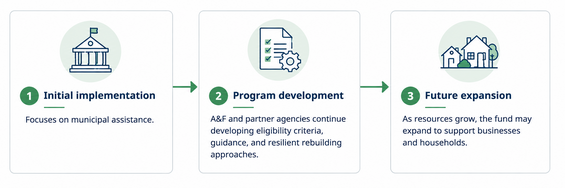
The initial implementation of the DRRF focuses on municipal assistance.
Given the Fund's current balance and anticipated funding levels over the next several years, A&F and its partner agencies are prioritizing municipal recovery and infrastructure needs during the program's initial phase.
As the Fund grows and additional resources become available, the Commonwealth intends to expand implementation to include assistance for businesses and households.
During this period, A&F and its partner agencies will continue developing eligibility criteria, program guidance, and approaches that encourage resilient rebuilding and reduce future disaster risk.
Additional information will be posted as program development continues.
Other Disaster Recovery and Resiliency Resources
The DRRF is one of several tools available to support disaster recovery, preparedness, and long-term resilience across Massachusetts.
Different programs serve different purposes. Some provide assistance following disasters, while others support planning, infrastructure improvements, hazard mitigation, climate adaptation, economic recovery, or emergency preparedness. Eligibility also varies by program, with some resources available primarily to municipalities and public entities, while others may be available to businesses, nonprofit organizations, farms, or residents.
Additional resources include:
- Environment & Climate One Stop – Centralized access to grants and technical assistance programs administered by EEA and its agencies.
- MassDOT Grant Central – Transportation and infrastructure funding opportunities, including support for roads, bridges, culverts, and related projects.
- Municipal Vulnerability Preparedness (MVP) Program– Municipal planning and project funding to improve resilience to climate impacts.
- Executive Office of Economic Development Infrastructure Programs and Grants – Programs supporting economic development, business growth, and community recovery.
Applicants are encouraged to review these resources, as they may provide assistance that complements or exceeds what is available through the DRRF depending on the circumstances of a particular project or disaster.
For further questions, please write to contactanf@mass.gov.