
The Challenge
Forested ecosystems will experience heightened stress from increased temperatures and intense precipitation events that may diminish their carbon sequestration and storage, as well as impact their water filtration abilities. Soils will be impacted by warmer winters and increased precipitation. Adding to these stressors are forest regeneration failures compounded by land use changes, increasing deer and moose browse, competition with invasive species, and forest fragmentation that will continue to impede the movement of species. Having a better understanding of soil health is imperative to inform resilience actions to support our forest ecosystems.
Project Alignment with ResilientMass Plan Priority Actions
The project addresses 2023 ResilientMass Plan and 2022 MA Climate Assessment Priority Impacts: Forest Health Degradation and Loss of biodiversity, habitats, and native species due to climate change impacts in the Natural Resources Sector.
The project also aligns with the following 2023 ResilientMass Plan goals:
- Science-based and Informed Decision-Making
- Resilient State Assets and Services
- Implement Adaptation Actions for Communities and Ecosystems
- Climate mitigation
- Resilient and Equitable Infrastructure, Ecosystems, and Communities
Climate Resilience Project Scope
The DCR’s Division of State Parks and Recreation (DSPR) has operated a Continuous Forest Inventory (CFI) program since the late 1950s, collecting data on above-ground vegetation. This project would increase the capacity of DSPR to include observations and measurements of soil physical and chemical properties in the CFI program. Soil physical and chemical properties are influenced by our changing climate, human activities, and the forests growing on them; and in turn exhibit tremendous influence on those forests. Yet, because of their extent and nature, relatively little data exist on their status and trends compared to the forest ecosystem above ground. This project would build capacity by designing a sampling plan, acquiring supplies and equipment, processing and analyzing samples, and storing data. Results would help identify how physical properties like bulk density, litter and duff depth, and particle size distribution; and how chemical properties like pH, cation exchange capacity, and organic matter and carbon, interact with forest stressors, disturbance, and succession. Results will be used to develop core forest science relevant to Massachusetts, tailor management actions to promote forest resilience based on soil and vegetation properties, and in decision support tools to prioritize strategic actions and active and passive management actions.
Funding was only received for this project in FY25, making it year 1 of a 5-year project. In FY25, DCR was able to:
- Design the Soils CFI program in a way that would be able to be sustained with anticipated subsequent ResilientMass funding.
- Secure a partnership with UMass via an ISA to procure laboratory equipment and personnel to support soil sampling processing.
The ISA between UMass and DCR stipulated that UMass would: secure equipment necessary for the field work; assist with development of the sampling and data analysis plan including a way to collect and manage data consistent with other databases on soil and forest properties; identify key staff resources for multi-year project and hire as needed (e.g., post-docs, research assistants); develop an understanding of the key datasets and variable space needed to model relationships between soil properties and forest growth that guide management decisions; collect and analyze soil samples; and develop and implement a messaging and outreach plan around data and models.
The ISA was signed close to the end of FY25.
In FY26 this project was not funded as expected. DCR cannot carry out this project without this support. Project remains paused until alternative sources can be identified or ResilientMass funding becomes available in future years. DCR does not have alternative sources of funding for this project.
Metrics and Results
FY25 was year 1 of this project. Year 1 metrics included devising the program’s framework for expansion of the CFI project to take on soil sampling and securing the necessary equipment. Both goals were achieved.
DCR designed the program in a way that would have been sustainable with ResilientMass funding and sought a partnership with UMass to procure equipment and capacity that would have been too cost-prohibitive for DCR to pursue on its own. The partnership with UMass would allow DCR to carry out this project in the most efficient and cost-effective way. However, this project did not receive year-2 funding in FY26. Therefore, no actual soil sampling collection and processing will take place unless additional funding is identified. DCR does not have alternative sources of funding for this project outside ResilientMass.
If the project were to be carried out as scoped and included in the ResilientMass Plan, the following metrics could be procured:
- Number of scheduled plots visited to collect soils data,
- Number of samples successfully collected,
- Number of samples successfully processed,
- Number of management practices prioritized/recommended.
Additionally, the following ResilientMass Metrics would be aligned with the project:
- Metric 106 (# of jobs supporting climate resilience (e.g. jobs specific to climate adaptation research, development, and product manufacturing, and adaptation equity, etc.) (direct, indirect, and induced))
- Metric 107 ($ of state funding for projects that include implementing nature-based solutions (NbS) for resilience)
- Metric 205 (Total resilience investment)
- Metric 185 (Carbon stored in vs. carbon lost from inland wetlands)
- Metric 190 (# of resilience projects focused on nutrient management (e.g., Cape Cod Nutrient Management Plan, CZM Nonpoint Source Pollution Grants))
- Metric 193 (Carbon stored in vs. carbon lost from coastal wetlands)
- Metric 196 (% of working forest land using climate-smart management practices)
- Metric 200 (Progress toward state biodiversity goals for forest and other terrestrial species (Phase, state of completion))
- Metric 201 (Carbon stored in vs. carbon lost from forests)
DCR does not yet know where data were collected or which sample locations actually align with the needs of DCRS. DCR does not have a complete set of its own sampling equipment and paid for lab equipment purchased and owned by a third party; and no staff with institutional knowledge of the project were able to be fully trained or retained.
Best Practices and Lessons Learned
- Support needs to be in place to successfully implement projects: Procurement, staffing, and material support all need to be in place prior to successful implementation.
- The third-party ISA was a cost-effective and efficient way for DCR to gain access to cost-prohibitive lab equipment, but it also left DCR with less control over the overall project goals. Investment should be made in building state agency capacity especially in areas like this, where the structure of private and non-profit land management limits capacity.
- Stability of funding is critical to conduct long-term research and development, especially on natural resources. This program may not have been the best fit for this ResilientMass funding without further exploration of alternative sources of funding to support future years.
Further Action
Without funding and process support, no additional work can continue on this endeavor.
Additional Information and Resources
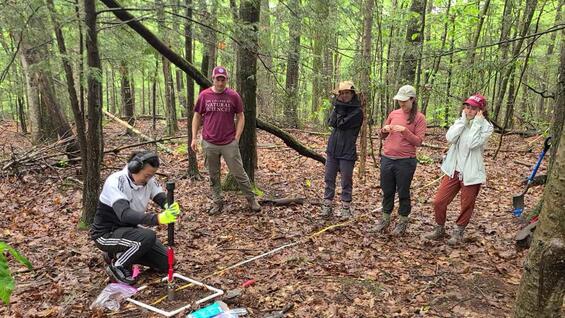
Figure 1. Project team during field data collection trials, Mount Holyoke Range State Park, June 18, 2025.
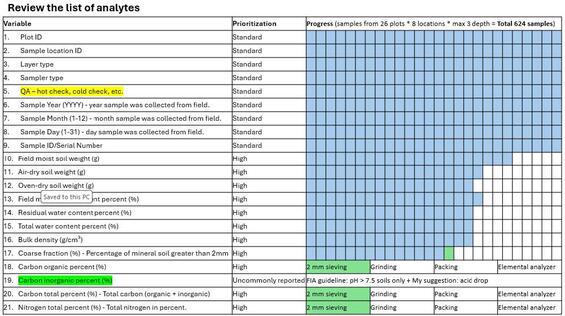
Table 1. Sample list of analytes and progress report dated 13 August 2025. Prepared by Jin Ho Lee.