
Overview
MSA did not facilitate coordination or promote standardization of programs and services across sheriffs’ offices. MSA has not taken sufficient steps to fulfill this aspect of its mission. Specifically, it has not facilitated discussions among sheriffs’ offices offering similar programs, nor has it worked to promote standardization or share best practices. As a result, opportunities to improve the consistency, equity, and quality of sheriff office–operated programs and services may have been missed.
We analyzed program data reported by sheriffs’ offices for calendar years 2023 and 2024 and found variation in how programs with similarly stated objectives are reportedly implemented across sheriffs’ offices. Specifically, some programs differed in intensity, duration, and requirements for staff member licensure or certification, indicating a lack of standardization.
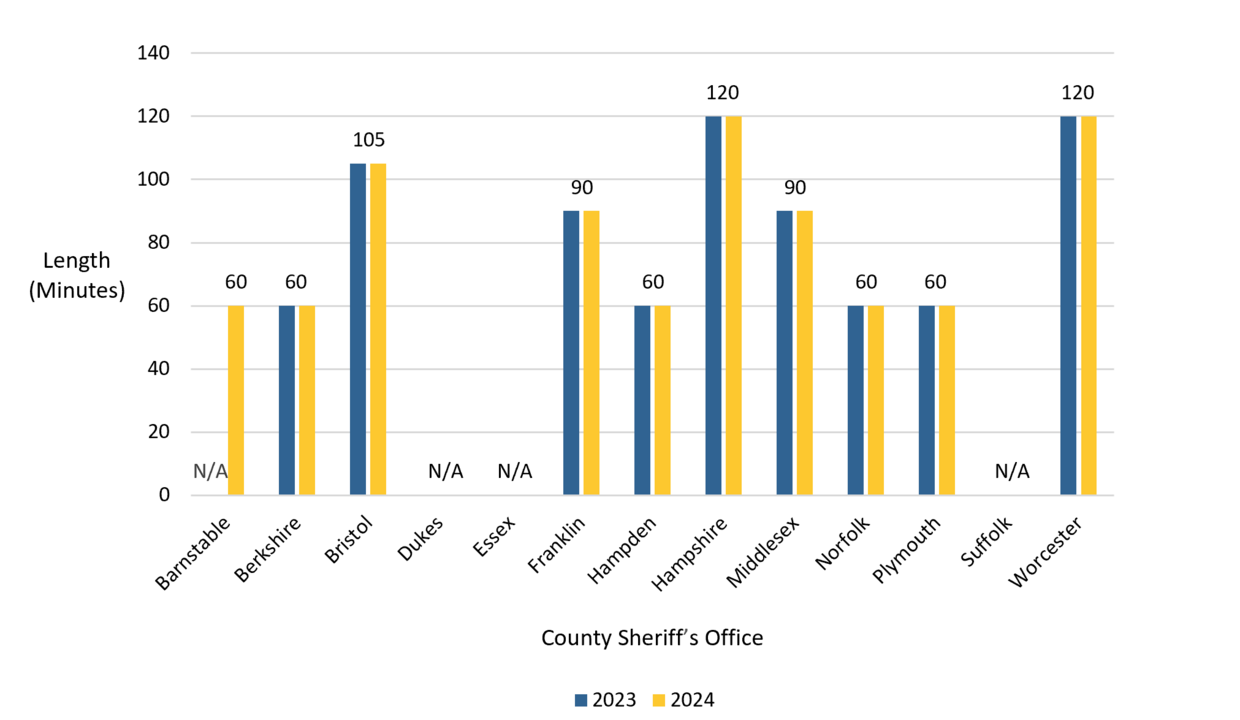
As one example, high school equivalency programs showed inconsistencies in several key areas. First, session length varied across sheriffs’ offices and between years. In 2023, four sheriffs’ offices offered sessions lasting 60 minutes, five sheriffs’ offices provided sessions longer than 60 minutes, and four sheriffs’ offices did not report session lengths. In 2024, five sheriffs’ offices reported 60-minute sessions, five sheriffs’ offices reported sessions longer than 60 minutes, and three sheriffs’ offices did not provide this information.
The graph below displays the intensity of the different high school equivalency programs, measured by the length (in minutes) of each program’s single session, as reported by each sheriff’s office in calendar years 2023 and 2024. The county sheriffs’ offices of Barnstable, Dukes, Essex, and Suffolk did not report any data for the programs that we reviewed for calendar year 2023, and Dukes, Essex, and Suffolk did not report any data for the programs we reviewed for calendar year 2024.
High School Equivalency Program Session Length by County Sheriff’s Office*
* An entry of N/A indicates that the sheriff’s office in question did not report session length data for this program in its report to MSA.
The high school equivalency programs that we reviewed also showed inconsistency in their overall, program-long duration. For instance, one sheriff’s office program lasted 12 weeks, a separate one ran for half a year, and three others required 36, 50, and 52 weeks to complete. These wide differences suggest that there is no standard approach to how long participants are expected to remain in the program, and that the quality of service offered to inmates may vary significantly based on where they are incarcerated.
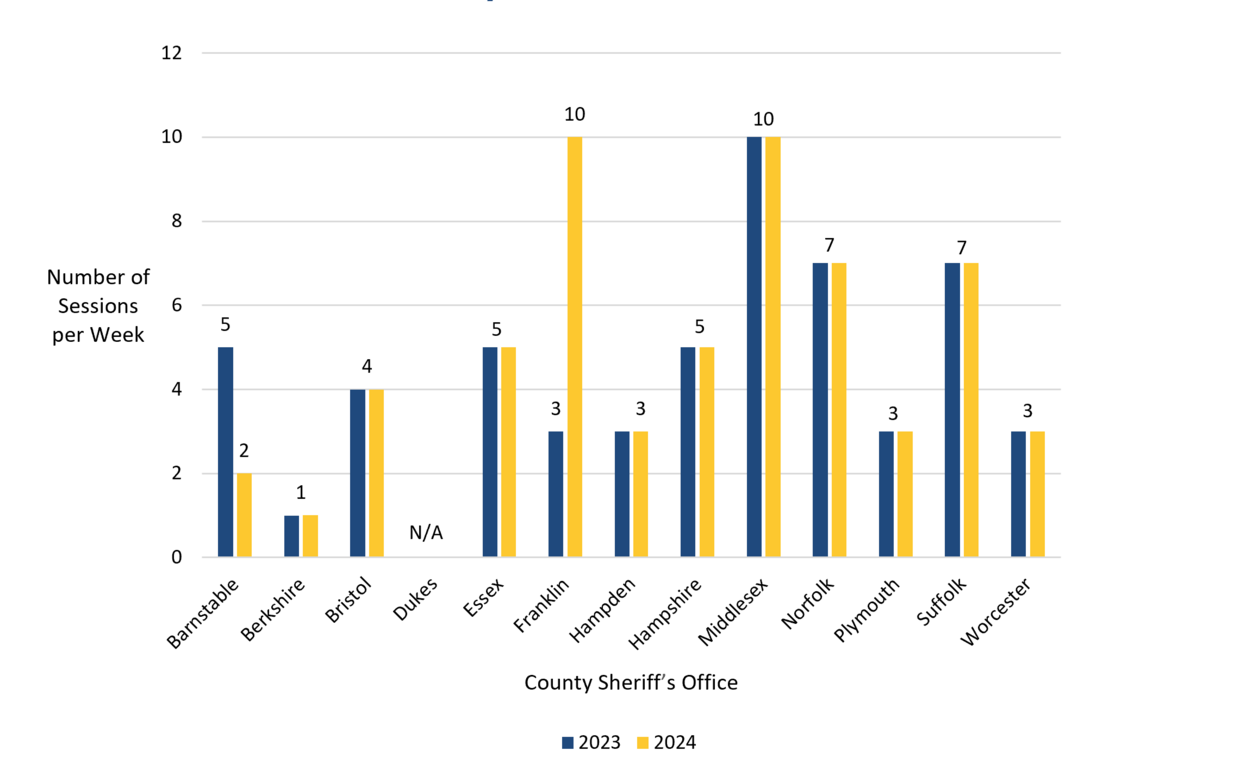
Additionally, the frequency of sessions offered varied significantly over time for individual sheriffs’ offices. In 2023 and 2024, high school equivalency programs were offered anywhere between 1 and 10 times per week. Some sheriffs’ offices maintained consistent schedules from one year to the next, while others either scaled back how often they were offered (such as from five times per week to two) or increased frequency (such as from three times per week to ten). We found that for certain programs, it was unclear how many sessions inmates were required to attend within a week in order to complete a program.
The graph below displays the session frequency of high school equivalency programs for 2023 and 2024 by sheriffs’ office, measured by the number of sessions held each week by each program.
High School Equivalency Program Session Frequency by County Sheriff’s Office*
* An entry of N/A indicates that the sheriff’s office in question did not report session length data for this program in its report to MSA.
There were also inconsistencies in teacher licensing requirements for the high school equivalency programs across sheriffs’ offices. Some sheriffs’ offices required instructors to have a teaching license, while others did not.
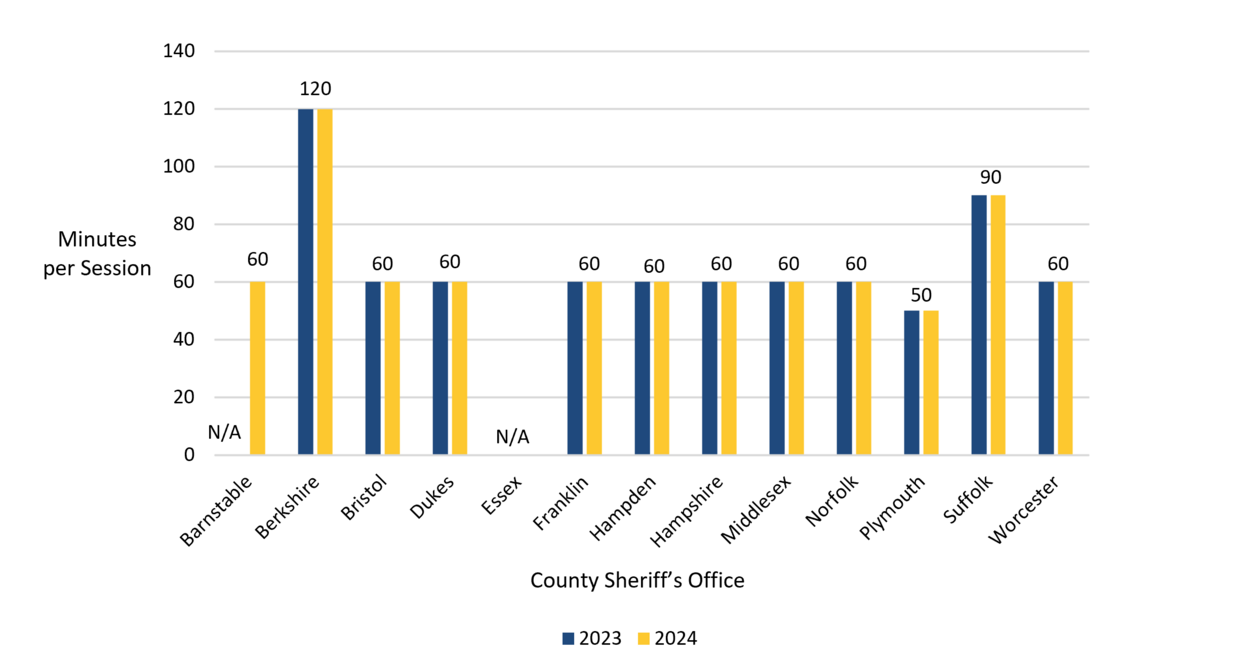
The alcohol recovery program was also offered by all sheriffs’ offices as part of their behavioral and mental health programming. These programs similarly showed variations in both session length and frequency across sheriffs’ offices. In 2023, one sheriff’s office offered a 50-minute session, eight offered 60-minute sessions, two provided sessions lasting 90 and 120 minutes, and two did not report session durations. In 2024, the only change from the 2023 data was that one sheriff’s office, which previously did not report session lengths, reported offering 60-minute sessions.
In terms of frequency, sheriffs’ offices varied in how often the alcohol recovery program met, ranging from one to four sessions per week. One sheriff’s office did not provide information on session frequency.
The graph below displays the intensity of the different alcohol recovery programs, measured by the length (in minutes) of each program’s single session, as reported by each sheriff’s office in 2023 and 2024.
Alcohol Recovery Program Session Length by County Sheriff’s Office*
* An entry of N/A indicates that the sheriff’s office in question did not report session length data for this program in its report to MSA.
These inconsistencies indicate a lack of standardization across sheriffs’ offices in delivering programs with similar objectives. Without uniform expectations for program delivery, duration, and staff member qualifications, it becomes difficult to assess program effectiveness, ensure equitable access, or make meaningful comparisons across jurisdictions. Inconsistent service levels create inequities in the state services administered by each sheriff’s office, meaning that some inmates may receive more or less, better or worse service based on the county in which they are incarcerated. Inconsistent data also compromises the reliability of the Programs, Services, Interventions, and Reinvestments (PSI) Matrix as a tool for oversight and decision-making.
Authoritative Guidance
Although MSA is not mandated to oversee how individual sheriffs’ offices implement programs and services, this oversight plays a key role in supporting collaboration and identifying best practices across counties; therefore, oversight is vital to MSA’s effective execution of its responsibilities.
The Commonwealth’s approved budget line item 8910-7110—Massachusetts Sheriffs’ Association Main Appropriation. for fiscal years 2023 and 2024 states,
For the operation of the Massachusetts Sheriffs Association, Inc.; provided, that the sheriffs shall appoint persons to serve as executive director, assistant executive director, research director and other staff positions as necessary for the coordination and standardization of services and programs [emphasis added], the collection and analysis of data related to incarceration, recidivism and generation of reports, [and] technical assistance and training to ensure standardization in organization, operations and procedures.
Reasons for Issue
According to MSA officials, they do not interpret either the language of their budget line item or their statutory role as requiring them to standardize how programs and services are implemented across sheriffs’ offices. Instead, they stated that their focus on “standardization” refers primarily to the development of standardized reports, consistency in data collection, and internal reporting practices for legislative purposes.
MSA officials further noted that each sheriff’s office operates within a unique, local context and may implement programs differently based on the specific needs and resources of their community. They emphasized that decisions around how services and programs are implemented fall outside the scope of MSA’s responsibilities.
Recommendations
- MSA should facilitate conversations among the county sheriffs’ offices to identify and develop best practices for administering programs that are similar in nature. This collaborative approach would help promote consistency, improve program quality, and support the development of a more uniform and reliable PSI Matrix.
- MSA should enhance data validation procedures to ensure complete and consistent reporting across all county sheriffs’ offices, with periodic reviews conducted to monitor compliance and effectiveness.
Auditee’s Response
The Massachusetts Sheriffs’ Association (MSA) welcomes the audit recommendations with regard to facilitating increased coordination in promotion of standardized delivery of programming across MSA member agencies. The MSA serves as a liaison between its member Offices and the legislature, government agencies and strategic partners. This role requires the MSA to serve in an advisory support capacity to the MSA member agencies, conveying changes in law, policy, and regulations to support consistency in meeting legislative priorities and mandates.
The MSA regularly and consistently convenes working groups and committees to create and deploy programming objectives and to refine data collection efforts. In furtherance of that objective, the MSA will initiate additional working sessions with representatives from the Sheriffs’ Offices. These sessions will focus on identifying commonalities in program administration, surfacing best practices, aligning methodologies, and developing a shared framework for similar programs. The goal is to establish a more consistent and reliable Programming, Services, Interventions & Reinvestments (PSI) Matrix across the Sheriff’s Offices.
It should be noted that the legislative mandate for each Sheriff’s Office is to provide a yearly listing of the programs provided at each facility. Understanding that each independent and elected Sheriff’s Office provides so much more than just programming to the incarcerated population, the MSA worked to create the PSI Matrix, designed to highlight the additional programs, services, interventions and community reinvestments for each of the Offices above and beyond any and all statutory requirements. The goal of the MSA with the PSI Matrix was never to standardize all of the programs, services, interventions and community reinvestments for each of the Sheriff’s Offices, but rather to highlight the expansive work being done by the Sheriffs. With full appreciation for the MSA’s mandate, the MSA will work with each of the Sheriff’s Offices to identify key programming as chosen by the Sheriffs collectively to ensure consistency and standardization to fulfill the requirement of the MSA’s line item.
In addition, many of the programs, services and interventions are provided by outside partners and their curriculum deployment may vary depending on the provider. While acknowledging these variances in curriculum delivery, the MSA and the Sheriffs are collectively committed to the standardization and consistency of key identified programs identified and chosen by the Sheriffs as priorities.
To ensure complete and consistent data reporting, the MSA will implement enhanced validation protocols to include:
- Standardizing data submission formats.
- Introduction of automated checks for completeness and accuracy.
- Implementing quarterly audits to monitor compliance and flag discrepancies.
- Facilitate feedback and support to agencies to ensure consistency and fidelity of reporting goals
These steps are designed to promote transparency, improve program quality, and ensure that the PSI Matrix reflects accurate and comparable data across jurisdictions.
Auditor’s Reply
Based on its response, MSA is taking measures to address our concerns regarding this matter. As part of our post-audit review process, we will follow up on this matter in approximately six months.
| Date published: | November 26, 2025 |
|---|