
I. Introduction
A. Purpose and Scope of the Guide
This is a guide for people involved in a case at the Division of Administrative Law Appeals, also called DALA, who don’t have a lawyer. When you don’t have a lawyer, you are said to be representing yourself. In this guide, people who represent themselves are called “self- represented litigants.”
If you represent yourself, you will still be required to follow DALA’s procedures and applicable law. This guide will help you understand how to do that, but it is not a substitute for legal advice. Although DALA staff may give you general information about rules and procedures, they cannot give you legal advice, help you interpret or apply rules, or otherwise participate in a hearing on your behalf.
This guide is intended to provide general information. It is not possible to cover every situation that might arise. Also, if there is any conflict between this guide and the applicable laws or rules, those laws or rules control.
We will begin with some general information about DALA and hearings.
B. What Is the Division of Administrative Law Appeals?
The Division of Administrative Law Appeals, also called DALA, is a Massachusetts state agency that hears and decides legal disputes between individuals (or organizations) and other state or local agencies. If a person, business or other organization disagrees with a decision made by a state or local agency, they may be able to challenge it by filing a case with DALA.
DALA is not part of the agency whose decision you’re challenging. It is an independent agency, and the person who hears your case—the magistrate—is a neutral decision-maker.
C. What Is a Magistrate at DALA?
A magistrate is a neutral decision-maker, which means they do not take sides and they make decisions based only on the facts and the law.
Every case is assigned to a magistrate who manages all parts of the case, such as setting deadlines, holding conferences, and issuing written orders. If your case goes to a full evidentiary hearing, the magistrate conducts the hearing, listens to the evidence and arguments, and in most cases, writes a decision to determine whether a party’s challenge is successful under the law. All DALA magistrates are licensed Massachusetts attorneys.
D. May I Call a Magistrate to Discuss My Case?
No. Communicating with a magistrate without the lawyer for the state agency being part of the communication is called “ex parte communication.” By law, the magistrate may not talk to you about your case unless all the parties are participating in the discussion. The magistrate may not talk to the agency’s lawyer without you, either.
E. What Are Cases at DALA Like?
Although DALA’s name includes the word “appeals,” the agency is more like a trial court than an appeals court. Parties may file motions, conduct discovery, subpoena evidence, and participate in evidentiary hearings where they may present witnesses and other relevant evidence. (These terms are defined in the glossary at the end of this guide.)
The individual, agency or organization that initiates a case before DALA is referred to as the petitioner—similar to a plaintiff in a civil lawsuit. The opposing party is the respondent, analogous to a defendant in civil litigation.
Each case is assigned to an impartial administrative magistrate, who oversees the proceedings—from prehearing conferences and motion rulings to managing discovery, conducting the evidentiary hearing, and issuing the written decision. The magistrate’s final decision is binding on the parties and, depending on the case type, the decision may be appealed to another agency or to the Massachusetts Superior Court.
Cases before the DALA may resolve in several ways: through settlement, withdrawal, dismissal, summary decision, or a written decision following an evidentiary hearing. For example, cases may be dismissed on procedural grounds, such as the failure to meet a statutory filing deadline. Others may be resolved through summary decision, which—like summary judgment in civil litigation—is appropriate when there are no genuine issues of material fact and the case can be decided as a matter of law. If a case proceeds to a full evidentiary hearing, the assigned magistrate will issue a written decision based on the evidence presented and the applicable law.
F. What Is a Hearing?
A hearing is like a trial. Both you and the agency can present evidence to the magistrate, who will make findings of fact and conclusions of law. The hearing is your opportunity to present your case and tell your side of the story. Before the hearing, you will be required to give the magistrate and the other party information about the witnesses you plan to call to the hearing and copies of the documents you plan to rely on. You should also bring extra copies of your documents with you to the hearing so that you can show them to witnesses.
G. Where Will the Hearing Take Place?
Most hearings are held at DALA’s Malden office, which is located at 14 Summer Street, 4th floor, Malden, MA 02148. However, virtual options are also available. See the section Where Will My Hearing Be Held?
II. Accessibility
| Jump Links: Accessibility | ||||
|---|---|---|---|---|
| What if I need an interpreter | Will the Hearing Room Be Accessible to People with Disabilities | |||
A. What If I Need an Interpreter?
If English is not your primary language, we may be able to provide assistance. To request language assistance, please email LanguageAssistDALA@mass.gov.
Upon request, DALA may also be able to help translate documents.
B. Will the Hearing Room Be Accessible to People with Disabilities?
Yes. All hearing rooms at DALA are accessible to people with disabilities in accordance with the Americans with Disabilities Act (ADA). However, if you will need special accommodations, please contact DALA using DALApleadings@mass.gov or (781) 397-4700 as soon as possible.
III. Filing Documents with DALA
A. Filing Documents
There are four ways to file documents at DALA—by mail, by hand delivery, by email, or by fax.
Be sure to include the name of the case and your docket number on all your filings. Both the name of your case and your docket number can be found on the first page of the notice of receipt of appeal you received. A case name includes the party appealing the decision and the party responding to the appeal (i.e., Smith v. Agency). A docket number is a sequence of letters and numbers that is special to your case (i.e., AA-00-000).
Unless the magistrate asks for a duplicate copy, file documents only once. If you file by fax or email, for example, do not send another copy by mail or in person unless the magistrate asks for it.
You must send copies of all filings to all other parties, and include a “certificate of service” confirming that you have done so. See the section You Must Give Documents to the Other Party.
B. Filing Confidential Documents
You must remove or obscure the following information from documents before you file them in a proceeding that is open to the public: any government-issued identification numbers; any parent’s birth surnames, if identified as such; any financial account numbers; and any credit card numbers. Additional details about these instructions appear in the “notice regarding public access and confidentiality” that you received from DALA along with the notice of receipt of appeal.
Removing or obscuring specific information from a document is called redaction. Sometimes, an entire document should be confidential. If a document needs to be filed, but is also confidential, it should be filed “under seal” and marked as confidential. Do not file confidential documents by fax. The magistrate may provide additional, case-specific instructions about filing confidential documents and information.
C. Filing by Mail
If you want to file your document by mail, please mail it to:
Division of Administrative Law Appeals
14 Summer Street, 4th Floor
Malden, MA 02148
Your document must be in the mail and postmarked by the due date.
D. Filing by Hand Delivery
If you want to file your document in person, you may deliver it to:
Division of Administrative Law Appeals
14 Summer Street, 4th Floor
Malden, MA 02148
E. Filing by Email
If you want to file your document by email, please send it to DALApleadings@mass.gov.
F. Filing by Fax
If you want to file your document by fax, please use (781) 397-4720.
G. You Must Give Documents to the Other Party
The same day you file a document with DALA, you must deliver, or “serve,” a copy of what you are filing to every party involved in your case. The other party will generally be a state agency. Deliver the agency’s copy to the agency’s lawyer, not to anyone else you may have dealt with at the agency. The name of the lawyer will be on the notice of receipt of appeal you received.
If you aren’t sure of a party’s or attorney’s address, you can ask DALA at DALApleadings@mass.gov or (781) 397-4700.
When you file a document with DALA, you must include a statement that you have given that document to all the other parties. This is called a “certificate of service,” and it is usually found after your signature.
Here is an example:
1. Certificate of Service
I, [your name], certify that on [date], I sent a copy of [document title] to [name of party’s representative] by [mail at their address or email at emailaddress@email.com].
H. What Happens if I Forget to Include a Certificate of Service on a Filing?
If you do not include a certificate of service, DALA may decline to consider your filing.
IV. The Progress of a Case at DALA
A. Filing an Appeal
When a state agency makes a decision that you want to appeal (challenge), the agency usually explains in writing, along with the decision, how to appeal.
If the state agency does not explain how to appeal, contact the agency and ask.
Follow the rules presented by the agency (such as sending the appeal to the right place) and meet the deadline for an appeal. Otherwise, your case could be over before you appeal it. In many types of cases, DALA has no legal authority to extend your deadline to file an appeal even if you are delayed for reasons that you cannot control and that are not your fault.
At a minimum, your appeal should list your name and address, should state that you are appealing a particular agency decision, and should include a copy of that decision. It is useful but not always required for you to include a more detailed description of the reasons for your appeal.
B. Rules and Laws
Cases before DALA are governed by the Massachusetts Administrative Procedures Act, General Laws chapter 30A.
Other applicable rules appear in the Standard Adjudicatory Rules of Practice and Procedure, 801 Code of Massachusetts Regulations chapter 1.00, which include a set of Formal Rules (section 1.01) and a set of Informal/Fair Hearing Rules (section 1.02). The notice of receipt of appeal you received will specify whether your case is governed by the Formal Rules or by the Informal/Fair Hearing Rules.
Each case will also be governed by a set of substantive statutes, regulations, and precedents, which will depend on the subject matter of the case. Some DALA decisions, which include discussions of various pertinent areas of the law, are collected online: Search all General Jurisdiction Decisions. Other DALA decisions are collected in the databases maintained by the Social Law Library, which can be accessed from any Massachusetts public library (among other locations).
C. Notice of Receipt of Appeal
After you submit your appeal to DALA, you will receive a written notice of receipt of appeal. The notice of receipt of appeal provides you with the rules and logistics relevant to your case (such as the requirement that you must give DALA your current contact information and information about how to file documents with DALA).
You may be asked to take additional steps before your case moves forward. Common next steps include:
- Responding to an order to show cause if it appears that your appeal may have a legal or procedural problem (for example, if it was filed late). This means you must send the magistrate and the other parties a written response explaining why your appeal should still be allowed to go forward. If you do not respond, or if the magistrate determines that your response is not legally sufficient, the appeal may be dismissed.
- Submitting written arguments and evidence if the case can be decided without a hearing. See the section Resolving a Case Without a Hearing.
- Attending a pre-hearing conference to discuss the issues, schedule, deadlines, procedures, and potential settlement. See the section Prehearing Conference.
- Filing a prehearing memorandum and proposed exhibits if the case involves factual disputes and will proceed to an evidentiary hearing. See the section Prehearing Submissions.
D. Prehearing Conference
A prehearing conference is a formal meeting to discuss the issues involved in your case, the schedule for the case’s progress, any deadlines, any other procedural issues, and the possibility of the parties reaching a settlement.
Prehearing conferences usually take place by telephone (but not always). If a prehearing conference is scheduled to take place in your case, you will receive a notice that will tell you how to call in (or attend in other ways) and what you need to be prepared to discuss.
Attendance at prehearing conferences and other events scheduled by DALA is mandatory. If you do not attend, your case may be dismissed or, if you are the respondent, a default may be entered against you.
E. Motions
1. Motions in General
A motion is a request. If you need to extend a deadline, reschedule your hearing, or anything else, file a motion explaining what you request and why. All motions must be in writing, except that some motions may be made orally during the hearing. Before you submit the motion, you should confer with the other side.
Motions, like all documents filed at DALA, must include a statement that you have given that document to all the other parties. This is called a “certificate of service.” See the section You Must Give Documents to the Other Party.
Some motions commonly filed at DALA:
- Motion to dismiss: If a respondent (usually the agency) believes that the appeal can be decided in its favor for some preliminary, non-substantive reason, the respondent can ask for the appeal to be dismissed. One common basis for a motion for dismiss is when the appeal was filed after the applicable deadline. Another common basis is when all of the facts asserted by the petitioner (usually the non-agency party) would not entitle the petitioner to win the appeal and obtain any relief, even if all of those facts are true. 801 C.M.R. 1.01(7)(g)(3).
- Motion for Summary Decision: If there is no genuine disagreement about the facts and one side believes the law clearly supports their position, that party may request summary decision. 801 C.M.R. 1.01(7)(h). See the section Motions for Summary Decision.
- Motion for Continuance: There are deadlines for various stages of the case. If you cannot meet a deadline or a date on which you have to make an appearance, you may ask for a postponement, which is called a “continuance,” with a motion. If you miss a deadline, your case can be dismissed.
- DALA continuances will be granted only for good cause.
- You should submit a written request (motion) as early as possible and, except in an emergency, at least three days before the event.
- It is best to speak with the other parties before asking DALA for a continuance. Specifically, you should: (a) ask whether they agree to the request, and (b) try to agree on new dates for the deadline, conference, or hearing.
- Once you have talked to the other parties, submit your request to DALA. You can send your motion by mail, fax, or email.
- It is best for your request to:
- Include the reason why you need to postpone (the “good cause” for the continuance) and how long you have known about the good cause. 801 C.M.R. 1.01(7)(d);
- State whether the other party or parties assent to the motion (agree to the request); and
- Propose alternative dates.
- Emergency motions to continue may be submitted less than three days in advance (if necessary). Such a motion should be entitled “Emergency Motion to Continue” and should explain in detail (1) why the motion could not have been filed sooner; (2) which, if any, other parties are opposed to the request; and (3) if you do not know another party’s position, what steps you have taken to contact that party and determine his/her/its position.
- There is additional information about motions to continue on DALA’s website.
2. Motions for Summary Decision
a. Moving for Summary Decision
Sometimes you or the agency may believe that a hearing isn’t needed because the important facts aren’t genuinely in dispute and the law clearly favors one side. In that situation, either party may ask the magistrate to decide the case without a hearing by filing a motion for summary decision. This is a request for the magistrate to rule that you or the agency wins either part or all of the case without having a hearing. You or the agency will file documents with the motion that you feel prove your case or the agency feels prove its case. The party requesting summary decision may ask for the magistrate to consider hearing oral arguments from the parties about the motion.
If an agency files a motion for summary decision, you have seven days from the date the motion is filed to file your written response to the motion. It is very important that you file a written response to the motion by the deadline (or, if necessary, request additional time to do so). If you do not, the magistrate may decide all or part of the case against you without a hearing.
b. Opposing a Motion for Summary Decision
When the opposing party moves for summary decision, and you want the case to go forward to a hearing, you can file a written response arguing against their motion. You are essentially arguing that the case should continue because the facts are genuinely in dispute. When you respond to a motion for summary decision, you need to explain why there are questions about the facts of the case that require a full hearing. It is helpful to point out to the magistrate if different witnesses tell different stories about the facts in question, or if documents support your side of the story. You must state your best case in writing to the magistrate in your response to a summary decision motion. In addition, you may ask the magistrate to consider hearing oral arguments from the parties about the motion.
In your response, you may include your own testimony in the form of a sworn affidavit or an unsworn declaration under penalty of perjury. You don’t need to get your testimony notarized. This testimony should include the facts that you feel show that you should win the case. Also, you may include with your response all documents that you feel show that you should win the case, which could include, as appropriate, letters, printed emails, reports, medical records, invoices, contracts, business records, photographs, audio recordings, and videos.
F. Discovery
1. What is Discovery and Why is it Helpful?
Discovery is a process for you to request the information and documents the agency has about your case. Discovery lets you get information and documents the agency staff plans to use as evidence at the hearing. Also, you can get information and documents the agency has that are reasonably connected to your case.
Discovery can help you understand what information the agency has about your case. It helps you prepare your case and helps prevent surprises at the hearing.
2. Types of Discovery
The most common and efficient method of obtaining discovery is through voluntary, informal communications among the parties. If there are documents or information that you need and that the opposing party may have, you are encouraged to simply ask the opposing party’s lawyer for them. The opposing party’s lawyer may also make similar informal requests to you.
If you are not receiving the documents and information you need through voluntary discussions, you can also obtain discovery through formal procedures called (a) document requests, (b) depositions, and (c) interrogatories. In most cases, unless you agree to give the agency more time, it must answer your requests and interrogatories within 30 days.
Document requests, when sent to the other party, require the other party to give you specific documents for your inspection and copy. To make a document request, send a written request to the other party. When the other party is a state agency, send the request to the agency’s lawyer. 801 C.M.R. 1.01(8)(b).
A deposition is oral testimony given by a witness or party under oath, as part of discovery process. In a deposition, you may ask a witness or party questions, and the other party can ask questions as well. Depositions are not usually permitted in cases before DALA. Among other things, they are only available if the person is not available to attend the hearing or it would be a hardship for them to attend. To request a deposition, you must file a motion specifying the name and address of each person you are planning to depose and the reasons for the deposition. 801 C.M.R. 1.01(8)(c)-(d).
Interrogatories are questions about the case that you can send to the other party. The other party must answer each question, unless it objects to a question on legal grounds. You can send interrogatories only with the magistrate’s permission. Usually, no more than 30 questions will be allowed. People often use interrogatories to get more detail about the evidence the other side has. You may not send any interrogatories to the other party later than 45 days before your hearing date. 801 C.M.R. 1.01(8)(g)-(h).
3. Who Gets to Participate in Discovery?
Every party in a case can make discovery requests. It is important for you to respond to discovery. In most cases, you have 30 days from the day you received discovery from the agency to answer and/or object to the requests.
4. Can Discovery Be Requested from Non-Party Individuals or Entities?
Yes. Parties can ask for subpoenas, which are formal orders requiring a person or organization to provide documents or testify at a hearing. Subpoenas can be used for both parties and non-parties. See the page Subpoenas in administrative proceedings.
5. Do Not File Discovery Requests, Responses, or Productions with DALA
You should not file discovery requests, responses, or productions with DALA in the first instance. If you have sent formal discovery requests to the other party and have not received satisfactory responses by the applicable deadline, you may file a “motion to compel.” That type of motion asks the magistrate to order the other party to comply with your discovery requests. If you need to file a motion to compel, you should attach the discovery requests and responses in dispute to the motion when you file it with DALA.
G. Prehearing Submissions
Before the evidentiary hearing, the parties will be required to provide information to the magistrate and to each other about the presentations they plan to make at the hearing. One of the orders you will receive will provide instructions about the information that you need to file. Typically, you will need to file two items:
- A set of proposed exhibits. Your proposed exhibits are the documents or other items that you will be asking the magistrate to consider. The types of exhibits that you may wish to propose will depend on the type of case you are pursuing. They may include application forms, correspondence, medical reports, treatment records, financial records, photos, and other materials. Typically, if you have given case-related documents to the opposing party (i.e., the agency), you will need to file them again with DALA as proposed exhibits.
- A prehearing memorandum. Your memorandum will need to describe the facts that you plan to prove at the hearing, the legal arguments that you plan to make, and other related pieces of information. The relevant facts will generally include the background that led to the agency decision that you are appealing. For example, if you are pursuing accidental disability retirement, you will need to describe the job you worked at, the workplace injury or hazard that you suffered, the nature of your disability, and other related facts. Usually, the agency decision that you are appealing will include a brief description of the agency’s analysis; your memorandum should explain why the agency’s reasoning is incorrect.
H. Evidence
1. Evidence in General
This discussion is only a very brief explanation for a self-represented litigant and cannot discuss all the aspects of evidence that may apply in your case.
Generally speaking, evidence is information, usually in the form of documents and sworn testimony from witnesses, used to establish the facts of a case.
2. Types of Evidence
Most evidence in DALA hearings comes from oral testimony at the hearing and documents admitted into evidence.
a. Testimony – Statements made by a witness under oath, just like at a trial. When testifying, a witness will tell the magistrate what happened or what he or she knows.
Both parties to a case can ask witnesses to testify, and both parties get to ask the witnesses questions. If a witness testifies, he or she can be asked questions by each side, no matter who asked the witness to be there. The magistrate may also ask witnesses questions. A witness may agree to appear at the hearing voluntarily or may be required to appear through a subpoena. See the page Subpoenas in administrative proceedings.
If you are a party in a DALA case, you can also testify, and the other party can call you as a witness to testify.
b. Documents – Documents can also be used as evidence. Examples include papers (such as letters, printed emails, reports, medical records, invoices, contracts, and business records) as well as photographs, audio recordings, and videos.
3. Rulings on Evidence
When a magistrate issues a decision, they can rely only on evidence that is relevant to the case, reasonably reliable, and consistent with any other legal rules that apply. One of the magistrate’s responsibilities is to determine which evidence should be “admitted” (considered) and which evidence should be “excluded” (disregarded). The magistrate will make rulings admitting and excluding evidence before the hearing, at the hearing, or both.
I. Resolving a Case Without a Hearing
You may be able to resolve, or settle, your case by talking to the agency. Settlement negotiations will be between you and the agency’s attorney. The magistrate will not participate in settlement negotiations.
If one side believes the law clearly supports their position and there is no genuine disagreement about the facts, that party may request a summary decision. See the section Motions for Summary Decision.
Alternatively, you and the agency may choose to have your case decided using written materials instead of holding a hearing. This works best when the main facts of the case are not disputed or can be extrapolated from documents rather than witness testimony. To request this option, the parties must file a notice with DALA. If it appears the case can be decided without a hearing, DALA will set a schedule that will give each party a deadline to submit:
- All documents, including affidavits, they want considered;
- The facts, including stipulated facts, they believe support their case; and
- Written arguments explaining why the law supports their position.
You can read the rule concerning this option here: 801 C.M.R. 1.01(10)(c)
J. The Hearing
1. What Happens at a Hearing?
Hearings can last anywhere from an hour to an entire week or longer, depending on the subject of the hearing. Hearings follow a trial format but are less formal.
Before the hearing formally begins, the magistrate will often ask if there is any “housekeeping” or anything that needs to be discussed to make the hearing go more smoothly. Tell the magistrate if any of your witnesses have scheduling limitations, if you have problems with the exhibits (yours or the other party’s), if you need to break at certain times for medical reasons, or anything else that might affect the flow of the hearing.
Hearings have most of the following steps, although some of these steps can be skipped:
- Beginning – The magistrate typically welcomes the participants and reads procedural information into the record. The magistrate formally admits documents into evidence as exhibits.
- Opening statement – Each party may quickly explain its position in the case and say what it believes it will prove with evidence. The opening statement is not evidence. The party who asked for the hearing typically will be asked to make its opening statement first, and the other party will follow. You don’t have to make an opening statement, but it can help the magistrate understand your position.
- Presentation of evidence – In most cases, the party who is asking that something be done has the burden of proof and must show by evidence (such as testimony and documents) that it is entitled to what it is seeking. Usually, this party presents its evidence first, followed by the other party or parties. See the section Evidence.
- Witnesses – As part of the presentation of evidence, each party may call witnesses, who are placed under oath or affirmation (in other words, they swear to tell the truth, or affirm that they will be providing testimony under the penalties of perjury). One by one, witnesses first answer questions from the party who called them (direct examination) and then may answer questions from the other party (cross-examination). The magistrate may also ask questions. In some circumstances, witnesses may be required to wait outside the hearing room until they are called to testify.
- Exhibits – Before the hearing, you will receive an order requiring the parties to inform the magistrate and each other about the exhibits that the parties will be asking the magistrate to consider. You should also bring copies of your exhibits to the hearing.
- Please note that you can contact the opposing party(s) before the hearing to determine whether you can agree on the exhibits to be introduced at the hearing. Whether you reach agreement or not, any proposed exhibits of 5 or more pages should be page-numbered.
- Objections – Any party may object to questions, testimony, or exhibits. An objection must have a legal reason. The magistrate will either “sustain” the objection (which means the testimony or exhibit won’t be considered when deciding the case) or “overrule” the objection (the evidence can be considered).
- Closing argument – At the end of the hearing, each party may summarize what the evidence shows and argue why the magistrate should recommend a decision in that party’s favor. The closing argument is not evidence.
- Typically, the magistrate will ask if the parties would like to make closing statements or submit post-hearing briefs that describe each party’s arguments and supporting sources. Depending on what the parties request, the magistrate may close the record after the closing arguments are made, or the parties may be instructed or invited to submit post-hearing briefs.
2. What is the Burden of Proof?
The party who must prove its claims is said to have the burden of proof. In hearings at DALA, the party with the burden of proof must show the facts by what is called a “preponderance of the evidence.” This means the party with the burden of proof must show that a fact is more likely true than not true. Cases at DALA are not criminal cases. Because of this, the burden of proof in hearings at DALA is never the criminal standard of “beyond a reasonable doubt.”
3. Who Has the Burden of Proof?
Most of the time, the party that sends the case to DALA—in other words, the individual or business challenging the agency decision—must meet its burden of proof to win. However, in some cases, the agency will have the burden of proof. When it is not clear who has the burden of proof, the magistrate will look at the case and decide which party has the burden of proof.
4. May I Bring Witnesses to the Hearing?
Yes, you may bring witnesses to testify for you. Witnesses should have personal (that, is first- hand) knowledge about the case. Before the hearing, you will receive an order requiring the parties to exchange the names of their witnesses and to provide information about the witnesses’ expected testimony before the hearing so that the parties can prepare. In those cases, if you don’t provide the information, your witnesses may not be allowed to testify.
If your hearing is in person, simply have your witnesses appear at the hearing location at the time and date for the hearing. Contact your witnesses before the hearing and have them arrange their schedules so they can arrive on time and be prepared to participate in the hearing. You may also request that a witness appear virtually.
5. May I Bring Documents as Evidence?
Yes. Be sure to bring copies for the magistrate and all other parties. Pay attention to any orders that require you to list or exchange the exhibits you intend to offer into evidence before the hearing. If there is an order like that, and you don’t list or exchange the exhibits, you might not be allowed to use them at the hearing.
Please remember to put page numbers on documents you want to use as evidence, if they are five pages long or more.
6. What Should I Call the Magistrate at My Hearing?
You should call the magistrate “Magistrate” or “Your Honor.”
7. What Should I Wear to the Hearing?
There is no dress code for hearings at DALA, but we ask that you respect the occasion by dressing appropriately. Many people choose to wear business clothing to hearings, but you do not need to buy business clothing if you do not already have it.
8. Where Will My Hearing Be Held?
Many hearings are held at DALA’s Malden office, which is located at 14 Summer Street, 4th Floor, Malden, MA 02148. However, virtual options are also available. Before your hearing is scheduled, you will have the chance to request where it will be held—at DALA’s office, fully remote, or with certain witnesses testifying remotely. In limited circumstances, you may also request an in-person hearing at a different location. The magistrate will decide whether to grant any requests about where and how the hearing should be held.
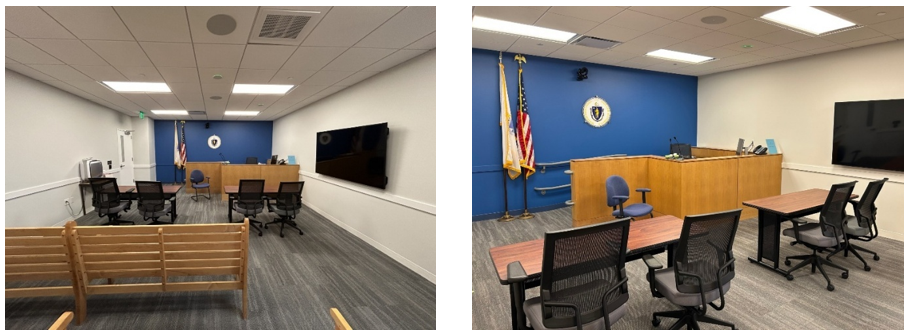
If it takes place in person at DALA’s office, the hearing will be held in a room like the one shown here. Please arrive early in order to become familiar with your surroundings.
9. Where Should I Park for a Hearing at DALA’s Malden Office?
There is parking in the building (14 Summer Street, 4th Floor, Malden, MA 02148) and at several nearby lots.
10. Is DALA’s Malden Office Accessible by Public Transportation?
DALA is located at 14 Summer Street, 4th Floor, Malden, MA 02148, which is across the street from the Malden Center T stop on the Orange Line.
11. What Happens if I Do Not Attend the Hearing or Do Not Participate in the Proceedings?
If you don’t show up for the hearing, your case may be dismissed or a default decision may be entered against you.
12. What if I Have an Emergency at the Last Minute and Can’t Attend the Hearing?
If you have an emergency on the day of the hearing, please call 781-397-4700 and explain the situation. Otherwise, if you have an emergency leading up to the hearing, file an emergency motion for a continuance (to request additional time) and notify the opposing party or parties. It is important to notify DALA of your emergency as soon as you can so that the magistrate can take appropriate action, if necessary.
13. Are Hearings Open to the Public?
DALA hearings are open to the public, except for a few kinds of hearings that the law makes confidential. However, anyone whose conduct interferes with a hearing may be removed from the room. With some exceptions, hearings may be recorded or photographed, but the person who wants to photograph or record the hearing must notify the magistrate before doing so. Also, a person’s recording or photographing must not interfere with the proceedings.
14. May I Watch a DALA Hearing?
If you would like to attend a hearing at DALA, please call ahead using (781) 397-4700. Please note that magistrates may determine that some hearings need to remain confidential, i.e., open only the magistrate, the parties, and the witnesses, but not the public.
15. How Will the Testimony Be Recorded?
The testimony will be recorded using digital audio-recording equipment, digital video-recording equipment, or a court reporter when one is arranged by the parties. Because of budget limitations, DALA does not provide court reporters.
16. How Do I Get a Copy of the Hearing Testimony?
A copy of the recording will be automatically sent by email to all parties.
17. Will the Magistrate Make a Decision on My Case at the Hearing?
No. In most cases, after the hearing, the magistrate will prepare a written final decision based on the evidence admitted at the hearing. A copy of the decision will be sent to you when it is issued.
K. After the Hearing
1. Will I Receive a Copy of the Magistrate’s Decision?
Yes. The magistrate will send a copy of the decision to the agency and all parties. The decision will be sent to the mailing address that appears in the filings in the case. You must inform the magistrate and the other parties if you change your mailing address at any time during the course of the case.
2. Can I Appeal DALA’s Decision?
Yes. In most cases, you may appeal a DALA final decision to the Superior Court. However, you should check the specific law governing the agency involved in your case to determine your rights to appeal, as you may be permitted and required to appeal to the agency itself or to another agency (e.g., the Contributory Retirement Appeal Board). If timelines are included in each agency’s specific laws, it is important to abide by them. Otherwise, you may lose the right to appeal DALA’s decision.
Additional Information
Additional Resources
Standing Orders
-
RESCINDED: Standing Order 13-1 (2013) , Open PDF file, 126.61 KB (English, PDF 126.61 KB)
-
Standing Order 23-001: Penalty Issues in Wage and Hour Law Cases, Open PDF file, 158.33 KB (English, PDF 158.33 KB)
-
Standing Order 25-01: Medical and Technical Evidence, Open DOCX file, 27.29 KB (English, DOCX 27.29 KB)
-
Standing Order 25-02: Voluminous Documentary Evidence, Open DOCX file, 25.23 KB (English, DOCX 25.23 KB)
Glossaries
- Glossary of DALA Terms
-
Glossary of Terms (Portuguese) (Glossario de termos comuns), Open DOCX file, 37.65 KB (English, DOCX 37.65 KB)
-
Glossary of Terms (Spanish) (Glosario de terminos frecuentes), Open DOCX file, 40.57 KB (English, DOCX 40.57 KB)
-
Glossary of Terms (Creole) (Diksyone mo popile yo), Open DOCX file, 38.48 KB (English, DOCX 38.48 KB)
-
Glossary of Terms (Vietnamese) (BẢNG CHÚ GIẢI CÁC THUẬT NGỮ THƯỜNG GẶP), Open DOCX file, 48.85 KB (English, DOCX 48.85 KB)
-
Glossary of Terms (Chinese) (常用术语表), Open DOCX file, 42.35 KB (English, DOCX 42.35 KB)