
Climate Change Challenge
Forest health degradation
Project Alignment with ResilientMass Plan Priority Actions
Restoring forest health to bolster climate change resiliency, assessment and management of invasive species, native grassland restoration
Climate Resilience Project Scope
ResilientMass funding was used to support numerous projects to restore ecosystem health and promote resilience in natural systems, including Atlantic White Cedar (AWC) swamps, an ecosystem vulnerable to climate change. ResilientMass funding supported field assessments of AWC ecosystems, remote sensing analysis, including the use of LiDAR for characterizations, and the development of a mobile assessment tool that staff and partners can use to evaluate and report AWC ecosystem status. Funding was also used for native warm-season grassland restoration at William Forward WMA. The project involved the conversion of non-native cool-season grasslands to native warm-season grasslands. The restored grasslands will provide habitat for numerous rare and common wildlife species. Warm season grasslands also have deep rooted plants that better sequester carbon than non-native cool season grasses. Funding was also used to support equipment needs for the habitat program (Prescribed Fire, Invasive Plant Control and Grassland Conversion). This funding was critical in the support of the Invasive Plant Program to fund the purchase of all personal protective equipment and herbicide and to promote Pitch Pine restoration through the reintroduction of prescribed burns. Pitch pine barrens are under threat from climate change, and imminently in danger from Southern Pine Beetle, a bark beetle that has expanded into New England because of warming winters. Prescribed fire is one of the primary tools recommended to improve resistance and resilience to Southern Pine Beetle.
Metrics and Results
The Atlantic White Cedar assessment tool is now live and being used by agency and partner staff. We do not yet have results on the number of AWC swamps that have gone through the assessment and verification process. The LiDAR data was processed in FY25 and is currently being utilized for the assessment.
At William Forward WMA, 46 acres of grassland have undergone the initial restoration actions, including the seeding of native plants.
In FY 2025, MassWildlife completed 29 prescribed burns for 1,270 acres. MassWildlife also conducted invasive plant control on 980 acres across 25 sites.
Best Practices and Lessons Learned
LiDAR has tremendous utility for forest and landscape analysis. The work with AWC is only scratching the surface of the capabilities for the technology. We plan to use the products developed through this project for a multitude of other utilities. We expect it to be leveraged by partners and other agencies to inform decision making and scientific pursuits as well.
The grassland restoration was a tremendous exercise in collaboration. We worked with the local fire department and other agencies to implement prescribed fire on the site, which was a precursor to planting. The buy-in from the local community is important when conducting large-scale habitat restoration. The project also worked with a vendor who specializes in native plant restoration, which was a tremendous asset in the project implementation.
The threat from Southern Pine Beetle (SPB) is imminent. The ResilientMass funding allowed for additional restoration treatments to be completed at Maple Springs WMA in Wareham. The equipment purchased to support prescribed fire allows for the restoration treatments to be maintained providing refugia and habitat for rare species, which building resilience to SPB infestation. The treatments used two methods for implementation. We are monitoring the effectiveness of each to determine where best to use each treatment method in the future.
The purchase of the personal protective equipment and herbicide allowed the 25 MassWildlife certified applicators to continue addressing the invasive species treatments. Invasives are the second biggest threat to biodiversity in the state, after habitat loss and fragmentation. We were able to upgrade all our equipment which allowed our treatments to be more effective and efficient.
The projects could be more cost-effective and efficient if contracts could span multiple fiscal years. The summer is mid-growing season so it can be difficult to complete projects within the FY timeline. Habitat management projects require multiple years of implementation to accomplish climate change and biodiversity goals.
Further Action
All projects are ongoing. The agency is committed to continuing and expanding on the work that has already been completed.
Additional Information and Resources
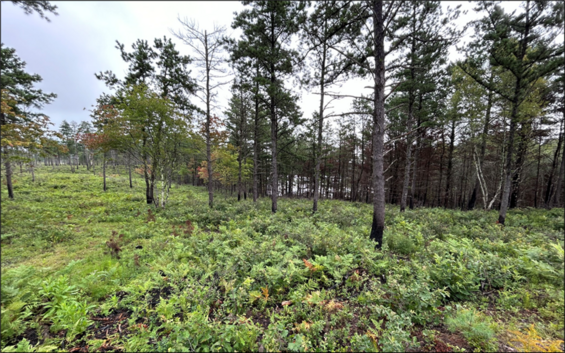
Pine Barrens under restoration at Camp Cachalot WMA/SF. Restored barrens are more resistant to Southern Pine Beetle.
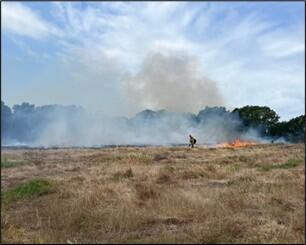
Grasslands under restoration at William Forward WMA. Prescribed fire was used to clear thatch before native grasses were planted.
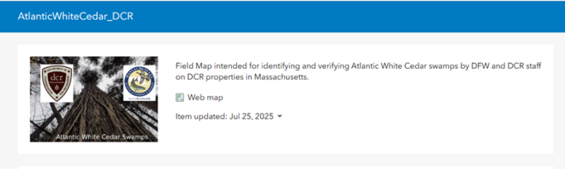
Screen shot of Atlantic White Cedar assessment tool on ArcGIS Online.