- Division of Marine Fisheries
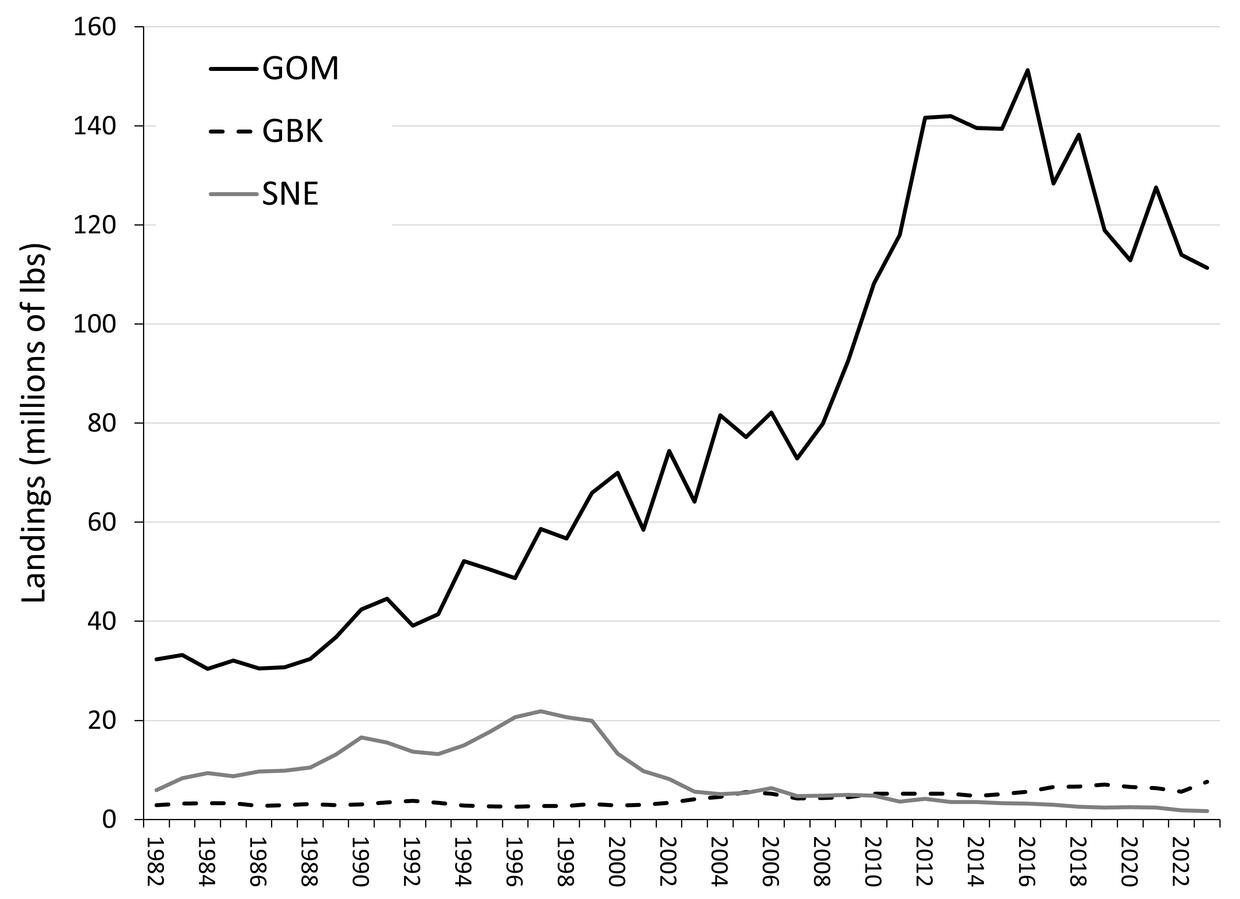
The American lobster resource and fishery in the U.S. is assessed and managed by the Atlantic States Marine Fisheries Commission (ASMFC). As part of this management, a benchmark stock assessment is conducted roughly every 5 years and was mostly recently completed and presented to the ASMFC Lobster Management Board in October 2025. The 2025 stock assessment team—consisting of lobster biologists and stock assessment scientists from Maine, New Hampshire, Massachusetts, NOAA Fisheries, and ASMFC—is responsible for compiling data on lobster life history, survey trends, landings and effort, and environmental conditions. Through this analysis, the team works to understand how the relative abundance of lobster in each stock is changing over time. Two lobster stocks are assessed in the US: the Gulf of Maine/Georges Bank (GOMGBK) stock, and the Southern New England (SNE) stock. The stock assessment team also pays close attention to sub-stock dynamics within the combined GOMGBK stock—Gulf of Maine and Georges Bank. The Gulf of Maine sub-stock dominates US landings (Figure 1).
The lobster stock assessment uses a size-based model to estimate population abundance by fitting data from surveys and commercial landings. Seasonal trawl surveys conducted by the states and the Northeast Fisheries Science Center, as well as the Ventless Trap Survey conducted in collaboration with industry members, provide estimates of abundance over time. Landings data come from reports supplied by harvesters and dealers. At-sea sampling trips conducted by state biologists provide information to the model about the size and sex ratio of those lobsters making up the commercial trap landings, plus information about how many egg-bearing females and v-notched females are caught but released as conservation benefits. The Commercial Fisheries Research Foundation’s Lobster and Jonah Crab Study Fleet also provides useful information on size and sex ratio of the catch. The model then produces estimates of abundance and exploitation (rate of lobsters caught and removed from the population) which are used to determine the status of the stock.
The stock assessment team also produces several model-free indicators—essentially straight-forward data products intended to provide a common sense look at the survey data to corroborate model results. These indicators provide the assessment with additional information on the health of the lobster stocks.
GOMGBK Stock
The model output and the model-free indicators provide a consistent picture for the GOMGBK stock. The stock has experienced dramatic increases in abundance over the last 20–30 years, reaching record highs around 2016. Since that time, the GOMGBK stock has declined from those record highs, but abundance still remains well above abundance from the early 2000s. These recent declines in adult abundance reflect changes detected in the young-of-year settlement indices, which experienced a period of low values in the mid-2010s. Lobsters that settled to the bottom during that time frame are those recruiting to the fishery in recent years, and the low recruitment levels observed in surveys are playing out now as declines in abundance and landings. While abundance in the GOMGBK stock has fallen below the Industry Target reference point, it remains above the Biological Limit reference point (Figure 2). The decline below the Industry Target suggests that declines in catch are likely and could cause some economic concerns for the industry. However, because the abundance in the GOMGBK stock remains above the Biological Limit, stock status is favorable.

The commercial lobster fishery is very efficient at harvesting those lobsters legally available to harvest, and landings closely track increases and subsequent declines in abundance. This means that exploitation has been very consistent over a long time period, and small changes in the calculated estimate of exploitation can quickly change the official stock status from not overfishing to overfishing. This is what happened with the 2025 assessment. The exploitation estimate is just above the Threshold, resulting in an overfishing finding. Because of this stability and the very narrow range of values separating favorable from unfavorable exploitation status, the assessment team recognizes that the abundance status is considered a more reliable indicator of stock status, and management advice is closely tied to the abundance estimate.
SNE stock
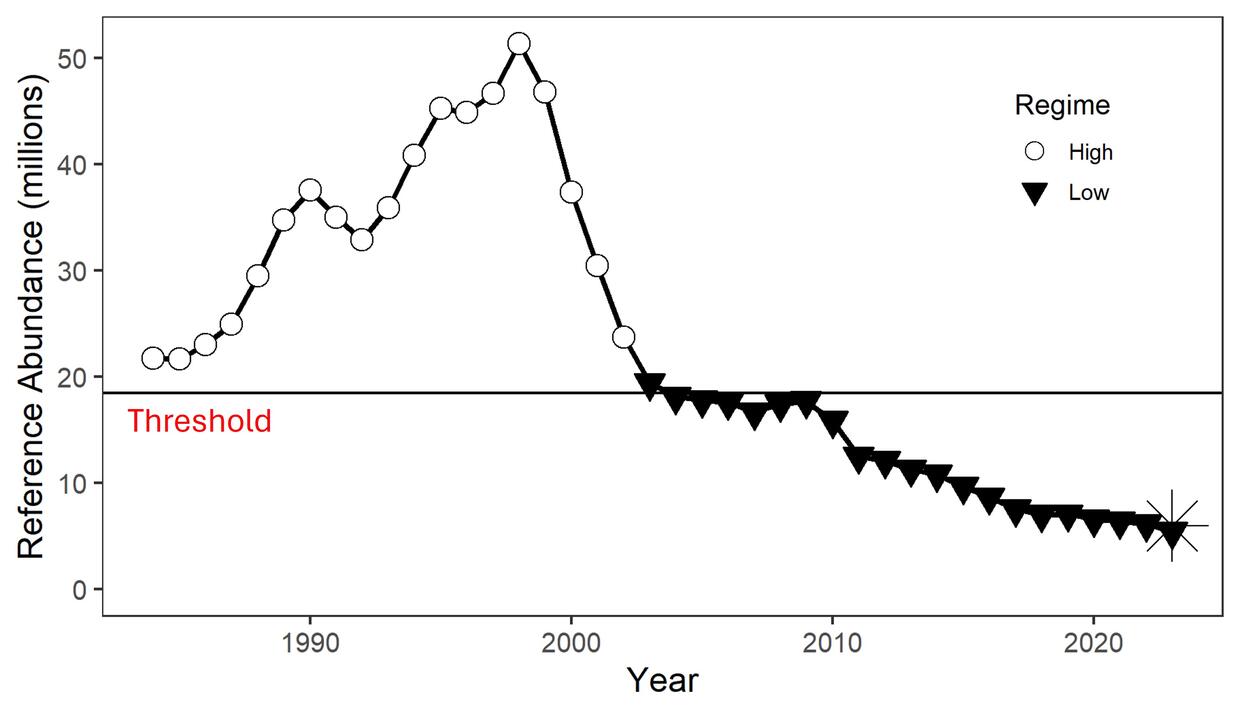
The SNE stock is significantly depleted (Figure 3). The model output and the model-free indicators provide a consistent picture of a depleted and substantially contracted stock. Abundance in the SNE stock peaked around 1998, but since then has experienced drastic declines, and is currently at a new all-time low. Water temperatures in the inshore environment, encompassing the bulk of historical settlement habitat for this stock, have continued to increase and are above suitable temperatures for lobsters for much of the summer and early fall. These unsuitable temperature conditions are playing a major role in the continued recruitment failure experienced by the SNE stock. Exploitation in the SNE stock shows that overfishing is not occurring, but similar to exploitation in GOMGBK, it has been relatively stable for a long time, since the last changes to minimum legal size that happened in the early 2000s. While recognizing that the SNE stock continues to experience unfavorable environmental conditions, the assessment team has recommended that managers take significant action in SNE to provide the best chance at stabilizing or improving abundance.
What’s Next
The 2025 lobster stock assessment paints a bit of a mixed picture of the resource and fishery. The story in SNE is unfortunately relatively clear; the stock is severely depleted. However, the GOMGBK lobster stock is overall in reasonably good condition with moderately high abundance and spawning stock biomass. Even so, there are a few realities to consider in the GOMGBK: settlement indices remain somewhat low, recruitment has declined, exploitation rates are relatively high, and the fishery is very dependent on new recruits, all of which are cause for some concern. This suggests that managers and the fishing industry should consider measures to reduce fishing effort to lower exploitation, cut expenses, and maximize catch per unit effort.
Over the next several months, the ASMFC Lobster Board will consider the need for possible management responses to the results of the 2025 stock assessment. The assessment team has recommended the Board initiate a Management Strategy Evaluation for the GOMGBK stock, starting with workshops to explicitly identify management goals and objectives. This process would provide opportunities for industry members and managers to discuss management goals together, convene experts to further explore socioeconomic conditions and concerns, and identify potential management tools to apply to future management of the fishery.
A more detailed overview of the 2025 lobster stock assessment can be found here on the ASMFC website.
By Tracy Pugh, PhD. Invertebrate Fisheries Program Manager, Lead Lobster Biologist, and Bob Glenn, Deputy Director