- Division of Marine Fisheries
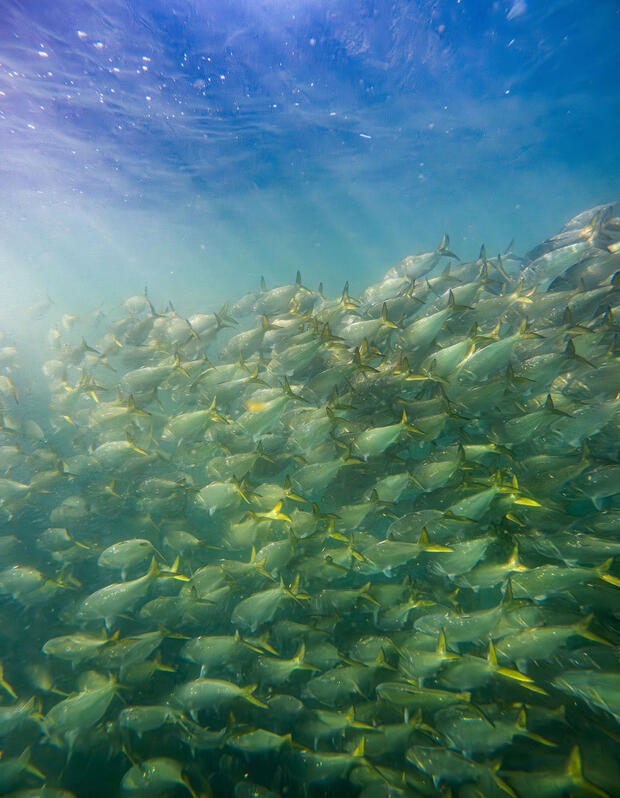
When I talk with anglers about Atlantic menhaden (Brevoortia tyrannus), I’m often met with blank stares until I mention their more commonly known nicknames like “pogies” or “bunker”. Then, I typically get a wide smile and a “Oh yeah, those make the best bait!”. Whatever name you call them by, menhaden do in fact make great bait because they are a favorite food for many popular sportfish. The list of top menhaden predators includes striped bass, tuna, bluefish, weakfish, dogfish, as well as ospreys, dolphins, and humpback whales. Finding a school of menhaden can sometimes mean witnessing a spectacular multi-species feeding frenzy!
Menhaden are seasonal visitors to Massachusetts shores, typically arriving in late April or early May from the south. Much of what we know about their migration patterns comes from one of the largest fish tagging studies ever conducted. Over 1 million menhaden were individually tagged in the late 1960s and early 1970s aboard commercial fishing vessels between Massachusetts and Florida. More than 100,000 of these tagged fish were later recaptured up and down the coast, yielding a rich dataset that provides an unparalleled view of their seasonal movements. From these data, we know that most of the population overwinters offshore of the mid-Atlantic states. As waters begin to warm in spring, schools of menhaden come inshore and move northward along the coast. Larger fish tend to migrate farther north, which creates a couple of interesting patterns: 1) the fish found north of Cape Cod are typically a few years older than the fish found to the south; and 2) menhaden don’t always enter the Gulf of Maine, particularly when there are few older fish in the population. Massachusetts fishery records dating back to the mid-1800s reveal that there have been many periods of time (some lasting decades) when menhaden were completely absent north of Cape Cod.
Menhaden begin spawning as early as age two and reproduce over a broad season that starts in the winter and extends throughout their entire northward migration. In Massachusetts, menhaden eggs are typically found in May and June. Newly hatched larvae will move with ocean currents toward shore until they reach suitable nursery habitat in coastal estuaries. The young-of-year will remain within these tidal rivers for several months before joining the southward migration of adults in the fall. Due to their small size, these “peanut bunker” emerging from estuaries are a favorite food for a huge number of predators and are often corralled at the water’s surface or tight to the shoreline in a feeding frenzy known as a “blitz”. Because of this life cycle, finding a school of peanut bunker in the fall means that adult menhaden were probably spawning not too far away in the spring.
As a filter feeder, menhaden swim with their mouths open to strain plankton from seawater using their gill rakers. For this reason, menhaden are not typically caught on bait fishing rigs, like herring or mackerel are. Instead, recreational anglers use weighted treble hooks to “snag” menhaden, which are then transferred to a circle hook as bait when fishing for striped bass. To avoid being eaten, menhaden swim in a highly synchronized way, forming dense schools that often ripple or splash at the water surface, making them relatively easy to find. Despite subsisting solely on tiny plankton, menhaden grow quickly, reaching a maximum size of 15 inches and can live for 10 or more years.
Menhaden support one of the largest commercial fisheries (by volume) in the country. The majority of these fish are caught by purse seine vessels and converted to animal feed or food supplements. However, menhaden are increasingly becoming an important source of bait for crab and lobster trap fisheries, particularly as other bait species like Atlantic herring have become scarcer. The oldest form of menhaden fishing comes from fish traps, known locally as “weirs”. Landings records for Massachusetts fish weirs date back to the 1870s, when menhaden were primarily harvested as a crop fertilizer, a practice learned by early colonists from indigenous tribes.
Because of their importance to popular predatory sportfish like striped bass, the menhaden fishery is now managed more conservatively than any other Atlantic coast fish. An ecosystem model is used to set catch limits that account for not just the sustained productivity of the menhaden population, but the productivity of its predators as well. In other words, harvest is reduced to ensure striped bass have plenty to eat, because those wide smiles that menhaden bring to the faces of anglers are a sign of just how important menhaden are to their predators, and the fisheries they support.
By Micah Dean, PhD, Senior Marine Fisheries Biologist