- Division of Marine Fisheries
Black sea bass, long a staple of mid-Atlantic recreational fisheries, have become increasingly prominent in Massachusetts waters over the last few decades. Prized for both their aggressive behavior and superb taste, black sea bass are a perfect target for both the beginning angler and those with years of experience. Growing to over eight pounds, these voracious predators can be found around many types of near-shore structure, making them readily available from shore, kayak, or boat.
Increases in the biomass of black sea bass in Massachusetts waters have led to heightened fishing effort. Recreationally, between 250,000 and over a million black sea bass are caught annually, with much of this effort concentrated in Buzzards Bay, Nantucket Sound, Vineyard Sound, and along Cape Cod. Black sea bass typically arrive in Massachusetts waters mid-spring, where they aggregate to feed and spawn. Several spawning aggregations in Massachusetts, particularly within Buzzards Bay, are well-known and attract anglers, and new spawning locations continue to be discovered. However, the timing and location of feeding and other aggregations is not well-known.
Contributing to further uncertainty, black sea bass are increasingly found outside their historical range. Over the last decade or so, black sea bass have been found by anglers and trap fisheries with increased frequency north of Cape Cod in the Gulf of Maine. Now, anglers can successfully target black sea bass in Cape Cod Bay, Boston Harbor, and even farther north. While concentrations in these areas remain significantly lower than in the south of Cape Cod, greater biomass in the Gulf of Maine may increase potential interactions with juvenile lobster, a key commercial species in Massachusetts waters, or expand opportunities for recreational and commercial fisheries in northern regions of the state.
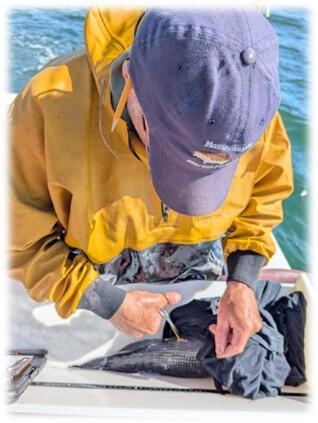
To better understand these potential impacts, the Massachusetts Division of Marine Fisheries (DMF) recently initiated a tagging study on black sea bass. In May of 2025, researchers tagged 66 fish in Buzzards Bay near Cleveland Ledge. Acoustic tags, which transmit signals to receivers anchored to the seafloor, were surgically implanted into each fish, allowing researchers to track fish movement over several years. DMF maintains receivers throughout state waters to monitor acoustic tags, including an array in Buzzards Bay. These fish will help DMF further understand not only when and where black sea bass spawn in Buzzards Bay but how they migrate north into the Gulf of Maine.
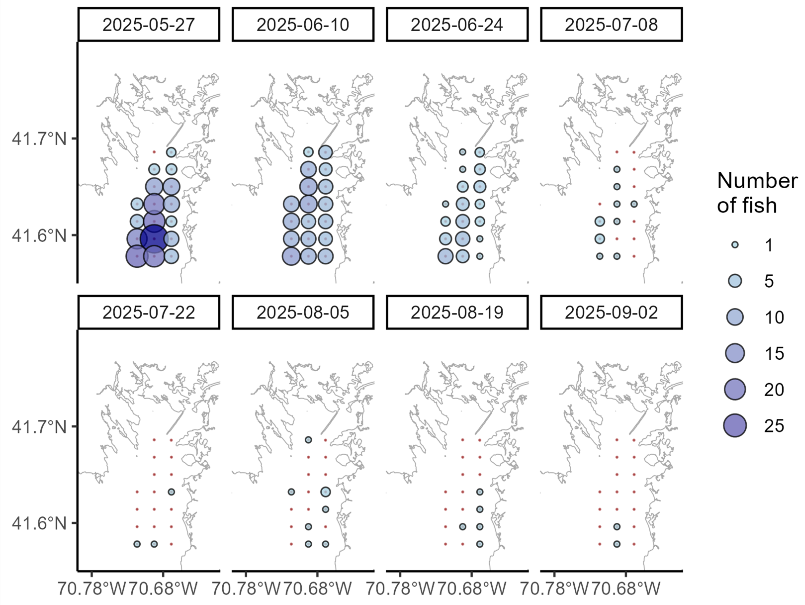
All 66 tagged fish were detected on our Buzzards Bay receivers. Many fish remained in the immediate area where they were released for several weeks; however, some fish did move throughout the array before exiting. By July 4th, 90% of the fish had left the array. While detection records are still being collected, collaborating researchers have already shared detections of 17 of the tagged fish in Rhode Island, Nantucket Sound, Vineyard South, and near Block Island. We look forward to diving deeper into this initial data and learning more about how and where black sea bass travel near Massachusetts waters—from movement within Buzzards Bay to migrations offshore.
Looking ahead to 2026, DMF plans to tag more fish in Buzzards Bay, as well as north of Cape Cod to better understand how black sea bass are expanding their range and uncover additional spawning grounds. Keep an eye out on our social media accounts and future newsletters to learn more about black sea bass research, and get in touch with us on Instagram, Facebook, or email at marine.fish@mass.gov!
By Bart DiFiore, Ben Gahagan, Elise Koob, Micah Dean, and Bill Hoffman