- Division of Marine Fisheries
The Division of Marine Fisheries’ (DMF) Fisheries Research and Monitoring (FRM) Project is responsible for collecting fishery-dependent data to characterize the catch of the Commonwealth’s commercial fisheries. One approach, port sampling, requires DMF biologists to collect this information by intercepting vessels at a fish house, or seafood dealer, during vessel offloads. Using this method is efficient and cost effective—the entire offload can be made available for sampling, multiple species can be sampled at one time, and multiple trips can be sampled during one visit to the fish house. Recently, DMF has ramped up its port sampling efforts to offset federal sampling shortfalls and bolster the stock assessments and management decisions that depend on these data.
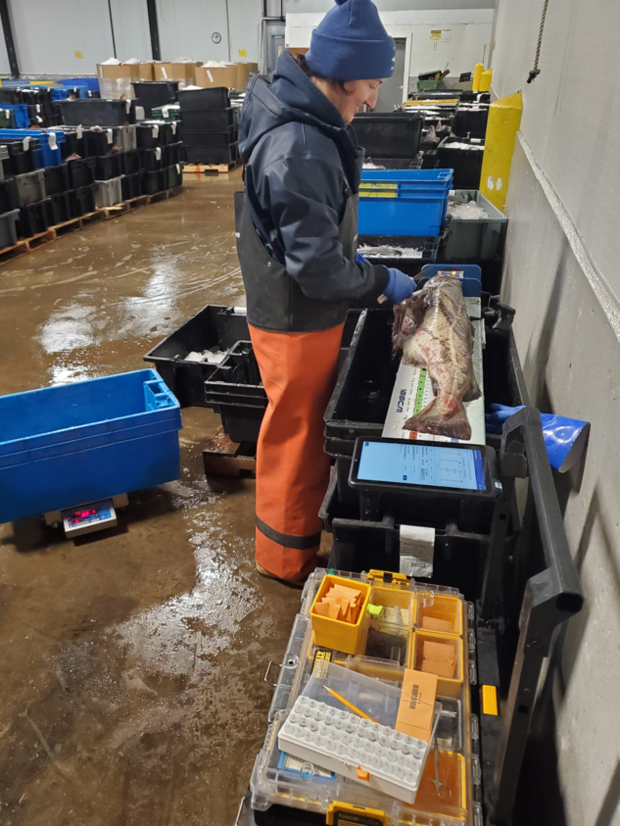
Information collected while port sampling is species-specific and is either grouped by stock area or statistical reporting areas. Data collection includes recording lengths and weights, and gathering age structures (otoliths, scales, or spines) by dealer market category. Ancillary information, such as sex and maturity, can also be collected. Together, these data are critical to inform scientists of the size and age of landed fish, effectively measuring removals by the commercial fishery. Fundamentally, port sampling is one of the most important data sources that contributes to a stock assessment.
As a member of the Atlantic States Marine Fisheries Commission (ASMFC), Massachusetts is required to conduct port sampling for ASMFC governed fisheries, completed through DMF’s FRM Project. Monitored species include striped bass, scup, summer flounder, Atlantic herring, menhaden, tautog, American lobster, and bluefish. Port sampling for federally regulated species—like cod, haddock, and other groundfish—has historically been completed by NOAA Fisheries’ Northeast Port Biological Sampling Program (NEPBSP). However, in 2022, a Northeast Fisheries Science Center (NEFSC) stock assessment for northeast and mid-Atlantic federally managed species revealed current biological sampling practices were insufficient to develop comprehensive stock assessments due to funding challenges.
In response to these untenable data gaps, DMF reallocated NOAA Interjurisdictional Fisheries Grant funds (from a conservation engineering focus aimed at improving net selectivity) to the more critical biological sampling, bolstering the FRM Project’s efforts. Subsequently, FRM was formally included into NEPBSP efforts beginning in 2023. Over the year, FRM staff received training, credentials, and formalized sample requests from the NEFSC. Reallocated grant funds allowed FRM to hire two full-time biologists dedicated to fishery-dependent sampling, and purchase equipment, including measuring boards and electronic scales.
In building up DMF’s port sampling efforts through FRM, DMF strived to collect useful and accessible data consistent with that of the NEPBSP that could be incorporated into federal stock assessments. The NEFSC Population and Dynamics Division establishes sampling requests biannually, including eight groundfish species by market category and statistical area. These are divided between contracted port samplers and FRM in Massachusetts; FRM conducts sampling in Gloucester, Boston, and New Bedford.
Using NOAA’s Vessel Monitoring System, FRM port samplers can determine where and when vessels will land and what species can be sampled. However, sampling is restricted to fishing trips that remain in just one statistical area to ensure sampled fish are from the same stock areas. FRM has begun to address this limitation in multiple ways. Through collaborations with the Northeast Seafood Coalition and two groundfish sectors, researchers have developed methods to access fish from rarely sampled areas. Additionally, FRM has partnered with the Conservation Law Foundation (CLF) and implemented a pilot study called OPPSAMP. This study sought to examine the effectiveness of isolating fish from individual tows during commercial fishing trips for port sampling by FRM staff. Four boats from Gloucester and Boston were enlisted and trained on protocols. Vessels were compensated by the sector managers for their efforts through funds furnished by CLF. This one-year pilot has ended, but FRM has continued to recruit vessels to participate in future similar projects in Eastern Gulf of Maine and Georges Bank when funding becomes available.

In late 2024, FRM started work with NOAA Cooperative Research Branch (CRB) and NEPBSP to administer the port sampling aspect of the Conversion Factor Study. This study aims to update gutted:whole weight and length:weight relationships used by NEFSC stock assessment scientists. These conversion factors are considered outdated and somewhat controversial, as they are limited to trawl survey data. The FRM and CRB collaboration will reassess these inputs through data collection over two years.
Since DMF reallocated grant funds to focus on biological sampling and support port sampling through FRM, staff have collected over 9,800 lengths, and 6,100 age structures from eight groundfish species, while continuing to support ASMFC assessment needs. The scale of data collection is significantly larger than what has previously been possible. With continued support from federal grant programs, NOAA, and DMF leadership, FRM will remain committed to collecting fishery-dependent data and providing important information used in future stock assessments.
By Bill Hoffman, Fisheries Research and Monitoring Project Leader