

Accessible routes
You must provide an accessible route from where people arrive at your restaurant to key destination points (like the host station).
The accessible route must follow the same path as the route for the general public. The accessible route should also connect to accessible seating, restrooms, and special features like bars, firepits, fans, or heat lamps.
Accessible routes must be clear of anything that could stick out and block the route, like lights, umbrellas, signs, or other fixtures. (MAAB 20.6: Protruding Objects)
Accessible routes must follow certain width, slope, and surface requirements:
Width
Routes must be at least 36 inches wide to be considered accessible (MAAB 20.4: Turns). If your outdoor dining is provided on a sidewalk, make sure there is a path at least 36 inches wide for pedestrians to pass by or access an entrance.
The minimum requirement is 36 inches, but it is best practice to make accessible routes at least 48 inches wide to give customers more space to move and turn around if needed.
If you use separation devices (like bollards, cones, planters, chairs, or chains) to separate the dining area, make sure they don’t narrow the route to less than 36 inches.
Slope
The Massachusetts Architectural Access Board (MAAB) defines two types of accessible routes: walkways and ramps.
- Accessible walkways are flat surfaces for people to travel from one place to another on the same level by walking or using a mobility device (like a wheelchair, crutches, or a walker). Accessible walkways have a slope of 0 – 5%.
- Accessible ramps are surfaces for people to get from one level to another without using stairs. Accessible ramps must have a slope of 5.1 – 8.33% (MAAB 20.9: Slope and Cross Slope).
How to calculate the slope of an accessible route (walkway or ramp)
- Place a 2-foot level on the route in the direction you move.
- Lift the downhill end of the level until the bubble is centered.
- Using a tape measure, measure the vertical gap from the surface up to the bottom of the lifted end of the level. Use this table to determine if the route is in compliance:
| Vertical gap measurement (inches) | Slope percentage | Compliance |
|---|---|---|
| 0 – 1.25 inches | 0% – 5% | Compliant walkway |
| 1.26 – 2.00 inches | 5.1% – 8.33% | Compliant ramp |
| More than 2.00 inches | More than 8.33% | Not in compliance (too steep) |
Surface
Whether it is a walkway or a ramp, your accessible route’s surface must be stable, firm, and slip resistant.
The accessible route’s surface also must be:
- Level (no more than a ½ inch change in level),
- Unbeveled (MAAB 29.2: Level Changes), and
- Cleared of objects (MAAB 20.6: Protruding Objects)
Landscaping
Grass, rocks, sand, and loose gravel are not considered accessible route surfaces. You are allowed to use these surfaces on your property, but do not use them on the accessible route.
Accessible tables and seating
Restaurant seating, including outdoor seating, must comply with MAAB 17.00: Restaurants. Routes to all dining areas, including outdoor dining areas, must be accessible.
There are specific rules about how many accessible seating options must be provided on an accessible route, how they should be distributed (based on size and location), and detailed dimensions about clear floor space and table and counter heights.
Seating
Seating at accessible tables must be movable. Seating that is fixed to a table, like certain picnic benches or school cafeteria tables, is not accessible (MAAB 35.1: Fixed Tables and Built-In Seating).
Required number of accessible tables
At least one table, or 5% of your restaurant’s total number of dining tables – whichever number is greater – must be accessible and on an accessible route (MAAB 17.2: Seating). If you are using the 5% rule, follow normal rounding conventions.
Accessible tables must be distributed based on the size and location of the dining space. If you have different types of tables or dining areas (like tables for different group sizes, in different locations, or for different services), distribute your accessible tables proportionally (MAAB 17.2: Seating). This helps to ensure that customers with disabilities have equal access to your different dining options.
Example 1: One dining option
A restaurant provides 50 outdoor tables at a park. All the tables are in a similar location and have similar seating capacity. Three tables out of the 50 would need to be accessible and located along an accessible route (5% of 50 = 2.5. Round up to 3 tables.)
Example 2: Variety of dining options
A restaurant has 62 tables. Ten of the tables offer light dining on the sidewalk. The remaining 52 tables are reserved for fine dining and are located on a closed street. In this scenario, 3 accessible tables would need to be provided (5% of 62 total tables = 3.1. Round down to 3 tables.) The 3 accessible tables should be distributed proportionally across the different dining options. Put one accessible table in the light dining area, and 2 in the fine dining area.
Accessible aisles
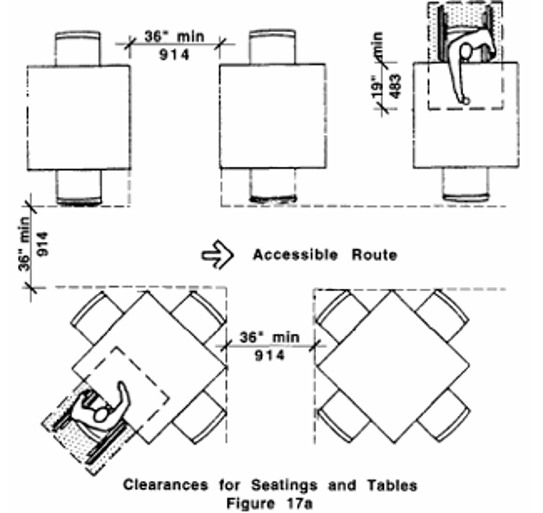
A 36-inch clearance (access aisle) is required between accessible tables. Do not allow seating or other obstructions to overlap the access aisle. (MAAB 17.2.2: Access Aisles). Measure the 36 inches from the back of a chair that is reasonably tucked in, not from the edge of the table.
The below figure shows five tables, and the 36-inch paths of travel around and between the accessible tables.
Clear floor space
Each seat at an accessible table must have a clear floor space of 30 inches across by 48 inches deep. The 48 inches can include up to 19 inches of knee clearance space under the table (MAAB 17.2.3: Clear Floor Space).
Maneuvering clearance
You must have a “maneuvering clearance” at each seat of an accessible table. This gives people enough space to back away from the table and adjust their seat. The minimum maneuvering clearance is 36 inches, measured from the edge of the table back (as if you were backing your seat away from the table).
Knee clearance
Each individual seating area should have adequate clear space for people who use wheelchairs or other mobility devices to maneuver and use the table. This includes clear “knee space” under the table.
You must have a clear space of at least:
- 27 inches high (floor to bottom of table),
- 30 inches wide (left of individual seating area to right of individual seating area), and
- 19 inches deep (end of table to center leg or other obstruction).
See MAAB 17.2.4: Knee Clearances.
Height of tables and counters
Accessible tables and counters must be between 28 and 34 inches high (from the floor to the top of the table). (MAAB 17.2.5: Height of Tables or Counters)
Parklets
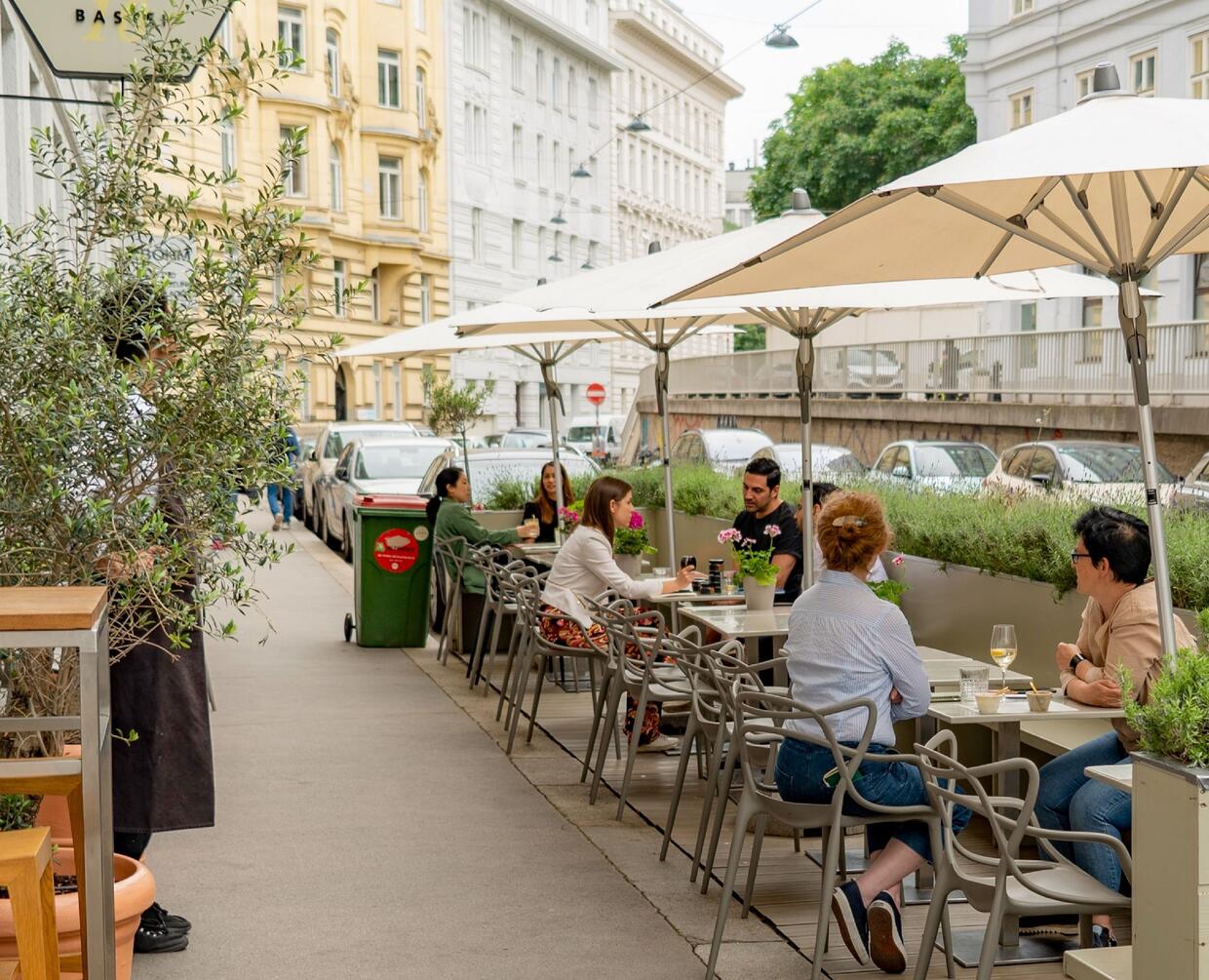
Outdoor dining spaces that take up on-street parking spaces are called “parklets”. Parklets are usually the size of an on-street parking space. If you use parklets to offer outdoor dining, laws and regulations about accessibility and accessible parking still apply, even if the parklet is technically in the road.
It is best practice to add a protective barrier between the parklet and the active roadway for safety purposes. Some cities and towns may require this.
Provide curb cuts wherever customers with disabilities might need to access the street from the curb. If you cannot provide a curb cut, you can apply for a variance from the MAAB to provide a temporary or portable ramp instead. You must have the MAAB’s permission to use a temporary or portable ramp instead of installing a curb cut.
Parking
Some outdoor dining spaces can reduce the availability of on-street parking and accessible parking within parking lots. Accessible parking requirements are based on the total number of parking spaces available in a specific parking lot or block.
If all parking is removed completely, such as closing a parking lot or street, there is no obligation to provide accessible parking during that time. However, when the outdoor dining season ends and parking is available again, accessible parking must also be made available again.
Any accessible parking space removed for the creation of a parklet must be relocated to a spot as close as possible to its original location.
Portable toilets
If your business has portable toilets, at least one toilet, or 5% of the toilets – whichever number is greater – must be accessible. If the portable toilets are provided in multiple locations on the same site, the 5% rule applies to each individual location. (MAAB 30.1.2: Portable Toilets)
Other access requirements
There are additional dining access requirements under the MAAB that involve:
- Dining counters without service,
- Counters and bars with service,
- Food service lines,
- Tableware and condiment areas,
- Raised platforms,
- Vending machines and other equipment,
- Cash registers, and
- Televisions
These additional requirements can be found under MAAB Section 17: Restaurants.
Non-discrimination and equal access requirements
In addition to architectural access requirements, public accommodations (like restaurants) have a legal obligation to not discriminate on the basis of disability and to provide equal access to their services. See disability rights in public accommodations to learn more about what this means.
Enforcement and recourse
If you can’t access an outdoor dining space due to a disability, see the enforcement and recourse section of our disability rights in public accommodations page for guidance.
If you have questions about what architectural access regulations mean and how they apply to your business, contact MOD. MOD can:
- Work out which version of the access codes apply and whether the situation seems to be compliant with that code,
- Offer ideas for temporary and permanent solutions to accessibility barriers, and
- Help you think through whether applying for a variance from the MAAB makes sense.
If, after reviewing this page and contacting MOD for guidance, you determine that complying with an MAAB architectural access requirement is impractical for your business, you can apply for a variance from the MAAB.
| Date published: | June 5, 2026 |
|---|