
Project Details
Project Title
Agawam Stormwater Master Plan
Municipality
Agawam
MVP Region
Greater Connecticut River Valley
Award Year
FY2021
Grant Award
$216,750
Project Length
One Year
Community Overview
The Town of Agawam, MA is located in Hampden County along the Western side of the Connecticut River, just west of Springfield, MA and just north of Connecticut. The Town has a population of 28,613 as of 2019, 8.1% of which lives below the poverty level. A State-recognized Environmental Justice community, designated by income, is located in the northeast corner of the Town. This Environmental Justice area is located within a FEMA-designated 100- year flood zone and Regulatory Floodway and is therefore more vulnerable to flooding associated with large storm events, as well as more frequent storm events anticipated to occur as a result of climate change.
Project Description and Goals
The Town-wide Stormwater Master Plan benefits the entire community. A municipal code review, impervious area mitigation assessment, and climate impact assessment was conducted as part of the development of the Stormwater Master Plan. These assessments and reviews aimed to:
- improve and update municipal ordinances and regulations to promote more resilient designs of infrastructure and developments by considering NOAA Atlas 14 Plus rainfall data during design
- integrate low impact development approaches into infrastructure and development designs, and
- reduce impervious area and heat island effects throughout the Town.
For example, by implementing these changes in the Town’s ordinances and regulations following this project, the Town’s infrastructure will be more adequately sized to handle increased storm event frequency and size resulting from climate change and reduce surface flooding.
In addition to the review and assessments outline above, the project included:
- a culvert assessment
- a priority storm drain structure evaluation, and
- a detention basin retrofit evaluation.
The results of these assessments and evaluations were used to develop a comprehensive Stormwater Master Plan and a Capital Improvement Plan, which will be utilized by the Town to prioritize future infrastructure improvements.
Lastly, the project included a robust public engagement program which included a video production with high school students, school residency program with a 5th grade classroom, a storm drain art and Earth Expo event, and a community survey. The video production was used as an introduction to the art residence program and the school residency program aimed to develop public art to relay messaging around clean water. The Earth Expo displayed the artwork created during the residency program and introduced the Stormwater Master Plan and regulatory review work. The community survey was intended to obtain a better sense of lived experiences and changing weather to gauge support for local efforts to adapt to climate change.
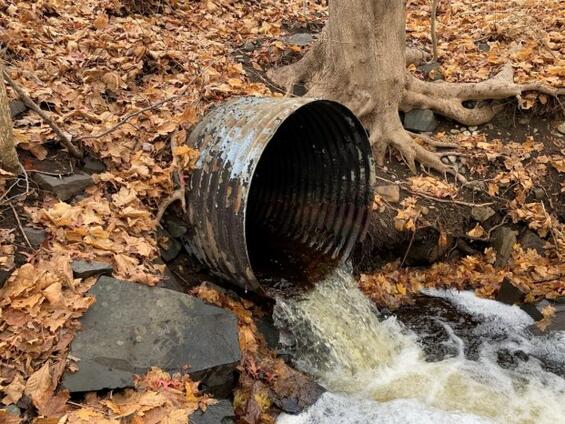
Example of a corrugated metal pipe culvert in poor condition.
Results and Deliverables
The project resulted in a Town-wide Stormwater Master Plan and Capital Improvement Plan that will be utilized by the community to support resilient stormwater infrastructure designs and make informed decisions on the selection and completion of stormwater infrastructure improvement projects.
The Capital Improvement Plan includes more than 50 high priority projects to be considered for implementation over an initial 10-year planning horizon.
To inform the development of the Stormwater Master Plan and Capital Improvement Plan, a culvert condition assessment, priority storm drain infrastructure assessment, detention basin assessment and retrofit survey, impervious area mitigation assessment, audit and recommendations to update municipal code for climate resiliency, and a climate impact assessment were conducted. Documentation collected during these assessments are provided as appendices to the Stormwater Master Plan.
Lessons Learned
The development of a Stormwater Master Plan needs to rely upon data collected in the field and knowledge of the community provided by Town staff, as well as resident complaints. A Stormwater Master Plan is a comprehensive planning document to identify needs and projects; however, it also needs to integrate an appropriate level of public education to support long-term success and implementation of projects.
It appears that the classroom art program had the highest level of public engagement and success with subsequent parent engagement versus other methods of engagement and outreach to adults. The classroom art program was also well received by the school administration with overwhelming support from teachers.
An engaged municipal project team and institutional knowledge by staff supported the success of the project to guide the engineering team with development of the Stormwater Master Plan and Capital Improvement Plan (CIP). It is important to present the CIP as a living document that may need to be updated during the 10-year planning horizon due to changing infrastructure conditions, regulations, and available funding sources in the future. Lastly, the CIP should be updated in the future as new information becomes available related to other planned projects for utilities and infrastructure in Town, such as the condition and planned replacement of sanitary sewer infrastructure. This will maximize the benefit and efficiency of the Town’s resources.
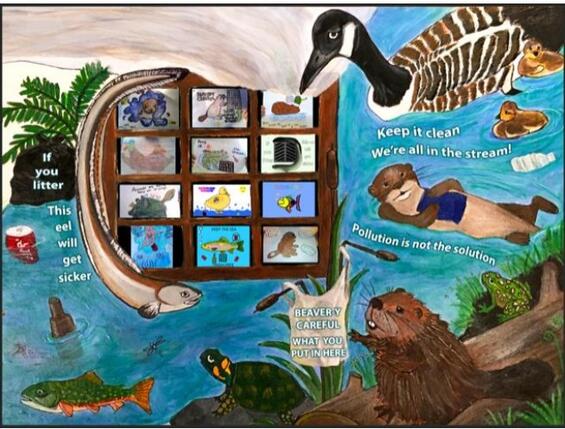
Storm drain art banner from Agawam's classroom community engagement.
Partners and Other Support
- Town of Agawam: Provided access to the Town’s GIS system to help the project team conduct field assessments and locate town-owned infrastructure. Worked with PVPC to support the municipal code review. The Town also provided guidance and feedback to the project team through the Master Planning process and identified several projects to be included in the Stormwater Master Plan and Capital Improvement Plan.
- Pioneer Valley Planning Commission (PVPC): Conducted a thorough review of the Town’s municipal code and worked with the Town’s Regulatory Review Advisory Working Group to advise on changes to the municipal ordinances and regulations to produce resilient developments in the future. PVPC also managed the community engagement program.
- Enchanter Circle and the Hitchcock Center for the Environment: Worked with PVPC to facilitate an 8-day artist-in-residence program in 12 5th grade classrooms at the Doering School in Agawam.
- Woodard & Curran: Technical Lead and steered the project by conducting all field assessments, the impervious area mitigation assessment, the climate impact assessment, and development of the Stormwater Master Plan and Capital Improvement Plan.