
Overview
The Massachusetts School Building Authority (MSBA), established under Section 1A of Chapter 70B of the Massachusetts General Laws, is a quasi-public agency that was created to reform and administer the funding process for capital improvement projects in the Commonwealth’s public schools. Established in 2004, MSBA replaced the former school building assistance program, which was previously administered by the Massachusetts Department of Education (now the Department of Elementary and Secondary Education).
According to its website, “MSBA partners with Massachusetts communities to support the design and construction of educationally-appropriate, flexible, sustainable, and cost-effective public school facilities. We are a financing agency, focused on bringing reform and innovation to the school building process.”
MSBA is overseen by a seven-member board of directors, consisting of the State Treasurer, who serves as its chairperson; the Secretary of Administration and Finance (or their designee); the Commissioner of Education (or their designee); and four additional members appointed by the State Treasurer. The four appointed members currently hold the following positions in addition to their seats on MSBA’s board of directors: principal at Perry Dean Rogers Partners Architects; former teacher and former Brookline School Committee member; associate vice president for real estate and capital projects at Northeastern University; and former town administrator for the Town of Eastham. The board approves projects through a formal voting process that governs how MSBA allocates its available funding.
MSBA is required to conduct periodic surveys of public school facilities across Massachusetts to assess their condition and help inform its grant programs. To date, MSBA has completed these School Surveys in 2005, 2010, and 2016. The next survey is currently underway and is expected to be completed by December 2025, which is almost a decade after the last one was completed.
MSBA is funded through a dedicated 1% statewide sales tax (drawn from the statewide 6.25% sales tax). According to its financial statements, in 2023 and 2024, MSBA had $1,264,674,000 and $1,247,278,000 of dedicated sales tax revenue, respectively.
MSBA Grant Programs
MSBA administers competitive, non-entitlement2 grant programs that provide financial assistance for projects addressing critical infrastructure needs in public school facilities, such as those that are outdated, overcrowded, or unsafe. These programs include the Core Program and the Accelerated Repair Program (ARP). The Core Program supports projects involving new construction, additions, and/or major renovations, while the ARP is designed for limited-scope projects, including the replacement of roofs, windows, and doors, as well as the conversion of heating systems to heat pumps in existing schools. Grants are awarded to school districts that MSBA determines to have the most urgent needs, based on the results of its due diligence process. This due diligence process for the Core Program consists of the following four phases, which are described in more detail below:
- reviewing Statement of Interest (SOI) submissions for completeness (i.e., verifying that MSBA received all required documents);
- reviewing SOI content and accompanying documentation;
- conducting Senior Study visits,3 if applicable; and
- recommending SOIs for invitation into the Eligibility Period.4
MSBA provides reimbursements to school districts for eligible construction costs, based on a reimbursement rate determined by a formula outlined in Section 10 of Chapter 70B of the General Laws. This formula establishes a base rate and adjusts it according to factors such as community income, property wealth, and the district’s proportion of low-income students. MSBA may apply additional incentive points to a school district’s base reimbursement rate to recognize specific project attributes. These incentive points can be awarded for initiatives such as forming a new regional school district, renovating existing facilities, and incorporating high standards of energy efficiency and indoor air quality. Districts cover project costs up front and submit invoices to MSBA, which reimburses a portion of the eligible expenses at the approved reimbursement rate.
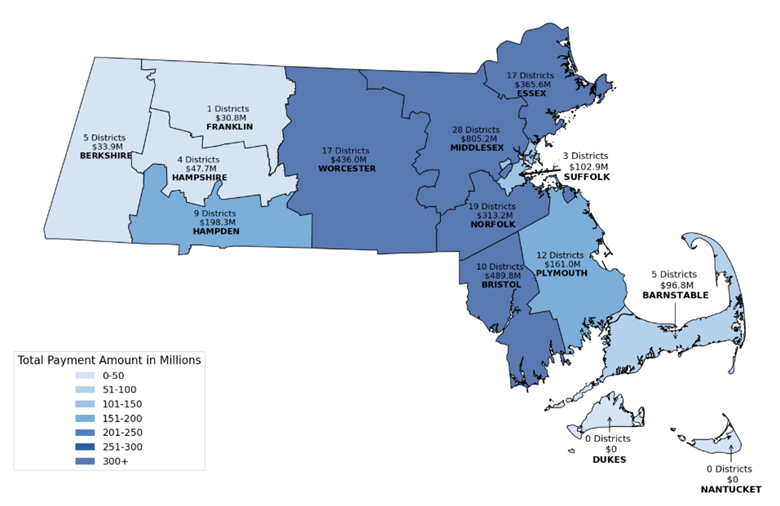
According to MSBA’s 2023–2024 Annual Report, MSBA issued nearly $1.3 billion in school construction payments to cities and towns during fiscal years 2023 and 2024. The map below summarizes Core Program reimbursement payments made by MSBA from January 1, 2020 through December 31, 2024, broken down by county, including the number of school districts that received payments and the total dollar amounts reimbursed. These payments reflect projects that may have been in different phases of development or construction during this period.
SOI Process
School districts interested in participating in MSBA’s grant programs must submit SOIs. MSBA opens its SOI system annually,5 typically during the month of January, for districts to submit one or more SOIs for consideration in grant programs. For each SOI, MSBA confirms that the submission is complete by verifying that all required documents have been received. Examples of documents submitted with an SOI include a signed SOI form, municipal and/or school committee authorization vote, and supporting materials such as engineering or professional facility reports detailing the severity and urgency of building issues, accreditation reports identifying deficiencies that place the school at risk, or photographs illustrating building conditions. Once an SOI is deemed complete, MSBA staff members review the information and any additional documents submitted with the SOI. The staff then compiles the data necessary to evaluate and prioritize SOIs filed that year according to urgency and need.
According to MSBA’s website, it uses the following data specifically for the Core Program,
Determining the most urgent and needy SOIs relies on many different data sources. MSBA staff use over 50 data points that include the SOI, the MSBA project management system, the MSBA’s [student] enrollment tool, the MSBA’s 2016 School Survey, and information from the Department of Elementary and Secondary Education (“DESE”). . . . There are many factors that can impact the assessment of urgency and need in an SOI, such as increasing enrollment, overcrowding, building conditions, general environment, and program deficiencies. As such, it is important to assemble as much data as possible so that staff may gain as complete a picture of the submitted SOI as possible.
If MSBA staff members determine that a Senior Study visit is necessary to complete the due diligence process, MSBA staff members, accompanied by a technical consultant, conduct a visit to the facility identified in the SOI.
After the content review and any necessary Senior Study visits are completed, MSBA staff members re-evaluate various factors that influence the level of urgency and need presented in each SOI. These factors include trends in student enrollment, signs of overcrowding, the physical condition of the facility, the overall learning environment, and any instructional or programmatic limitations. This analysis helps MSBA staff members assess how these elements collectively reflect the level of need described in the SOI.
Since the number of Core Program projects that MSBA can approve each year is limited by its annual budget cap, and the number of SOIs submitted generally exceeds the funding available, MSBA staff members conduct a comparative review of all SOIs that progress to this stage. Each SOI is evaluated in relation to the others and is assigned a relative level of urgency and need, ranging from minor to major. Based on this review, the MSBA extends formal invitations to selected districts to enter the next stage of the funding process.
The table below presents data from 2020 through 2024 on the number of SOIs submitted to the Core Program and ARP, including how many districts were invited to participate, how many districts expressed interest but were not invited to participate, and the total number of SOIs submitted each year.
| Year | Program | Total SOIs Submitted | Invited to Participate | Not Invited to Participate |
|---|---|---|---|---|
| 2020 | Core | 71 | 15 | 56 |
| 2020 | ARP | 90 | 25 | 65 |
| 2021 | Core | 58 | 17 | 41 |
| 2021 | ARP | 60 | 28 | 32 |
| 2022 | Core | 54 | 10 | 44 |
| 2022 | ARP | 67 | 33 | 34 |
| 2023 | Core | 63 | 19 | 44 |
| 2023 | ARP | NA* | NA* | NA* |
| 2024 | Core | 47 | 22 | 25 |
| 2024 | ARP | 72 | 70 | 2 |
* There was a temporary, one-year pause to the ARP in 2023.
MSBA staff members submit the results of their reviews of SOIs to MSBA’s chief executive officer, executive director/deputy chief executive officer, and the Facilities Assessment Subcommittee.6 MSBA senior management then prepares and presents their recommendations to MSBA’s board of directors, which votes on which school districts will be invited to participate in MSBA’s grant program. Once a school district is invited into the grant program, it begins a structured, collaborative process with MSBA, during which the district completes the steps outlined in the image below.
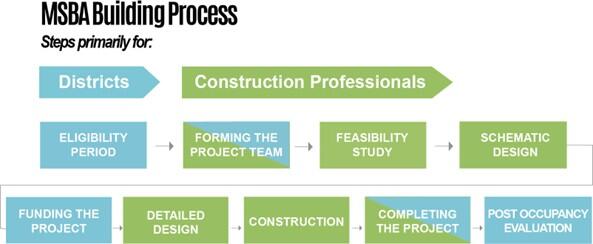
Source: MSBA’s website (https://www.massschoolbuildings.org/index.php/building)
See Appendix for more information on each of the steps in the image above.
Green Schools Program
The MSBA Green Schools Program is built into MSBA’s Core Program for new school construction and major renovation projects. The Green Schools Program is a set of requirements and incentives that promote the design of schools that are energy-efficient, sustainable, and healthier for students and staff members. All projects must meet minimum green building standards by achieving certification through either the Leadership in Energy and Environmental Design (LEED) school rating system, developed by the US Green Building Council, or the Northeast Collaborative for High Performance Schools’ (NE-CHPS’s) criteria. These certifications are specifically designed for school environments and help ensure high performance in areas such as energy use, indoor air quality, and environmental impact.
In addition to achieving a green building certification, all MSBA Core Program projects must comply with the minimum energy efficiency requirements outlined in the Massachusetts Department of Energy Resources’ “Stretch Code Green Community” standards. Projects that exceed these baseline requirements are eligible for additional reimbursement from MSBA. Before 2023, projects that achieved an energy performance of 20% better than the then-current Massachusetts base energy code qualified for a 2% bonus reimbursement. In 2023, MSBA updated its policy to replace this incentive. Under the new policy, projects that meet the Department of Energy Resources’ more stringent “Opt‑in Specialized Code” are now eligible for a 3% bonus reimbursement instead of the previous 2%. Also, beginning in 2023, projects that incorporate enhanced indoor air quality measures may receive an extra 1% reimbursement, provided they meet certain indoor air quality point thresholds under LEED or NE‑CHPS. A district that meets both of these criteria would receive a total of 4% in Green Schools Program reimbursements.
School districts must fulfill certain sustainability requirements in a project in order to receive these bonus reimbursements. If a district does not satisfy those requirements, it will not qualify for bonus reimbursements, and MSBA will adjust the reimbursement rate accordingly.
Project Closeout and Final Payment
After a district has been reimbursed for up to 95% of its estimated grant, MSBA withholds the remaining 5% until the project reaches substantial completion, all project costs have been paid by the district, and the district submits a Final Request for Payment Reimbursement, along with all required closeout documentation.
At this stage, MSBA conducts a final audit of the project, which must be reviewed and accepted by the district in which the project was completed. The purpose of this audit is to verify that all reported costs are documented, paid by the district, eligible under MSBA policies, and consistent with the approved project scope and budget. Once the audit is complete and MSBA’s board of directors approves the final grant amount, the remaining 5% of the grant is paid to the district.
As part of the closeout process, MSBA also ensures that districts have met their sustainability commitments under the Green Schools Program. Districts are required to submit an MSBA form called the Certificate of Green Schools Program Achievement, which is signed by both the owner’s project manager7 and the project designer. This certificate confirms that the project has completed certain Green Schools Program requirements. Included as part of this certification are the project’s final NE-CHPS or LEED scorecard and official certification letters or emails from NE-CHPS or the US Green Building Council. These scorecards and letters provide detailed evidence showing how the building meets environmental and energy efficiency standards. This final step ensures that the sustainability measures committed to during the planning phase have been fully implemented before the district receives the final payment.
| Date published: | December 24, 2025 |
|---|