

Overview
The Department of Fire Services’ Senior SAFE grant program delivers fire and life safety education, smoke and CO alarm installation, and other injury prevention strategies to older adults, who are most at risk of death or serious injury in a fire at home.
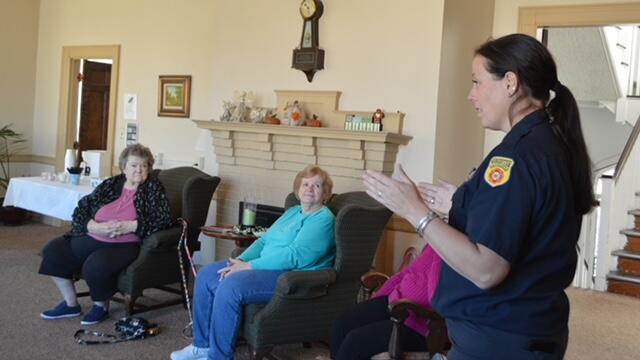
Modeled after the successful Student Awareness of Fire Education (SAFE) grants, Senior SAFE provides funding for trained firefighter-educators who engage with people aged 65 and older through senior centers, councils on aging, and home safety assessments.
Objective
Older adults have always faced a disproportionate risk of death in residential fires. Last year, they represented about 20% of the Massachusetts population but about 50% of fatal fire victims. The Senior SAFE grants were launched in 2014 to mitigate that risk by giving seniors the knowledge and tools to prevent and escape fires at home.
Accomplishments
During the length of the program, DFS Senior SAFE has provided about $7.6 million in grant awards to local fire departments that directly helped seniors remain safe at home while living independently. In addition to priceless fire and life safety education, these funds have also supported an estimated 21,150 senior fire safety presentations; 68,675 home visits; 73,250 smoke alarm installations; 48,250 carbon monoxide alarm installations; and 40,675 other safety device installations, including stovetop firestops, bed shakers, nightlights, house numbers, etc.
The number of Massachusetts residents aged 65 and older rose by 57% between 2004 and 2024. In the 10 years before Senior SAFE, and average of 14 older adults per year died in residential fires; in the 10 years following its launch the average number is 19. This is an increase of about 40%, significantly lower than the overall increase in older adults during the same time period.
Reflection
What worked well?
Because the Senior SAFE program is delivered at the local level, the firefighter-educators are often personally familiar with the seniors they serve, the homes in which they live, and the municipal, non-profit, and/or NGO agencies that work with them. As a result, these messengers are familiar with and trusted by their clients.
Many fire departments, especially those in smaller and rural communities, may not have the budgets to purchase the alarms and other safety devices they distribute through the program. They may not have the staffing levels necessary to conduct the presentations and home visits. The Senior SAFE program helps to fill these gaps.
What lessons were learned or barriers overcome?
School-age children in Massachusetts have received consistent, statewide fire safety education since the 1990s. Many of today’s older adults didn’t grow up with those foundational fire prevention and protection lessons. Declining mobility, fixed finances, and other risk factors are now combining to increase their vulnerability.
The Senior SAFE program is overcoming these challenges on two fronts: first, by funding personnel who can deliver specific, actionable, age-appropriate education, and second, through financial support for free distribution of smoke alarms, carbon monoxide alarms, and other vital life safety tools that are proven to reduce the human toll that fire takes on the Commonwealth’s residents each year.
ReiMAgine Aging 2030 Goal Alignment
- Goal 6: Information & Communication, Policy & Practice
Contact and Resources
Contact: jake.wark@mass.gov
Resources: Senior SAFE Program and Fire Safety for Seniors