

Massachusetts State Seal An official website of the Commonwealth of Massachusetts Here's how you know

Official websites use .mass.gov

A .mass.gov website belongs to an official government organization in Massachusetts.

Secure websites use HTTPS

A lock icon or https:// means you've safely connected to the official website. Share sensitive information only on official, secure websites.

Department of Unemployment Assistance - Appendix

Customer Experience (CX) Checklist

Figure 13. Customer Experience Checklist from the Employment and Training Administration (Page 1 of 5)
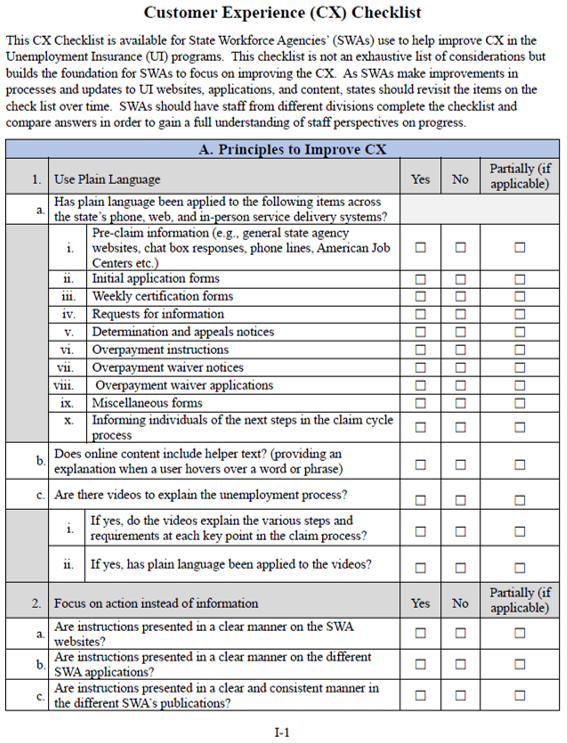
This is an image of the first page of the Employment and Training Administration’s (ETA’s) Customer Experience (CX) Checklist. More information in caption.
The text on the page reads as follows: This CX Checklist is available for State Workforce Agencies’ (SWAs) use to help improve CX in the Unemployment Insurance (UI) programs. This checklist is not an exhaustive list of considerations but builds the foundation for SWAs to focus on improving the CX. As SWAs make improvements in processes and updates to UI websites, applications, and content, states should revisit the items on the check list over time. SWAs should have staff from different divisions complete the checklist and compare answers in order to gain a full understanding of staff perspectives on progress. [Each question includes three boxes on the right side of the page where staff members can check the options “Yes,” “No,” or “Partially (if applicable)”] A. Principles to Improve CX 1. Use Plain Language . . . a. Has plain language been applied to the following items across the state’s phone, web, and in-person service delivery systems? i. Pre-claim information (e.g., general state agency websites, chat box responses, phone lines, American Job Centers etc.) ii. Initial application forms iii. Weekly certification forms iv. Requests for information v. Determination and appeals notices vi. Overpayment instructions vii. Overpayment waiver notices viii. Overpayment waiver applications ix. Miscellaneous forms x. Informing individuals of the next steps in the claim cycle process b. Does online content include helper text? (providing an explanation when a user hovers over a word or phrase) c. Are there videos to explain the unemployment process? i. If yes, do the videos explain the various steps and requirements at each key point in the claim process? ii. If yes, has plain language been applied to the videos? 2. Focus on action instead of information . . . a. Are instructions presented in a clear manner on the SWA websites? b. Are instructions presented in a clear manner on the different SWA applications? c. Are instructions presented in a clear and consistent manner in the different SWA’s publications? The document is also available on ETA’s website at https://www.dol.gov/sites/dolgov/files/ETA/advisories/TEN/2024/TEN%2018-24/TEN%2018-24.pdf.

Figure 14. Customer Experience Checklist from the Employment and Training Administration (Page 2 of 5)
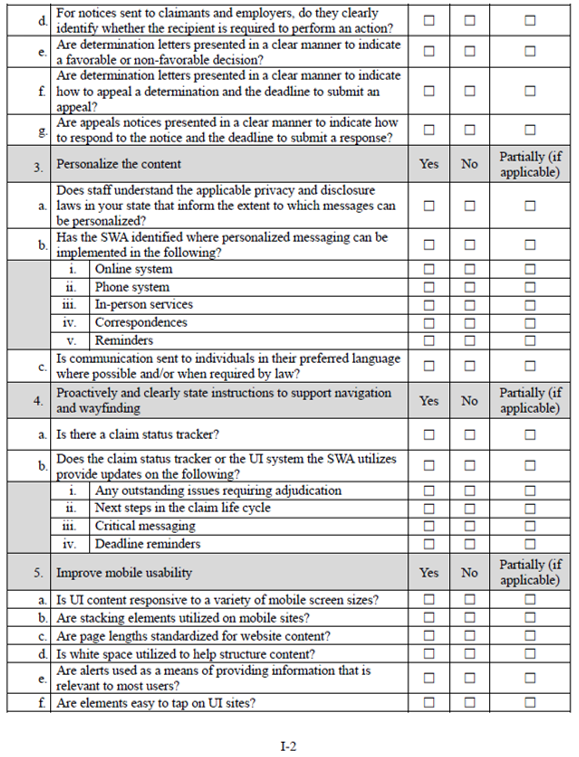
This is an image of the second page of ETA’s CX Checklist. More information in caption.
The text on the page reads as follows: [Each question includes three boxes on the right side of the page where staff members can check the options “Yes,” “No,” or “Partially (if applicable)”] [Continuation of Section 2 (Focus on action instead of information) from the previous page] d. For notices sent to claimants and employers, do they clearly identify whether the recipient is required to perform an action? e. Are determination letters presented in a clear manner to indicate a favorable or non-favorable decision? f. Are determination letters presented in a clear manner to indicate how to appeal a determination and the deadline to submit an appeal? g. Are appeals notices presented in a clear manner to indicate how to respond to the notice and the deadline to submit a response? 3. Personalize the content . . . a. Does staff understand the applicable privacy and disclosure laws in your state that inform the extent to which messages can be personalized? b. Has the SWA identified where personalized messaging can be implemented in the following? i. Online system ii. Phone system iii. In-person services iv. Correspondences v. Reminders c. Is communication sent to individuals in their preferred language where possible and/or when required by law? 4. Proactively and clearly state instructions to support navigation and wayfinding . . . a. Is there a claim status tracker? b. Does the claim status tracker or the UI system the SWA utilizes provide updates on the following? i. Any outstanding issues requiring adjudication ii. Next steps in the claim life cycle iii. Critical messaging iv. Deadline reminders 5. Improve mobile usability . . . a. Is UI content responsive to a variety of mobile screen sizes? b. Are stacking elements utilized on mobile sites? c. Are page lengths standardized for website content? d. Is white space utilized to help structure content? e. Are alerts used as a means of providing information that is relevant to most users? f. Are elements easy to tap on UI sites? The document is also available on ETA’s website at https://www.dol.gov/sites/dolgov/files/ETA/advisories/TEN/2024/TEN%2018-24/TEN%2018-24.pdf.

Figure 15. Customer Experience Checklist from the Employment and Training Administration (Page 3 of 5)
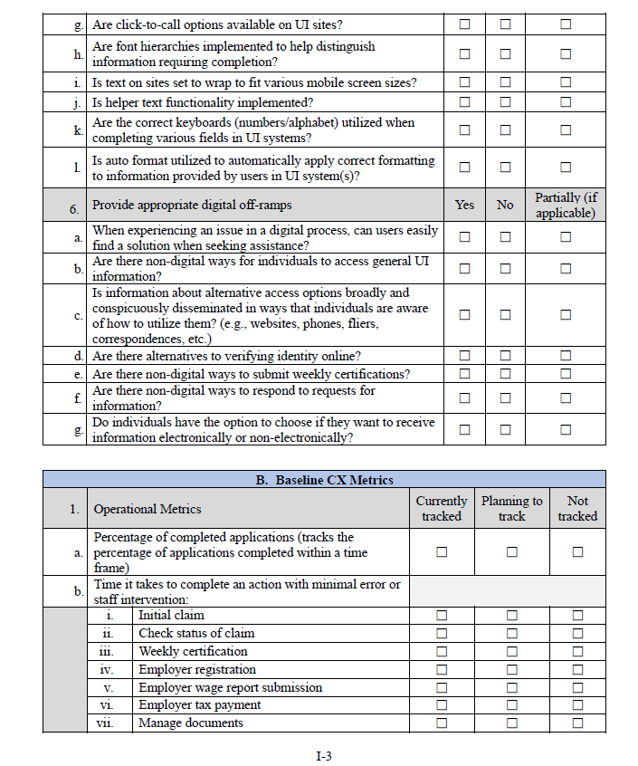
This is an image of the third page of ETA’s CX Checklist. More information in caption.
The text on the page reads as follows: [Each question includes three boxes on the right side of the page where staff members can check the options “Yes,” “No,” or “Partially (if applicable)”] [Continuation of Section 5 (Improve mobile usability) from the previous page] g. Are click-to-call options available on UI sites? h. Are font hierarchies implemented to help distinguish information requiring completion? i. Is text on sites set to wrap to fit various mobile screen sizes? j. Is helper text functionality implemented? k. Are the correct keyboards (numbers/alphabet) utilized when completing various fields in UI systems? l. Is auto format utilized to automatically apply correct formatting to information provided by users in UI system(s)? 6. Provide appropriate digital off-ramps Yes No Partially (if applicable) a. When experiencing an issue in a digital process, can users easily find a solution when seeking assistance? b. Are there non-digital ways for individuals to access general UI information? c. Is information about alternative access options broadly and conspicuously disseminated in ways that individuals are aware of how to utilize them? (e.g., websites, phones, fliers, correspondences, etc.) d. Are there alternatives to verifying identity online? e. Are there non-digital ways to submit weekly certifications? f. Are there non-digital ways to respond to requests for information? g. Do individuals have the option to choose if they want to receive information electronically or non-electronically? B. Baseline CX Metrics . . . [Each question includes three boxes on the right side of the page where staff members can check the options “Currently tracked,” “Planning to track,” or “Not tracked”] 1. Operational Metrics . . . a. Percentage of completed applications (tracks the percentage of applications completed within a time frame) b. Time it takes to complete an action with minimal error or staff intervention: i. Initial claim ii. Check status of claim iii. Weekly certification iv. Employer registration v. Employer wage report submission vi. Employer tax payment vii. Manage documents The document is also available on ETA’s website at https://www.dol.gov/sites/dolgov/files/ETA/advisories/TEN/2024/TEN%2018-24/TEN%2018-24.pdf.

Figure 16. Customer Experience Checklist from the Employment and Training Administration (Page 4 of 5)
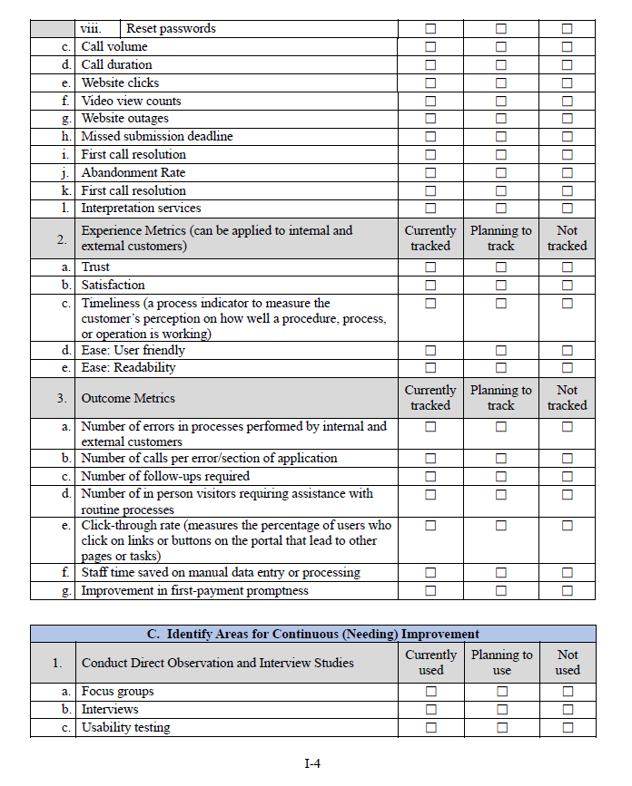
This is an image of the fourth page of ETA’s CX Checklist. More information in caption.
The text on the page reads as follows: [Continuation of Section 1 (Operational Metrics) from the previous page] [Each question includes three boxes on the right side of the page where staff members can check the options “Currently tracked,” “Planning to track,” or “Not tracked”] viii. Reset passwords c. Call volume d. Call duration e. Website clicks f. Video view counts g. Website outages h. Missed submission deadline i. First call resolution j. Abandonment Rate k. First call resolution l. Interpretation services 2. Experience Metrics (can be applied to internal and external customers) . . . a. Trust b. Satisfaction c. Timeliness (a process indicator to measure the customer’s perception on how well a procedure, process, or operation is working) d. Ease: User friendly e. Ease: Readability 3. Outcome Metrics Currently . . . a. Number of errors in processes performed by internal and external customers b. Number of calls per error/section of application c. Number of follow-ups required d. Number of in person visitors requiring assistance with routine processes e. Click-through rate (measures the percentage of users who click on links or buttons on the portal that lead to other pages or tasks) f. Staff time saved on manual data entry or processing g. Improvement in first-payment promptness C. Identify Areas for Continuous (Needing) Improvement [Each question includes three boxes on the right side of the page where staff members can check the options “Currently used,” “Planning to use,” or “Not used”] 1. Conduct Direct Observation and Interview Studies . . . a. Focus groups b. Interviews c. Usability testing The document is also available on ETA’s website at https://www.dol.gov/sites/dolgov/files/ETA/advisories/TEN/2024/TEN%2018-24/TEN%2018-24.pdf.

Figure 17. Customer Experience Checklist from the Employment and Training Administration (Page 5 of 5)
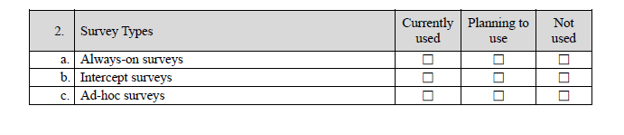
This is an image of the fifth page of ETA’s CX Checklist. More information in caption.
The text on the page reads as follows: [Each question includes three boxes on the right side of the page where staff members can check the options “Currently used,” “Planning to use,” or “Not used”] 2. Survey Types a. Always-on surveys b. Intercept surveys c. Ad-hoc surveys The document is also available on ETA’s website at https://www.dol.gov/sites/dolgov/files/ETA/advisories/TEN/2024/TEN%2018-24/TEN%2018-24.pdf.
Date published: September 21, 2026

Help Us Improve Mass.gov  with your feedback

Please do not include personal or contact information.
Feedback