
- Scientific name: Sympistis riparia
- Species of Greatest Conservation Need (MA State Wildlife Action Plan)
- Special Concern (MA Endangered Species Act)
Description
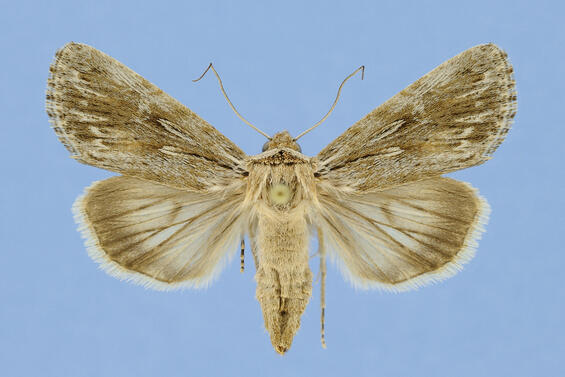
Dune sympistis, Sympistis riparia
The dune sympistis (Sympistis riparia) is a noctuid moth with a wingspan of 30-35 mm (1.2-1.4 in) (Forbes 1954). The forewing is olive tan in color, frosted with white scales, particularly toward the costal margin; the subterminal area has a series of faint to prominent black dashes, each outlined with white, extending from the wing apex to the anal angle. The forewing has a black basal dash that extends into a white, elongate claviform spot. The orbicular spot is also white and elongate, finely outlined with black. The reniform spot is obscure, consisting of a diffuse patch of white scales, often with a small black dot at the inner edge. The forewing fringe is checkered with alternating olive tan and white scales. The hind wing is tan, pale proximally and darker toward the outer margin, with a faint discal spot and white fringe. The head, thorax, and abdomen are all tan, frosted with white.
Life cycle and behavior
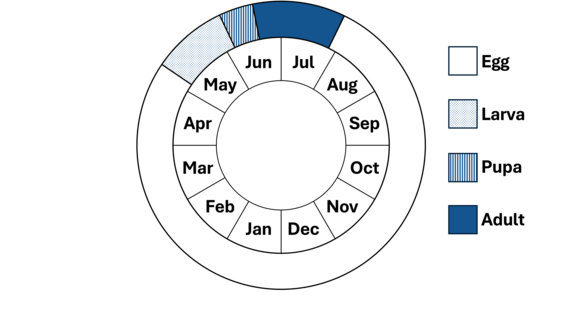
In Massachusetts, dune sympistis moths fly from mid-June to late July. Eggs overwinter and hatch in late April or early May. Larvae feed on the flowers and new growth of beach plum (Prunus maritima) (Goldstein & Nelson 2017) and pupate in early June.
Distribution and abundance
The extent of the global range of the dune sympistis is unclear due to confusion with several closely related species (McDunnough 1941, Troubridge & Crabo 1998), but at least consists of the coastal Atlantic region from the Canadian Maritime Provinces south to North Carolina. Specimens from the Great Lakes states are transitional in wing pattern to the western Sympistis major (Forbes 1954). Specimens from west of the Great Lakes likely represent Sympistis major or another closely related species. In Massachusetts, the dune sympistis occurs along the coast, in both the northeastern and southeastern parts of the state.

Distribution in Massachusetts.
1999-2024
Based on records in the Natural Heritage Database.
Habitat
In Massachusetts, the dune sympistis inhabits coastal dunes and bluffs, as well as coastal sandplain grasslands and heathlands.
Healthy habitats are vital for supporting native wildlife and plants. Explore habitats and learn about conservation and restoration in Massachusetts.
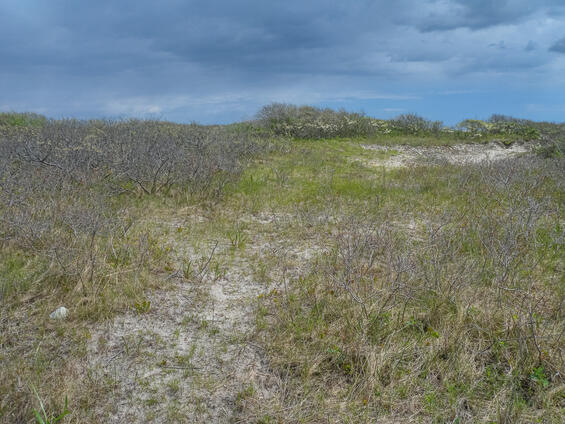
Coastal dunes with beach plum (Prunus maritima), habitat for the dune sympistis. Habitat managed by Mass Audubon at Allens Pond Wildlife Sanctuary.
Threats
The dune sympistis is threatened by habitat loss and fire suppression. Other potential threats include coastal dune nourishment, introduced generalist parasitoids, aerial insecticide spraying, non-target herbicide application, and off-road vehicles. This species is vulnerable to climate change, as its habitat is threatened by sea level rise.
Conservation
Land protection and habitat management are the primary conservation needs of the dune sympistis in Massachusetts. In particular, coastal dunes and bluffs and coastal sandplain grasslands and heathlands should be conserved, restored, and managed to maintain habitat for this species and other species dependent on such habitats.
Survey and monitoring
The distribution of the dune sympistis in Massachusetts is well documented. Known populations of this species should be surveyed to document persistence at least once every 25 years; every 10 years is more desirable when practicable.
Management
Management of coastal dunes and bluffs should avoid dune nourishment. Management of sandplain grasslands and heathlands benefits a suite of rare and threatened species, and habitat condition should be monitored and management adapted as needed.
Research needs
The natural history and conservation needs of the dune sympistis are relatively well known. However, this species is vulnerable to climate change; the future effects of a warming climate on this species should be studied.
References
Forbes, W.T.M. 1954. Lepidoptera of New York and Neighboring States. Part III. Memoir 329, Cornell University Agricultural Experiment Station, Ithaca, New York. 433 pp.
Goldstein, P.Z. and M.W. Nelson. 2017. Two psammophilic noctuids newly associated with beach plum, Prunus maritima (Rosaceae): The dune noctuid (Sympistis riparia) and coastal heathland cutworm (Abagrotis benjamini) in northeastern North America (Lepidoptera, Noctuidae). ZooKeys 661: 61-89.
McDunnough, J. 1941. Oncocnemis riparia Morr. and its races. Canadian Entomologist 73: 171-174.
Troubridge, J. and L. Crabo. 1998. New Oncocnemis (Lepidoptera: Noctuidae) from the Pacific Northwest. Journal of the Entomological Society of British Columbia 95: 33-51.
Contact
| Date published: | March 24, 2025 |
|---|