
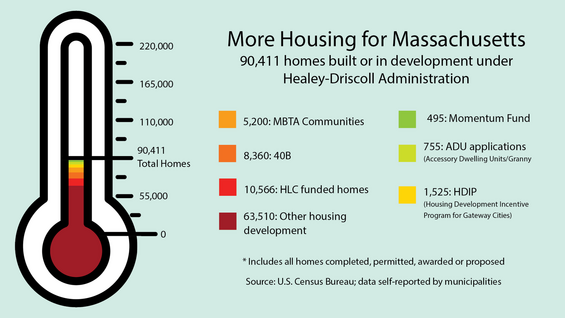
HLC has begun an effort to track housing production in Massachusetts and released initial production estimates in August 2025. Between January 2023 and July 2025, Massachusetts saw an estimated 63,100 homes added to the supply, with 18,300 currently under construction. There are also approximately 3,600 affordable homes that have been awarded funding from HLC and a known 5,400 privately-financed homes that have been proposed. In total, an estimated 90,400 homes have been completed, started construction, or have been proposed since the beginning of the Healey-Driscoll Administration. This document describes how HLC arrived at these estimates and what stakeholders should expect regarding updates and changes in the future.
Broadly speaking, HLC relies on two Census Bureau products to determine the number of housing starts and completions: the monthly Census Building Permit Survey and the Current Address Count Listing Files. Using internal HLC datasets, we then estimate the number of units completed or under construction that were funded by HLC or enabled through one of our programs or policies. These are subtracted from the total starts and completions, and what remains is all other private market development. Estimates of units that have not yet started construction are drawn from HLC award lists, internal tracking of development proposals in MBTA Communities Districts, and information collected directly from local building inspectors. More detail on all these sources and calculations is provided below.
HLC plans to update the totals for starts and completions at least twice per year when new Address Count Listings become available. There will also be periodic adjustments to the number of units in each category as HLC conducts quality control and verifies construction and completion dates for funded developments. HLC will continue efforts to improve municipal data reporting and streamline data collection pipelines so that the state can have an accurate picture of what is happening in each city and town without creating undue burden for municipal officials and staff.
Total Housing Completions
Estimates of total units completed are drawn from the Current Address Count Listing Files, a new Census Bureau product derived from data collected by the US Postal Service, among other sources. The Address Count Listings are an extract of the Census Bureau’s Master Address File (MAF), a detailed and continuously maintained inventory of every residential address in the country. The MAF is updated biannually based on the latest information from USPS delivery sequence files. Census Bureau staff also review the data to verify the addresses and remove those that no longer exist or which are misclassified (e.g., group quarters addresses listed as housing unit addresses.) Current Address Count Listing Files are provided at a detailed geographic scale (census block) and addresses are added around the time that units become available for occupancy. While it is not possible for HLC to independently validate the Address Count data, a manual review of the data and comparison to know development opening dates showed that it is accurately reflecting new developments and the timing of their completion.
Five vintages of the data are currently available: July 2025, December 2024, July 2024, December 2023, and 2020 Decennial Census (published online June 2022). Communications with Census Bureau staff confirmed that no records for January 2023 were available, so HLC interpolated an estimate using the estimates from April 2020 and December 2023. Based on this data, we estimate that there were 3,033,100 residential addresses in Massachusetts in January 2023 (34,600 more than were counted on the 2020 decennial census.) By July 2025 the count had increased to approximately 3,096,200. From this we estimate that 63,100 units have been completed and made available for occupancy since January 2023.
Total Housing Starts
Information on permits issued (also referred to as housing starts) is drawn from the Census Building Permit Survey, a monthly survey administered to building officials in all 351 municipalities. The survey solicits information about units permitted, building type (single family, 2-4 units, 5 or more), and total value of permits. HLC downloaded and analyzed 2023 and 2024 reports by municipality and the statewide June 2025 year-to-date report. Over this period, approximately 71% of municipalities reported data monthly, while 22% did not provide any survey responses (the remainder provided responses for some but not all months.) The Census Bureau attempts to compensate for nonresponse by imputing estimated permit issuance, but HLC did not use imputations due to the high level of uncertainty surrounding these figures. HLC relied only on the data reported by building inspectors, who issued permits for 28,545 units since January 2023. This statistic is almost certainly an underestimate of total permitting and will increase as data are collected from nonreporters.
In order to estimate how many of the permitted units are still under construction as of January 2025, HLC assumed that permitted units became available for occupancy on the following construction timelines: 1 year for 1-unit buildings, 1.5 years for 2-4 unit buildings, and 2 years for buildings with 5 units or more. Only units permitted in those timeframes prior to the end of the reporting period are assumed to be still in construction. For example, single family homes permitted in 2023 are all assumed to be complete and accounted for in the Address Count Listing Files; whereas those permitted in the latter half of 2024 are counted as under construction. Based on these assumptions, HLC estimates that there were 18,300 homes under construction in Massachusetts in July 2025.
HLC funded developments
HLC administers a wide variety of funding programs to support the construction of affordable rental housing. These include state and federal tax credit programs as well as subsidies from state capital sources. HLC queried its grant management system to identify new construction or adaptive reuse developments where the award, construction start, or placed-in-service date is after 2023. In total, there were 8,800 units meeting these criteria, including an estimated 4,200 units that have been completed during that period and 4,600 that are currently under construction. There are also an estimated 1,800 HLC-funded units that have been awarded but have not yet started construction. HLC is still working to verify the construction and completion dates for developments, so these estimates will continue to improve over the coming months.
Housing Development Incentive Program
The Housing Development Incentive Program (HDIP) offers both local and state tax incentives for market rate development in Gateway Cities. HDIP funding is administered by the Housing Development Division at HLC, which provides a conditional certification before construction begins and a final certification once the property is leased up. Analysis of the HDIP tracker identified 1,263 units that have been awarded but not started construction and 262 units that are in the construction phase.
40B Comprehensive Permits
HLC and its quasi-public partner organizations (MassHousing, MassHousing Partnership, and MassDevelopment) maintain an interagency tracking spreadsheet of developments that have submitted a request for a Project Eligibility Letter under the 40B Comprehensive Permit statute. HLC also monitors when developments are issued a building permit and when they are placed in service. Analysis of the data identified 4,800 units that are in construction and 3,600 that have been occupied since January 2023.
Accessory Dwelling Units
The Affordable Homes Act requires accessory dwelling units (ADUs) to be allowed as-of-right in all single-family zoning districts statewide (excluding Boston, whose zoning is covered exclusively by a separate state statute). HLC’s regulations for ADUs require municipal building inspectors to record information about each application, including type, location, size, cost, and milestone dates. The law went into effect on February 3, 2025. In July, HLC administered a survey to municipal building officials seeking information about the number of ADUs applied for, permitted, and completed since the beginning of the year. 235 building officials responded, representing 67% of the municipalities in MA, containing 82% of the state’s housing units. Building inspectors reported more than 840 applications, of which about 10% have been rejected or withdrawn. Approximately 550 building permits have been issued as well as 70 certificates of occupancy. Based on these responses, HLC estimates that there have been 70 new ADUs completed, there are 480 under construction, and 200 proposed but not yet approved.
MBTA Communities
HLC collects information about developments proposed in or near MBTA Communities Districts. To date, staff have collected information about 44 developments totaling 5,200 units. The status of each has not been determined, so all of these units are classified as “proposed” until there is information to confirm they have moved into the construction phase.
Momentum Fund
The Momentum Fund is a revolving fund that provides flexible capital to help mixed-income housing production. To date, the fund has announced awards for approximately 500 units. None have started construction prior to July 2025, so all of these units are classified as “awarded.”
Other Private Market Development
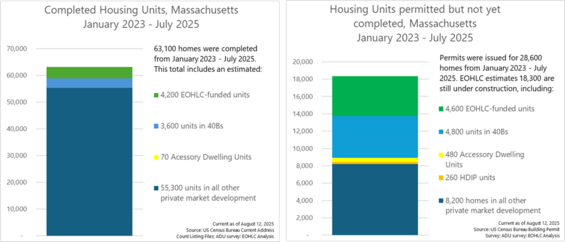
The units associated with HLC subsidies and programs were subtracted from the total housing starts and completions. What remains is classified as all other private market development. The charts below show the total completions and starts as well as the portion that are classified as all other private market development.
Caveats
The housing production tracking being led by HLC represents the first significant effort to track both ongoing production and unit completions comprehensively across the state. Production estimations are based on the most accurate available data and are subject to revision, quality control and regular updates.
The building permit estimates lack data from non-reporting municipalities and likely underestimate the total amount of permitting. However, these same data also include units that are a 1:1 replacement for an existing home so there may be some permitted units that are not adding to the supply. HLC estimated the timeline from permit issuance to completion based on industry sources, but some projects may be placed in service before or after those dates. The Address Count Listing File estimate for January 2023 is an interpolation based on two other data points and may not reflect the exact unit count at that time. The effective date of the July 2025 estimate has not been published by the Census Bureau so it may reflect a count of units from slightly before that date. The lead time from address listing to occupancy has not been determined, so there could be some units assigned addresses but not yet fully completed. Some completions may be seasonal units not meant for permanent, year-round occupancy. The address count listing does not account for the conversion of units from year-round to seasonal uses, a process that diminishes the count of units available to residents.
Dates of approvals, construction start dates and placed in service dates in HLC’s data systems may not be completely accurate given the uncertain nature of many projects and the difficulty in updating timelines on a regular basis. The MBTA Communities development tracker is added to on an ad-hoc basis and is not comprehensive of all proposed developments. The ADU survey is an underestimate due to a 33% nonresponse rate.
Summary
This first-ever estimate of housing production proposals, starts, and completions shows that Massachusetts has a strong housing pipeline. We will need to maintain and expand this momentum throughout the 10-year period covered by A Home For Everyone, which calls for production of 222,000 new homes between 2025 and 2035.
In the coming months, HLC will continue to verify, review, and improve the data underlying these statistics, including creation of municipal-level estimates.
| Date published: | August 19, 2025 |
|---|