

Introduction to health impact assessments

The guiding principles of an HIA are:
- Involvement and engagement of stakeholders to inform a decision
- Consideration of the vulnerable groups
- Evaluation of both short- and long-term impacts and benefits
- Assessment of health using evidence-based methods that consider physical, mental, environmental, economic, and social determinants of health
An HIA can be applied to evaluate a proposed project, program, or policy across many different sectors. The goal of an HIA is to bring a wide range of public health concerns into the decision-making process. This can help reduce impacts and promote healthy communities. HIAs can be useful in assessing health risks and benefits of decisions where health is not typically considered, like those involving transportation and land use planning projects.
Using MA EPHT data for health impact assessments
Health and environmental datasets provided on the MA EPHT portal can help inform HIAs. The portal is uniquely positioned to inform HIA practice by:
- Improving access to baseline health and environmental data
- Providing content developed by specialists in data analyses, GIS, data visualization, epidemiology, toxicology, and risk communication
- Serving as a tool supporting the development of collaborative partnerships and cross-program activities or initiatives
MA EPHT data are collected and updated on an ongoing basis. This aspect makes MA EPHT data especially useful for monitoring and evaluating actions and decisions over time. For example, data can be used to evaluate pre- and post-implementation impacts of the HIA decision or action.
Steps of a health impact assessment
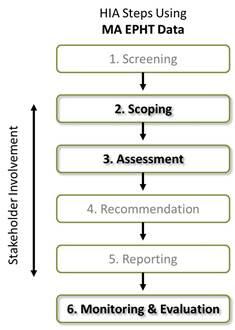
The HIA process consists of six steps:
- Screening – identify plans, projects, or policies for which an HIA would be useful
- Scoping – explore the relevant health outcomes and environmental issues of interest
- Assessment – identify the populations that would be affected, describe the baseline health of the populations, and determine the potential impacts
- Recommendations – suggest solutions or changes to the plan, project, or policies to best improve health outcomes
- Reporting – present and share results
- Monitoring and Evaluation – determine the effect of the HIA on the plan, project, or policy
Data from the MA EPHT website can be used to inform the following steps of an HIA:
- Scoping
- Assessment
- Monitoring and Evaluation
Stakeholder involvement is an important component of HIA and each step of the HIA process provides opportunity for meaningful engagement. Stakeholders include those with an interest in the outcome of the decision the HIA is informing, such as policymakers or transportation officials, and the people who will be most directly impacted by the decision.
The stakeholder involvement process includes:
- Formal and informal meetings to share information and solicit input on the project proposal
- Formal community meetings
- Outreach to interested groups not able to participate in formal stakeholder meetings
- Sharing draft presentations, draft reports, and related information in publicly accessible forums such as websites and local libraries
The Minimum Elements and Practice Standards for Health Impact Assessment (MEPS) outlines the minimum criteria that an HIA should address as well as best practices for conducting it.
Health impact assessments in Massachusetts
Examples of HIAs in Massachusetts include:
- HIA of a proposed natural gas compressor station in Weymouth, MA (2019)
- Assessing the health impacts and benefits of regional climate action plan strategies in western Massachusetts (2017)
- Community Investment Tax Credit HIA (2014)
- HIA of the MassDOT grounding McGrath study (2013)
- Transit-oriented development and health: An HIA to inform the Healthy Neighborhoods Equity Fund (2013)
- Speed reduction on local roads HIA (2012)
- The Quequechan River Rail Trail project HIA (2012)