
- Scientific name: Sparganium angustifolium Michx.
Species of Greatest Conservation Need (MA State Wildlife Action Plan)
Description
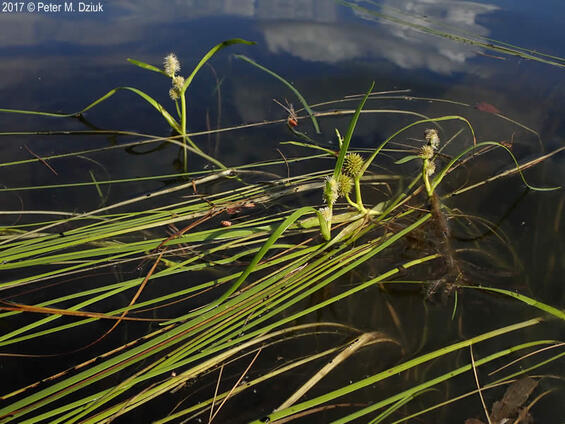
Photo by Peter M. Dzuik, MinnesotaWildflowers.info.
The bur-reeds (genus Sparganium) are a small group of grass-like aquatic and wetland plants of the cat-tail family (Typhaceae); seven species are known from Massachusetts. Unlike true grasses, the leaves lack sheaths and ligules (a characteristic flap of tissue at the base of the leaf blades), and unlike many other aquatic and wetland species with ribbon-like leaves, the leaves of bur-reeds lack a defined mid-vein. Male and female flowers are borne in separate flower heads usually on the same plant. Fruits are arranged in dense spherical heads.
Narrow-leaved bur-reed, Sparganium angustifolium, has a floating stem and leaves. The leaves are only 1.5-5 mm (0.06-0.2 in) wide and are usually rounded on their backs. The inflorescence is not branched, the lowest 2 to 5 flowering heads are pistillate heads, and the upper 2 to 4 are staminate. All are in the axils of leaves or bracts and may be sessile or on a stalk from the leaf axil. When mature the fruiting heads are up to 3 cm (1 in) wide. The tepals are spatulate-shaped and about 2/3 as long as the fruit. The achenes are a dull brown, 3-5 mm (0.12-0.2 in) long, abruptly contracted to a beak 1 mm (0.04 in) long, round in cross-section and is straight, or only slightly curved.
Narrow-leaved bur-reed might be confused with small bur-reed, S. natans (Endangered). Small bur-reed also has narrow leaves only 2-6 mm (0.08-0.24 in) wide, similar to narrow-leaved bur-reed, but the leaves of small bur-reed will only reach a length of 60 cm (2 ft) while those of floating leaved bur-reed can be 120 cm (4 ft) in length. Small bur-reed will have only one terminal head of male flowers, unlike narrow-leaved bur-reed which has 2 to 4 heads of male flowers. The vegetative plants of floating bur-reed, S. fluctuans (SGCN, watch list), may be confused with narrow-leaved bur-reed. The leaves of floating bur-reed can range from 3-11 mm (0.12-0.43 in) wide but typically are over 5 mm (0.2 in) while those of narrow-leaved bur-reed are less than 5 mm (0.2 in). Green-fruited bur-reed (S. emersum) may also be confused with narrow-leaved bur-reed, as it too sometimes has floating leaves, which are typically stiffer and wider at 6-12 mm (0.24-0.47 in) wide, and, instead of being flat, its leaves are keeled and triangular in cross-section. American eelgrass (Vallisneria americana) also has long ribbon-like leaves that float in the water. Narrow-leaved bur-reed has green parallel veins with several cross veins between them, while eelgrass has a central vein and many fine parallel veins on either side of it.
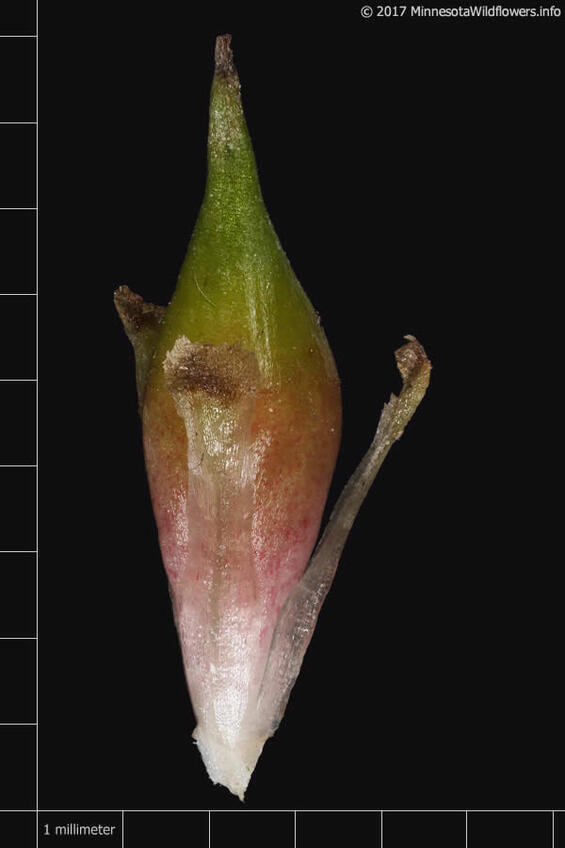
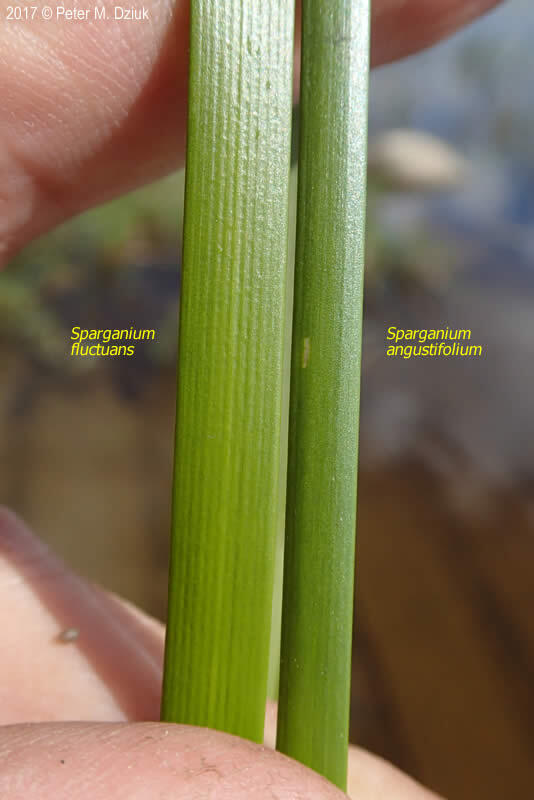
Photos by Peter M. Dzuik, MinnesotaWildflowers.info.
Life cycle and behavior
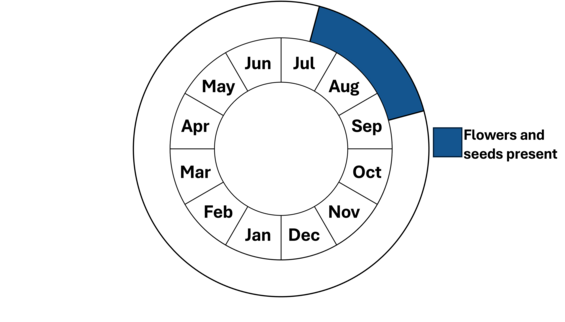
Narrow-leaved bur-reed is a perennial aquatic plant with floating leaves. Flowers may be present from mid-July through September. Fruits would be found soon after if the plants flower. The fruits will float initially when released and are dispersed by the water flow.
Population status
Narrow-leaved bur-reed has recently been listed as a species of greatest conservation need and is maintained on the plant watch list. There is only 1 occurrence in the state verified since 1999 found in Worcester County. Five historical occurrences were located in Berkshire, Essex, and Franklin Counties. In addition, there are no additional herbarium records in the Consortium of Northeastern Herbaria.
Distribution and abundance
Narrow-leaved bur-reed has a circumpolar distribution, is found across the US and Canada, Greenland, Europe, and Asia. In North America, it is known in every Canadian province except for Nunavut. In the US, it is found west of the Rocky Mountains to the Pacific Ocean and into Alaska. It also occurs in the upper mid-west, and New England, with its range extending as far south as West Virginia (critically imperiled) and Pennsylvania (imperiled). New Jersey assesses this species as possibly extirpated. In Massachusetts, it is currently assessed as imperiled, while New York assesses it as vulnerable. Vermont considers it secure, and it is not known from Rhode Island. Connecticut, Maine, and New Hampshire have not assessed it (NatureServe 2025).
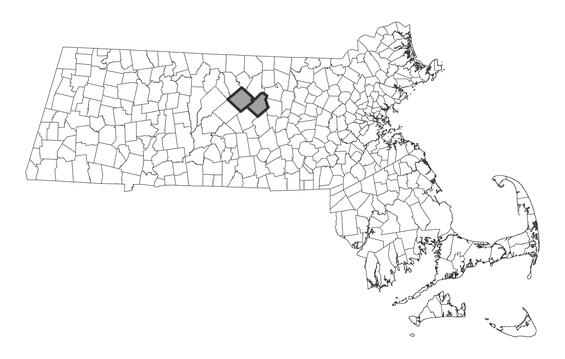
Distribution in Massachusetts. 1999-2024. Based on records in the Natural Heritage Database.
Habitat
Narrow-leaved bur-reed may be found in shallow or deep water and is occasionally found on mud. The water in the pond or lake where it is found typically has a higher pH. This species is found in the quiet waters of clear lakes, ponds, and slow-moving rivers, often in less than 1 m (3 feet) of water, but is sometimes found in deeper water.
Healthy habitats are vital for supporting native wildlife and plants. Explore habitats and learn about conservation and restoration in Massachusetts.
Threats
Little is known about the threats to this under-surveyed species. It is likely that invasive aquatic weeds are a threat to narrow-leaved bur-reed. It could potentially be threatened by development, alteration of hydrology, erosion, pollution, recreational activities, invasive species, drought, and other threats in some places. As this species is near its southern extent in Massachusetts, it may be threatened by climate change, but that is unknown.
Conservation
As there is only one population currently known in Massachusetts of narrow-leaved bur-reed, it is thought that it is under-surveyed. It may be that it is not being reported because of its similarity to other floating-leaved bur-reed species, though the narrow-leaves should be distinctive. Surveys both of past known locations and new potential sites are needed. Look for narrow long leaves with evenly spaced parallel veins. The best time to survey for it is when it is in fruit from mid-July through September.
The ecological needs of this species are not well understood, so management needs are not well known. However, controlling invasive aquatic species may be needed, as might maintenance or restoration of hydrology. All active management of rare plant populations (including invasive species removal) is subject to review under the Massachusetts Endangered Species Act and should be planned in close consultation with MassWildlife’s Natural Heritage & Endangered Species Program.
The exact ecological needs of this species are not well understood. As this plant is under-surveyed, more standard information is needed such as lists of associated species, comments on habitat quality and threats, and assessments of soil conditions and phenology. Research is needed to determine whether this plant can be grown in a nursery or garden setting for purposes of reintroduction. If habitat degradation accelerates the losses of current populations, this strategy could prove useful to the long-term conservation of this species.
References
Bertin, R. I, Rawinski, T. J. (2012) Vascular Flora of Worcester County, Massachusetts. New England Botanical Club. 291pp.
Bertin RI, Hickler MG, Searcy KB, et al (2020) Vascular Flora of Franklin County, Massachusetts. New England Botanical Club.
Consortium of Northeastern Herbaria. 2025. Herbarium records. https://portal.neherbaria.org/portal/collections/list.php. Accessed 4/6/2025.
Cullina M, Connolly B, Sorrie B, Somers P (2011) The vascular plants of Massachusetts: a county checklist, 1st revision. Massachusetts Natural Heritage & Endangered Species Massachusetts Division of Fisheries and Wildlife, Westborough, MA
Crow, Garrett E. and C. Barre Hellquist. 2000. Aquatic and Wetland Plants of Northeastern North America, Volume Two. The University of Wisconsin Press. Madison, Wisconsin.
Fernald, M. L. 1950. Gray’s Manual of Botany, Eighth (Centennial) Edition—Illustrated. American Book Company, New York.
Gleason, Henry A., and Arthur Cronquist. Manual of Vascular Plants of Northeastern United States and Adjacent Canada, Second Edition. Bronx, NY: The New York Botanical Garden, 1991.
Haines, A. 2011. Flora Novae Angliae – a Manual for the Identification of Native and Naturalized Higher Vascular Plants of New England. New England Wildflower Society, Yale Univ. Press, New Haven, CT.
Kraul, R.B. 2000. Sparganium. Pages 270–277 in Flora of North America Editorial Committee (Editors). Flora of North America North of Mexico. Volume 22: Magnoliophyta: Alismatidae, Arecidae, Commelinidae (in part), and Zingiberidae. Oxford University Press, New York, New York, USA.
NatureServe. 2025. NatureServe Network Biodiversity Location Data accessed through NatureServe Explorer [web application]. NatureServe, Arlington, Virginia. Available https://explorer.natureserve.org/. Accessed: 4/3/2025.
POWO (2025). Plants of the World Online. Facilitated by the Royal Botanic Gardens, Kew. Published on the Internet; https://powo.science.kew.org/ Accessed: 4/3/2025.
Seymour, Frank C. 1969. The Flora of New England, First edition. Charles E. Tuttle Company, Inc. Tokyo, Japan.
Contact
| Date published: | May 8, 2025 |
|---|