

River Herring in Massachusetts
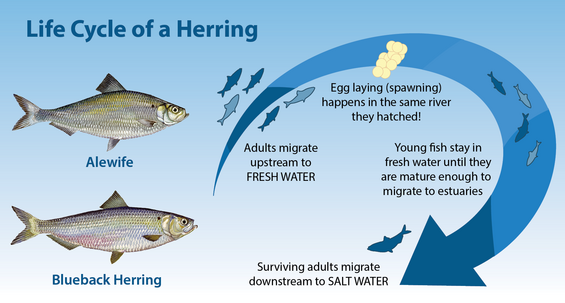
The diadromous life cycle of river herring in Massachusetts.
River herring are diadromous, meaning they migrate between fresh water and salt water to complete their life cycle. Each spring, when rivers begin warming and reach the right temperature, adult herring migrate or "run" up rivers to reach freshwater habitats where they can spawn. Their eggs will hatch just days after laying, and then the young herring will spend the next several months feeding and growing in fresh water. Once they are large enough, river herring begin their journey back to the ocean, where they will spend the next few years reaching maturity. When they are ready to spawn, they live migrate back from salt water to the freshwater river where they first hatched.
In Massachusetts, two closely related species share the common name river herring, alewife and blueback herring.
- Alewife spawn in late March to mid-May, when water temperatures reach 51ºF.
- Blueback herring spawn in late April through June when water temperatures reach 57ºF.
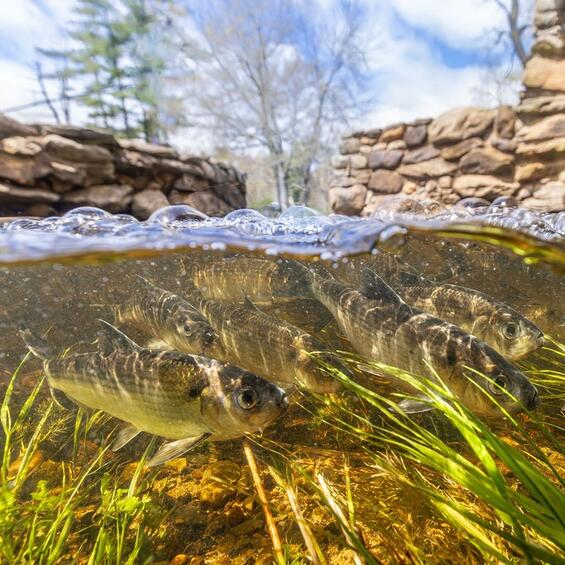
Photo by @CHARLIELIKESWATER.
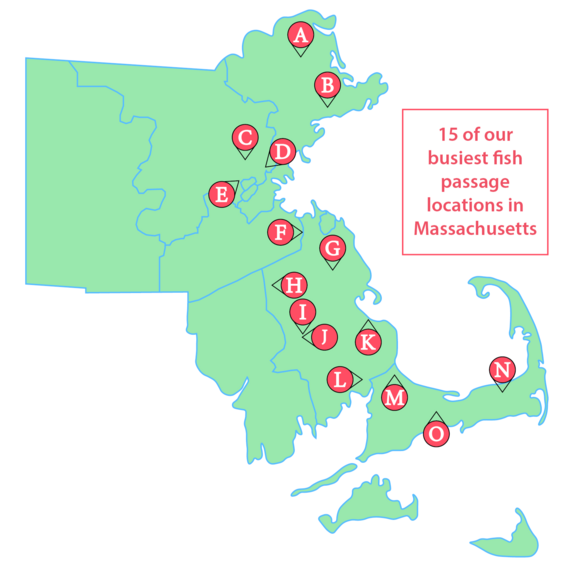
Use the viewing guide below to find a location near you to watch a herring run.
Viewing guide
| Map | Viewing location | Ideal viewing dates | Herring run size | Parking |
|---|---|---|---|---|
| A | Woolen Mill Dam and Fishway, Parker River, Newbury This is the first of six dams on the Parker River, and each has a fishway to provide passage to the headwaters in Pentucket Pond. | April 15 - May 15 | 20,000 - 50,000 fish | Limited parking |
| B | Apple and Pond Street Bridges, Alewife Brook, Essex Mass DMF maintains an electronic counting station at Pond Street, with current run counts displayed. Bridges are located just off Western Avenue (Route 22). | April 1 - May 1 | 20,000 - 50,000 fish | Limited parking |
| C | Central Falls Dam and Fishway, Aberjona River, Winchester The ladder (located off Main Street near Mystic Valley Parkway) was installed in 2016, providing access to previously inaccessible habitat in Wedge and Horn Ponds. | May 1 - June 1 | 100,000 + fish | Street parking |
| D | Mystic Lakes Dam and Fishway, Mystic Lakes, Medford River herring are counted using an underwater video camera operated by the Mystic River Watershed Association (mysticriver.org). | May 1 - June 1 | 100,000 + fish | Public parking (group friendly) |
| E | Watertown Dam and Fishway, Charles River, Watertown This is the second of eight dams along the Charles River. Mass DMF and other agencies have worked to provide 20 miles of fish passage access to upstream spawning habitats. | May 1 - June 15 | 100,000 + fish | Street parking |
| F | Jackson Square Dam and Fishway, Back River, Weymouth The weir-pool fishway (built in the 1990s by Mass DMF) is one of seven total fish ladders, spanning almost five miles from Boston Harbor to Whitman’s Pond. | April 15 - May 15 | 100,000 + fish | Public parking (group friendly) |
| G | Barker Street Dam and Fishway, Herring Brook, Pembroke Near the Allen/High Street intersection, Herring Brook has more than 347 acres of spawning and nursery habitat. Improved passages have greatly increased fish numbers in the pond. | April 15 - May 15 | 100,000 + fish | Public parking |
| H | War Memorial Park Dam and Fishway, Town River, West Bridgewater Town River has 354 acres of spawning and nursery habitat available in Lake Nippenicket. Run viewing is best seen on Arch Street (between River Street and Bryant Street). | April 15 - May 15 | 10,000 - 20,000 fish | Public parking |
| I | Oliver Mills Dam and Fishway, Nemasket River, Middleboro Located on Nemasket Street, just off Route 44, the river has one of the largest spawning areas in eastern Massachusetts, at more than 5,000 acres. | April 1 - May 1 | 100,000 + fish | Public parking (group friendly) |
| J | Wareham Street Dam and Fishway, Nemasket River, Middleboro Located off the Wareham and Sylvan Street intersection, this large weir-pool ladder was designed and constructed by Mass DMF in 1996. | April 1 - May 1 | 100,000 + fish | Limited parking |
| K | Jenny Grist Mill Dam and Fishway, Town Brook, Plymouth Substantial improvements were made to the fishway (including the removal of several dams) to boost access. The Mill is located near the intersection of Summer Street and Spring Lane. | April 15 - May 15 | 100,000 + fish | Public parking |
| L | Mill Pond Dam and Fishway, Agawam River, Wareham More than 500 acres of spawning and nursery habitat are available in the pond and impoundments (located just off Route 6/28 West). Parking is available at the Elk Lodge. | April 15 - May 15 | 20,000 - 50,000 fish | Street parking |
| M | Monument River Fishway, Monument River, Bournedale Mass DMF has monitored this run for more than 30 years using electronic and visual counts to estimate population size, which has ranged from 91,000 fish in 1980 to 672,000 in 2000! | April 15 - May 30 | 100,000 + fish | Public parking (group friendly) |
| N | Lower Mill Pond Dam and Fishway, Stony Brook, Brewster Located near the intersection of Stony Brook and Setucket Road, this fishway is described in great detail by John Hay in his book “The Run”. | April 15 - May 15 | 20,000 - 50,000 fish | Limited parking |
| O | Mill Pond Dam and Fishway, Marstons Mills River, Barnstable Fish passage restoration work led by the Town has improved access to Middle and Hamblin ponds. | April 15 - May 15 | 10,000 - 20,000 fish | Street parking |
What is a fish ladder?
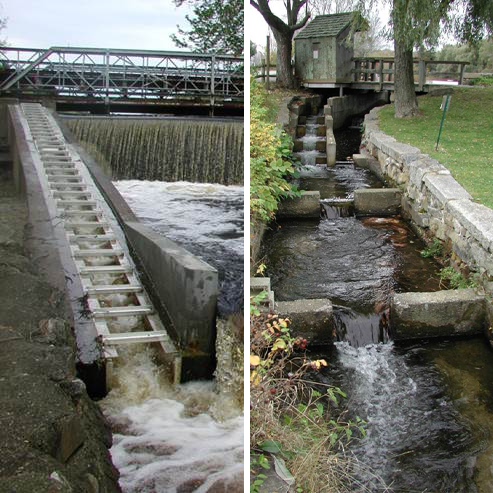
Examples of a baffle fishway (left) and a weir pool (right).
A fish ladder is a fabricated structure (which often resembles a ladder with steps) that allows fish swimming upstream to get past barriers such as dams, waterfalls, and locks. River herring can swim very fast in short bursts to pass up the ladder, making for a spectacular show!
- Baffle fishways look just like ladders. The “steps” of the ladder give fish a place to rest as the make their way up the fishway.
- Weir pools are made up of a series of small pools of regular length to create a long, sloping channel for fish to travel upstream.
By the numbers
- There are 13 diadromous species in Massachusetts, including river herring, American eel, and rainbow smelt. Diadromous fish migrate between fresh and salt waters.
- Massachusetts has over a 100 separate river herring runs!
- Six rivers have spawning run counts that have exceeded a half million river herring, including the Nemasket, Back, Monument, Herring River (Harwich), Herring Brook (Pembroke), and the Mystic River. Active restoration and management contribute to their large spring spawning runs.
- Mass DMF designs and installs eel ramps in coastal rivers to assist upstream migrations. Thirteen eel ramps have been installed in Massachusetts since 2007.
- Mass DMF selectively stocks herring to boost populations at sites with recent restoration actions. In recent years, they have stocked six different locations, and in the past decade, have stocked over 25,000 river herring throughout the region.
Contact
Address
| Last updated: | April 15, 2026 |
|---|