

Overview
DCAMM is responsible for capital planning, public building construction, facilities management, and real estate services for the Commonwealth. The DCAMM team values inclusive design and has a process to identify opportunities where universal design strategies can make a design and construction project more successful. Designing spaces with everyone in mind benefits older adults as well, fostering independence and social connection while creating public spaces that are more accessible, welcoming, and enjoyable for all. Recent projects have incorporated design features that support independent navigation, accessibility, comfort, and usability for a wide range of users. These age-friendly design considerations often benefit everyone who uses the space, not only older adults.
Objective
Through planning, design, and project delivery, DCAMM project managers and designers work to create environments that are intuitive, equitable, and usable by the broadest range of people possible, including older adults.
Accomplishments
Rather than relying solely on code compliance, project teams look for opportunities to improve usability, navigation, comfort, and inclusion through design. Post-construction evaluations have identified several recurring design strategies that support these goals.
Intuitive Wayfinding
Recent projects have incorporated design features that help individuals orient themselves within a building and navigate independently. For example, intuitive wayfinding benefits people living with dementia and supports their ability to live as long as possible in their community of choice.
- Use of landmarks within corridors and common areas
- Color and contrast at doorways and key destinations
- Floor-specific colors and visual cues that reinforce location and aid navigation
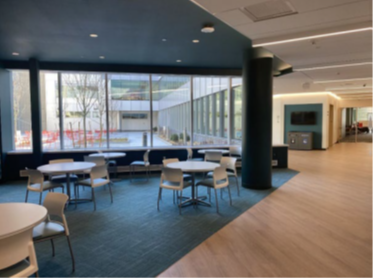
Bunker Hill Community College features such as landmarks, color contrast, and visual cues exemplify the concept of intuitive wayfinding.
Accessible Circulation
Universal design promotes circulation systems—entry and exit routes as well as internal paths through a building—that are easy to understand and equitable for everyone. Rather than creating separate experiences for users of differing mobility, DCAMM integrates accessible routes into primary circulation paths whenever possible.
- Elevators located adjacent to primary entrances and main circulation paths
- Accessible routes that are integrated into the primary user experience
- Reduced reliance on complex decision-making points and confusing pathways
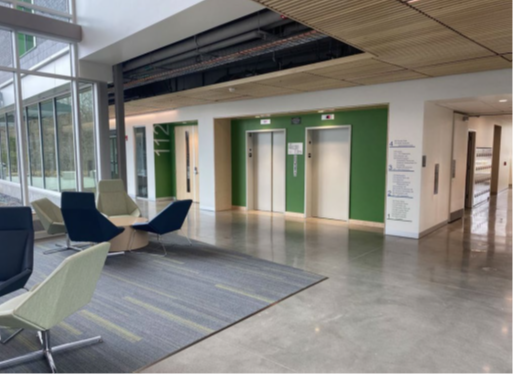
At MassBay Community College, accessible circulation routes integrated into the primary user experience support equitable access and independent movement throughout a facility.
Connection to Nature
Natural light, views, and visual connection to the outdoors can improve comfort, orientation, and overall experience. These elements are particularly valuable in supporting age-friendly environments because they help users maintain awareness of place and time while creating welcoming spaces.
- Access to natural light through generous windows and views to outdoor spaces
- Use of natural elements and landscaping as visual reference points
- Daylight and open sightlines that support orientation and wayfinding
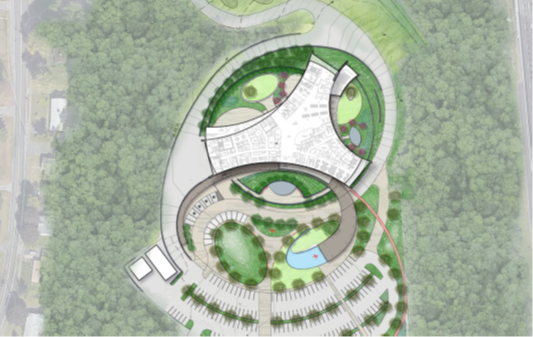
The new Massachusetts Veterans Home at Holyoke was planned for user-controlled access to natural daylighting and various gardens and courtyards including memorial spaces and sensory gardens. This building has a specific benefit to older adults as all residents are veterans over the age of 60.
Flexible and Inclusive Spaces
Flexible and inclusive spaces allow people with different needs and preferences to use facilities comfortably and independently.
- A range of seating types and flexible furnishings
- Inclusive restroom facilities designed to accommodate diverse users
- Spaces that support different needs without requiring special accommodation
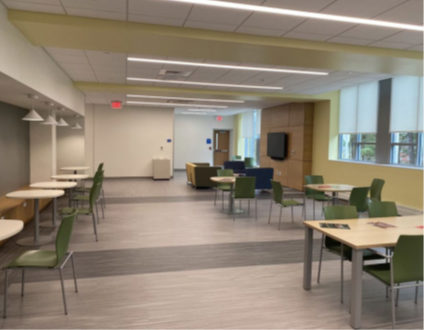
At Westfield State University flexible spaces and varied seating options support a broad range of users and activities without requiring specialized accommodations.
Reflection
Through this work, DCAMM has found that many of the principles of Universal Design can be achieved through simple and cost-effective strategies including, but not limited to:
- Improved lighting, reducing glare and providing brighter even lighting throughout spaces
- Increased visual contrast in the materials/colors, making edges easier to perceive
- Clear wayfinding signage
- Matte finishes/slip resistant flooring to improve navigation
- Distinctive artwork that creates a recognizable landmark and improves wayfinding
While many of DCAMM’s projects are full renovations or new buildings, some projects are more limited “surgical” interventions. Even when there were significant barriers to creating meaningful changes, the above strategies have had a positive impact, transforming existing facilities into more welcoming places.
ReiMAgine Aging 2030 Goal Alignment
- Goal 3: Places & Spaces