
Overview
Video: Wrong Way Driving Detection Spotlight
Skip this video Wrong Way Driving Detection Spotlight.What is Wrong-Way Driving?
Wrong-way driving occurs on separated, limited access roadways when a driver uses an off-ramp to enter the highway in the wrong direction.
While wrong-way crashes only account for a small percentage of the crashes on our roadway system, results are often catastrophic and deadly.
In 2025, there were 6 fatal wrong-way crashes resulting in 6 fatalities.
Wrong-Way Crash Data (2021 to present)
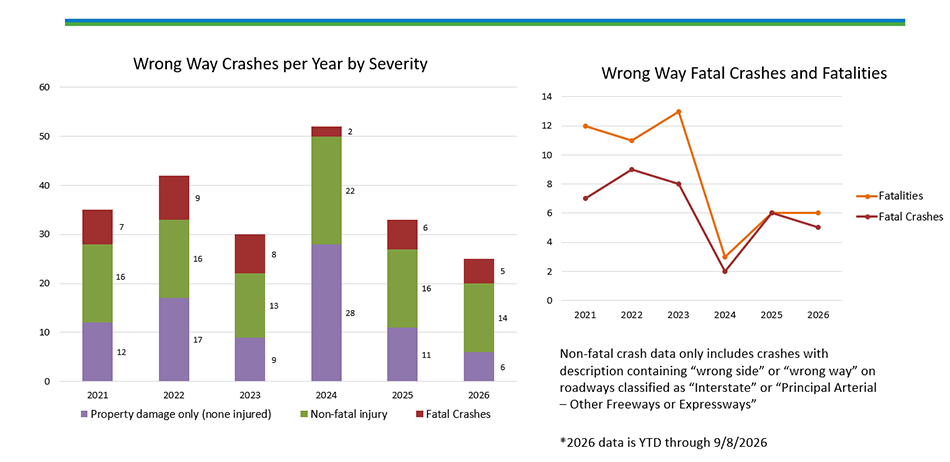
The charts above show wrong way crash data since 2021; they reveal that wrong way crashes consistently cause safety concerns on Massachusetts roadways. In each of the last 5 years, the data show at least 40 wrong way crashes each year (lowest in 2023) peaking with 52 crashes in 2024. Since 2021, there have been 37 fatal wrong way crashes resulting in 51 fatalities.
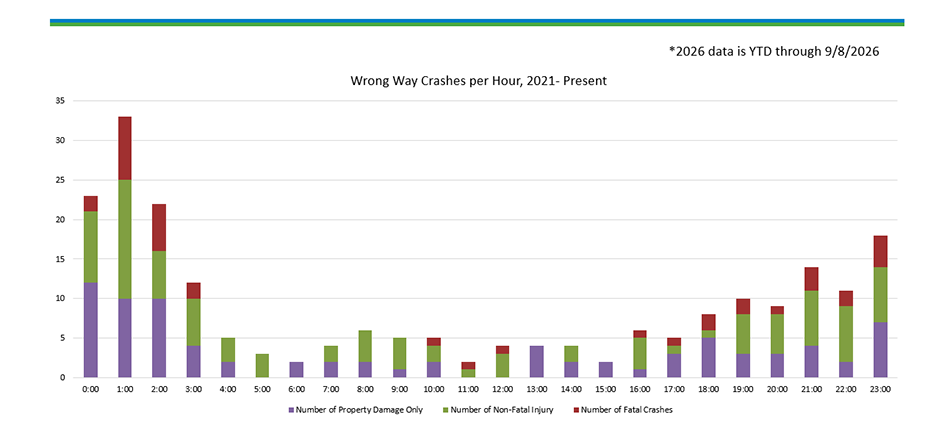
While wrong way crashes can and do occur at all hours throughout the day, most crashes happen from 9:00 pm to 4:00 am.
What is MassDOT Doing About It?
Roadway safety is a top priority at MassDOT. MassDOT has been working for years to prevent wrong-way crashes, by developing standards for wrong-way signs and pavement markings that were installed at all highway off-ramps in 2014, as well as piloting wrong-way detection systems at 16 locations across the state in 2022.
In June 2026, Governor Maura Healey announced a comprehensive statewide initiative to expand these efforts to reduce wrong-way driving. Countermeasures focus on both detection and prevention and will be deployed over the next few years. Education and outreach campaigns will also be developed so that we all can do our part to keep our roads safe.
“Wrong-way driving remains one of the most dangerous behaviors across the nation’s roadways … Every life saved is a reminder of why these investments matter, and we remain committed to using innovation and data-driven solutions to make our roads safer for everyone.”
—Interim Secretary of Transportation and MBTA General Manager Phillip Eng
(Source: WWD Press Release)
Implementation Strategy Overview
MassDOT developed a five-pronged implementation strategy aimed at preventing and detecting wrong-way driving incidents.
“People deserve to be safe on our roads, and we’re taking action. By investing in new technology, stronger safety measures and targeted infrastructure improvements, we’re working to prevent these crashes before they happen and help save lives.”
—Governor Maura Healey
(Source: WWD Press Release)
Focus Area 1: Signal Detection & Warning Systems at Signals
MassDOT will install technology to detect and warn vehicles traveling the wrong way at off-ramps throughout the state. The detection systems monitor off-ramps and immediately alert authorities upon a driver progressing down the off-ramp in the wrong direction.
MassDOT has partnered with industry leaders to use cutting edge detection technology, being the first state-wide organization to install this type of detection system in the country.
MassDOT aims to install wrong-way detection systems at about 100 priority locations by the end of Fall 2026 and around 200 more by the end of Fall 2027.
Focus Area 2: Ramp Signage & Pavement Markings
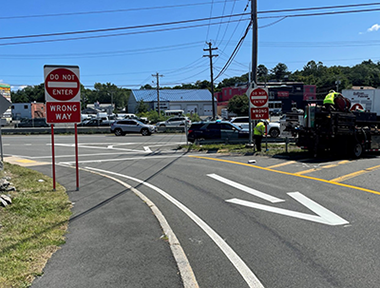
MassDOT staff have reviewed all wrong-way access points to ensure that signs and pavement markings on off-ramps are in acceptable condition and installed per standards. Upgrades are ongoing and will be complete by next year.
In locations identified as high risk and/or where wrong-way driving history is present, quick-build designs will be implemented that install countermeasures including additional pavement markings, enhanced signage, flex posts, and curbing at ramp approaches to further prevent confusion and encourage correct entry.
Focus Area 3: Mainline Signage Expansion
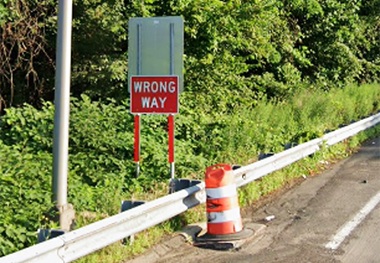
MassDOT will add wrong-way signage to the back of select signs on main stretches of highway to increase awareness.
This effort will deploy approximately 1,200 additional wrong-way signs over the next 1–2 years.
Focus Area 4: Innovative Technology at Unsignalized Ramps
MassDOT will pilot twelve (12) next-generation wrong-way detection trailers at unsignalized, high-risk off-ramps.
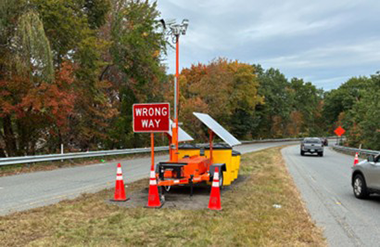
The 12 portable detection trailers will be deployed and monitored for effectiveness. The data collected will be analyzed to determine which permanent countermeasures would be most effective at each particular location.
MassDOT will take lessons learned from Focus Area 1, Detection & Warning Systems at Signals, and look to apply the same technology at applicable unsignalized ramp locations.
Focus Area 5: Targeted Ramp Geometry Improvements
Long term, MassDOT will leverage the data collected from the detection systems and early years of the program to identify locations that require significant geometric or operational improvements through reconstruction. MassDOT will initiate and design capital projects at these locations.
“Roadway safety is MassDOT’s top priority, and through the comprehensive strategy we are announcing today, we expect to make significant progress in reducing wrong-way driving crashes.”
—Undersecretary and State Highway Administrator Jonathan Gulliver
(Source: WWD Press Release)
Map of Detection System Installations
[Insert map showing installed detection systems across the state]
View the wrong-way driving detection system map
Education & Outreach
- If you find yourself driving the wrong way, pull over immediately. Turn around only if it is safe to do so. Call 911 for police assistance to turn around if needed.
- If you see a wrong-way driver, pull over immediately and call 911.
- If alerted that there is a wrong-way driver in your area, pull over immediately.
- Roughly 80% of wrong-way drivers were impaired. Do your part by only driving when you are alert.
- Look for wrong-way signs when driving and be aware of your surroundings rather than relying on GPS. There have been several wrong-way incidents that resulted from drivers misinterpreting their GPS or because of a time lag between the instruction and the actual correct time to turn.
Frequently Asked Questions (FAQ)
- What types of roadways are included in the wrong-way driving program?
The initial phase of the wrong-way driving program is focused on divided highways where access is primarily limited to dedicated on- and off-ramps. Limited access highways where the on- and off-ramps are located side-by-side at their junction with a secondary road may confuse drivers, creating a condition that may cause them to unintendedly drive up the off-ramp, which is why the wrong-way detection and notification systems will predominantly be installed at those types of interchanges. However, other interchange types that have geometric conditions that may cause confusion and divided highways that have a limited number of breaks in access for intersections with side streets and driveways are also under consideration for the program. High-speed interstate-to-interstate ramps and full cloverleaf interchanges that offer no opportunity for wrong-way access under normal conditions are not under consideration for this program. - Why don’t we use rumble strips to stop people?
Massachusetts installs rumble strips on the shoulders of our higher-speed roads to provide warning to drivers that they are leaving the traveled way and may inadvertently depart the roadway and crash. However, rumble strips are, by the nature of their design, bidirectional. This means that they would make an identical sound if driven over in either direction, so it would be impractical to install them in a manner that would provide an alert for a wrong-way driver without providing the same exact noise to a driver going in the correct direction.
Connecticut DOT has experimented with installing a specialized design for rumble strips that would provide noise only in a single direction. However, following installation, these single direction rumble strips did not perform as anticipated and now the state is doing additional research. MassDOT works with our state highway DOT partners on issues like this and will continue to monitor their results.
There has been some research done on developing profiled pavement markings that would provide an audible alert for vehicles traveling the wrong way while making little to no sound for vehicle traveling in the correct direction. Unfortunately, profiled pavement markings are infeasible in states that require snow plowing because the plows would shear any profile off of them.
- Do the signs make sounds?
No.
- Why don’t we use spikes to stop people?
While using spike strips on off-ramps may seem like a simple solution to stop wrong-way drivers, there are several undesired consequences that are associated with using them that prevent MassDOT and other highway agencies across the country from using them:
- Spike strips are designed for very low-speed applications for vehicles that are traveling in the correct direction. They are most commonly used in parking areas where average speeds may not exceed 5 miles per hour. However, on off-ramps, both traffic volumes and average speeds are significantly higher than those in parking lots. There are no commercially available spike strip systems that have been designed for permanent installation on roadways for off-ramp speeds.
- Spike strips are not designed for motorcycles to safely traverse them.
- Law enforcement and emergency responders sometimes use off-ramps to enter the mainline to respond to an incident more quickly. Having spikes on off-ramps would prohibit this.
- Snowplow operators routinely run forward and backwards on ramps to clear snow curb to curb during heavy snow events to avoid having to loop back to the previous exit, a practice that would not be possible with the presence of spike strips. This would also affect similar street sweeping operations on the ramps.
- Drivers traveling the correct direction down the off-ramp may perceive spike strips in the pavement as a hazard and either suddenly apply their brakes or make an evasive maneuver, creating a danger to them and others.
- Dirt, debris, and other substances will likely build up in spike strips, potentially damaging them. Permanently installed spikes that are broken or torn may cause damage to tires of traffic traveling in the correct direction. Maintenance on them would require a complete shutdown of the ramp to ensure worker safety.
- Spikes may not deflate tires of wrong-way vehicles quickly enough to prevent vehicles from entering the highway. If a wrong-way vehicle reaches the mainline with defective tires and continues to drive the wrong-way, it will still pose a threat to motorists traveling in the correct direction.