
- Executive Office of Energy and Environmental Affairs
- Drought Management Task Force
Media Contact
Aisha Revolus, Communications Manager
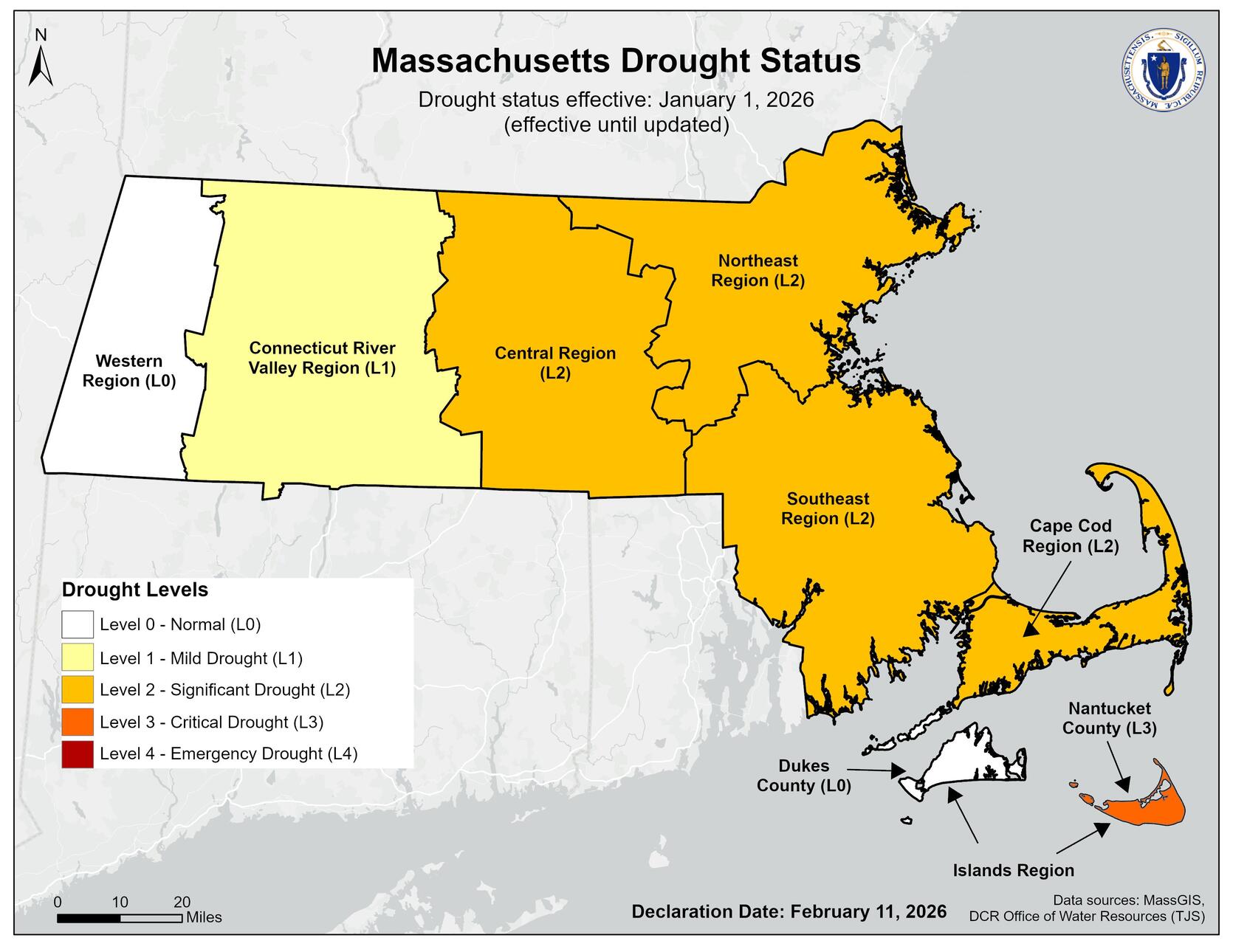
Boston — Today, Energy and Environmental Affairs (EEA) Secretary Rebecca Tepper declared the Southeast Region has worsened to a Level-2 Significant Drought, and the Millers River Basin has improved. All other regions remain unchanged.
Drought is a look back at conditions over a period of time. The Drought Management Task Force (DMTF) collected and analyzed data from August 2024 through January 2026.
During January, Massachusetts received a significant amount of snow and a total of 2 to 3.5 inches of precipitation. In spite of this, precipitation deficits since 2024 remain. Additionally, record cold temperatures and frozen ground have prevented snowmelt from occurring and soaking into the soil, limiting groundwater recharge and discharge to streams.
The current drought, which began in 2024, has continued to have significant impacts on the natural environment, including low streamflow, decreasing water levels in lakes and ponds, and declining groundwater in nearly all regions. Although local water supplies are currently stable, as the drought continues to persist and with reduced recharge at this time of the year, it is prudent for all to be very conservative and save water whenever possible.
As outlined in the Massachusetts Drought Management Plan, continued detailed monitoring of drought conditions must continue. The drought levels also require ongoing coordination among state and federal agencies to implement drought response actions such as water-use restrictions. Additionally, engagement with municipalities, including local Boards of Health (BOH), is essential. This includes providing technical outreach and assistance to water suppliers and affected municipalities. Residents are asked to report to their local BOH if wells drying up; BOHs are asked to report here on the condition of local private wells.
Residents can report dry environmental conditions and submit photos to help monitor the situation on the Massachusetts Water Impact Reporter (here). Additionally, a FAQ is now available for questions regarding the current drought status and water conservation; and private well owners can go here for information on how the drought may impact them.
The Massachusetts Department of Environmental Protection (MassDEP) will continue to assist communities in managing their water systems. The Massachusetts Water Resources Authority (MWRA) water supply system is not experiencing drought conditions.
Below are recommendations for communities and individuals living and working within a Level 1–Mild Drought, Level 2–Significant Drought, and Level 3-Critical Drought including those utilizing a private well. Residents and businesses are strongly urged to check with their local water system in case more stringent water restrictions are in place. Many systems may have other, more severe local conditions and constraints on water supply.
For Regions in Level 3 – Critical Drought
Residents and Businesses:
- Minimize overall water use
- Follow state water conservation actions and any local water use restrictions
- Monitor total household water use shown on your water bill for sudden increases, which often indicate leaks. Use the MA Home Water Use Calculator tool to evaluate household water use.
- Fix any toilet or faucet leaks immediately. Check for leaks in homes and businesses regularly by:
- Checking water meters for constant dial movement
- Using dye tabs to check for toilet leaks
- Conducting regular inspections of all pipes and fixtures, including those located in utility rooms, crawlspaces, and other hidden areas
- Use dishwashers rather than handwashing dishes. Run the dishwasher only on a full load
- Aggressively reduce indoor water use by:
- Taking showers and avoiding baths
- Reducing shower length and consider using a shower timer
- Running washing machines only on a full load
- Not letting water run while brushing and shaving
- Replacing old fixtures and appliances with water-efficient ones. Make sure toilets, faucets, and showerheads are WaterSense labeled
- Stop all non-essential water use
Immediate Steps for Communities/Municipalities:
- Provide timely information on the drought and on water conservation tips to local residents and businesses taking advantage of the state’s library of outreach materials
- Enforce water use restrictions with increasingly stringent penalties
- Strongly discourage or prohibit washing of hard surfaces (sidewalks, patios, driveways, siding); personal vehicle or boat washing
- Establish or enhance water-use reduction targets for all water users, identify top water users and conduct targeted outreach to help curb their use
Short- and Medium-Term Steps for Communities/Municipalities:
- Establish a year-round water conservation program that includes public education and communication, taking advantage of the state’s library of outreach materials
- Implement or establish drought surcharge or seasonal water rates
- Prepare to activate emergency inter-connections for water supply
- Develop or refine your local drought management plan using guidance outlined in the state Drought Management Plan
For Regions in Level 2 – Significant Drought
Residents and Businesses:
- Minimize overall water use;
- Follow local water use restrictions;
- Fix indoor leaks, such as from toilets, faucets, and showers, which result in more than 60 percent of indoor use; and,
- For larger buildings and businesses, conduct water audits to identify areas of leaks and potential water conservation opportunities.
Immediate Steps for Communities/Municipalities:
- Limit or prohibit washing of hard surfaces (sidewalks, patios, driveways, siding); personal vehicle or boat washing; and,
- Establish water-use reduction targets for all water users, identify top water users and conduct targeted outreach to help curb their use.
Short- and Medium-Term Steps for Communities/Municipalities:
- Establish a year-round water conservation program that includes public education and communication, taking advantage of the states library of outreach materials;
- Provide timely information to local residents and businesses;
- Implement or establish drought surcharge or seasonal water rates;
- Check emergency inter-connections for water supply; and,
- Develop or refine your local drought management plan using guidance outlined in the state Drought Management Plan.
For Regions in Level 1 – Mild Drought
Residents and Businesses:
- Minimize overall water use;
- For larger buildings and businesses, conduct water audits to identify areas of leaks and potential water conservation opportunities;
Communities/Municipalities:
- Establish a year-round water conservation program that includes public education and communication, taking advantage of the state’s library of outreach materials;
- Provide timely drought and water conservation information to residents and businesses;
- Check emergency inter-connections for water supply; and,
- Develop a local drought management plan.
State agencies will continue to closely monitor and assess conditions across the state, coordinate any needed dissemination of information to the public, and help federal, state, and local agencies prepare additional responses that may be needed in the future. The DMTF will meet again on Friday, March 6, at 10:00 AM. For further information on water conservation and what residents can do, visit the EEA’s drought and water conservation pages.
###
