- Executive Office of Housing and Livable Communities
- Governor Maura Healey and Lt. Governor Kim Driscoll
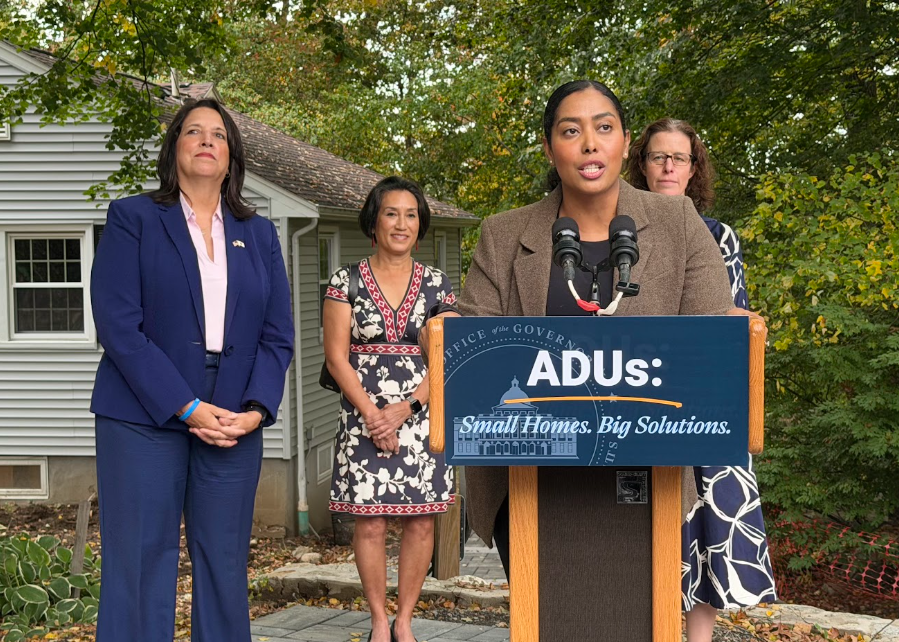
Lexington — Governor Maura Healey today announced a new $5 million investment to make it easier and more affordable to build Accessory Dwelling Units (ADUs) across Massachusetts, bringing the administration's total commitment to supporting ADU development to $15 million. The new Community ADU Pilot Program will help housing developers build more rental homes, while additional assistance for homeowners and updated regulations will make it easier and more affordable to build ADUs.
The announcement builds on Governor Healey's landmark Affordable Homes Act, which made it easier to build ADUs statewide and has already led to more than 2,000 approved units. ADUs offer a practical way to increase housing supply, create more affordable options for residents and help families stay in the communities they love.
“We made it easier to build ADUs across Massachusetts, and more than 2,000 have already been approved,” said Governor Maura Healey. “Now we're investing another $5 million to build even more homes and help homeowners get their projects off the ground. We need more housing to bring down costs, and ADUs are an important part of making sure families, seniors and young people have more options in the communities they love.”
“ADUs are a great way to create more housing in our existing neighborhoods and give residents more options for where and how they live,” said Lieutenant Governor Kim Driscoll. “We're providing creative opportunities to build new homes while helping homeowners overcome the costs and challenges that can stand in the way. These investments will help communities add much-needed housing and make it easier for more people to find a place they can afford.”
“ADUs give us another way to create more housing in the communities people want to call home. Our existing programs help homeowners overcome barriers to design, planning and financing,” said Housing and Livable Communities Secretary Juana Matias. “With today’s $5 million investment, Governor Healey is building on that work by helping developers create new rental homes and making ADUs an option for more people. By putting existing sites to work, we can add much needed affordable housing across Massachusetts.”
The administration announced the upcoming second phase of Massachusetts Housing Partnership’s $10 million ADU Incentive Program (ADUIP), which will provide financial assistance to help homeowners overcome costs that can prevent ADU projects from moving forward.
The first phase of the ADUIP launched in July, providing low-cost feasibility studies to help homeowners understand whether an ADU is viable on their property. In eight weeks since launching, more than 350 studies are underway or completed.
The second phase of the program will now use findings from these initial feasibility studies to identify common and persistent costs that prevent homeowners from moving from planning to construction of ADUs. Based on those findings, MHP will provide financial assistance to help homeowners address eligible expenses and overcome barriers that could otherwise prevent projects from progressing. With the additional funding commitment for the Community ADU Pilot Program, this now brings the Administration’s total commitment to creating ADUs to $15 million.
“MHP is proud to partner with the Healey-Driscoll Administration to make housing more affordable across the Commonwealth,” said MHP Executive Director Rachel Heller. “Making ADUs possible statewide was a critical milestone. Now we need to help homeowners and affordable housing developers turn that opportunity into homes. Hundreds of households are already getting the technical assistance they need through the Feasibility Study Provider program. Building on that momentum, our new ADU Affordable Housing Developer Pilot will help expand long-term affordable housing options for families across Massachusetts.”
Additionally, the new $5 million Community ADU Pilot Program will provide financial assistance to qualified affordable housing developers to build income-restricted ADUs on properties where they already have site control. Administered by the Massachusetts Housing Partnership (MHP) and funded by the Executive Office of Housing and Livable Communities (HLC), the program is expected to support the construction of 20 to 30 affordable ADUs.
In Lexington, the nonprofit Lexington Housing Assistance Board (LexHAB), which has worked for more than four decades to create and preserve affordable housing, is moving forward with four income-restricted ADUs. Projects like these demonstrate how ADUs can expand affordable housing opportunities within existing neighborhoods.
“What I’ve seen from the Governor, the Lieutenant Governor and the Secretary is a real willingness to think outside the box: to make ADUs legal statewide, and then to say yes when a small developer called with an idea that didn’t fit neatly into any existing program. That kind of creativity is rare in government, and it’s exactly what we need,” said Tara Mizrahi, LexHAB Board Member and President of Affirmative Investments.
The administration is also working to make ADU construction easier, more affordable and more predictable through updates to statewide regulations.
HLC recently completed a public comment period on proposed regulatory changes designed to clarify local permitting requirements, reduce barriers to construction and streamline the ADU development process. Feedback from residents, municipalities, housing providers and other stakeholders will inform the final updates.
Before Governor Healey signed the Affordable Homes Act in 2024, Massachusetts had no consistent statewide standard for ADU zoning and permitting. A patchwork of requirements, including owner-occupancy restrictions, restrictive size limits, subjective design reviews and discretionary approvals, often made ADUs difficult or impossible to build. The Affordable Homes Act changed that by creating a consistent statewide standard allowing one ADU up to 900 square feet (or no larger than half the gross floor area of the principal dwelling) to be built by right on lots located where single-family homes can be built, subject to reasonable local requirements. Boston has separate zoning authority and its own ADU rules.
The Healey-Driscoll Administration, in partnership with MassHousing, made low interest loans available to homeowners interested in building an ADU. HLC also developed the state’s ADU Design Challenge, which provides publicly available designs to help reduce planning costs and simplify the development process. For more information about ADUs in Massachusetts, visit Mass.gov.
These efforts are part of the Governor Healey’s broader commitment to building more housing and lowering costs for Massachusetts residents. In 2024 Governor Healey signed the $5.16 billion Affordable Homes Act, the largest housing bond bill in state history. The law, together with the administration’s other initiatives such as converting vacant state-owned land into housing, commercial to housing conversions, the MBTA Communities Law, creation of the Momentum Fund, and sizable increases in housing tax credits and subsidies are already delivering results for the people of Massachusetts. Massachusetts added more than 34,500 new homes in 2025, and the administration continues to advance new housing through investments in affordable and public housing, commercial conversions, transit-oriented development and other tools to help communities build more homes.