- Governor Maura Healey and Lt. Governor Kim Driscoll
- Executive Office of Housing and Livable Communities
Media Contact
Jacqueline Manning, Press Secretary
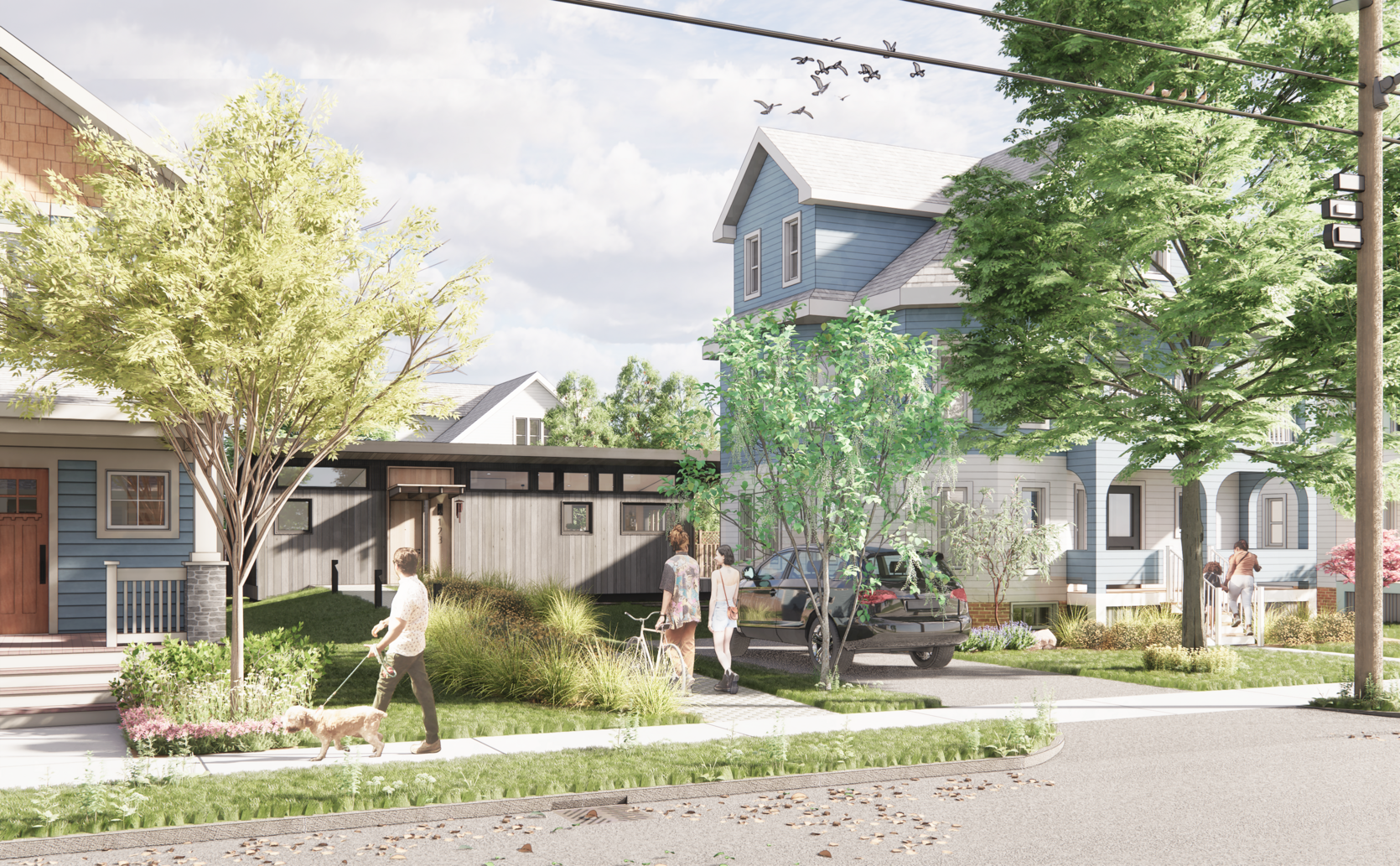
Boston — Governor Maura Healey today announced the winners of the Massachusetts ADU Design Challenge, a statewide competition designed to make it easier and more affordable for homeowners to build accessory dwelling units, or ADUs. across Massachusetts.
The administration is awarding eight winning submissions from architects, builders, designers, contractors and design-build teams across Massachusetts. Launched in December 2025, the challenge received more than 100 submissions from designers representing nearly 50 municipalities across the state.
“Accessory dwelling units can help families stay together, create more housing options and lower costs in communities across Massachusetts,” said Governor Maura Healey. “We made ADUs legal by right across the state, and now we’re making it easier for homeowners to take the next step. These winning designs give people real, practical starting points they can use to create a home for a parent, a caregiver, a young adult starting out or a renter looking for a more affordable place to live.”
“ADUs are a smart way to add housing in neighborhoods people already love, without changing the character of those communities,” said Lieutenant Governor Kim Driscoll. “This challenge helps homeowners get over one of the biggest hurdles by putting strong, ready-to-use designs directly in their hands. Combined with statewide zoning reform, technical support and financing, we’re doing our part to help more people build these homes.”
“Changing the law was a major step, but it was never the only step,” said Juana B. Matias, Secretary of Housing and Livable Communities. “We want to help more homeowners build ADUs, and that means making the process easier to navigate from start to finish. We’re doing just that by setting consistent rules and offering better designs, technical assistance, financing and practical tools that help turn interest into action. We are grateful to everyone who submitted designs to this challenge. The submissions represent a creative and diverse range of ideas for how ADUs can work in communities across Massachusetts, and the Design Challenge is an important part of that work.”
ADUs, also known as granny flats or in-law apartments, are one of the fastest, most cost-effective ways to add new housing in existing neighborhoods and lower costs. ADUs are small, independent homes located on the same lot as a principal dwelling. They can be created within an existing home, as an addition or as a detached structure. They can help support multigenerational living, create space for caregivers, give young adults a foothold in expensive housing markets and provide homeowners with more flexibility as their needs change.
But for many homeowners, getting started can be complicated and expensive. By making high-quality designs publicly available, Governor Healey is removing a key barrier to help more residents move projects forward.
Entries to the ADU Design Challenge ranged from compact ADUs of up to 500 square feet to larger dwelling units between 501 and 900 square feet. They featured sustainable, accessible and innovative construction methods designed to meet the needs of Massachusetts residents. Winners were selected by an independent jury of eight members representing expertise in architecture, construction, housing and sustainability. Jurors evaluated submissions for the top three overall awards based on design quality and vision, presentation, livability, feasibility and affordability, and sustainability. Category winners were selected based on criteria specific to each award, with final selections based on average scores from all judges.
The ADU Design Challenge was funded entirely through private dollars, with support from AIA Massachusetts, Eastern Bank Foundation, Massachusetts Housing Partnership and The Boston Foundation.
The winners of the Massachusetts ADU Design Challenge are:
- All-Challenge 1st Place: Fabricated Module, Local Dwelling: A New England ADU. Designers: Ana Cheng, Aren Fenner and Jansen Meals of ICON Architecture, of Boston.
- All-Challenge 2nd Place: Eco Gable. Designers: Garrett Avery, Alexander Catalano, Sarah Glennon, Maeve Kelley, Elena Stancheva and Starr Warner of Catalano Architects, of Boston.
- All-Challenge 3rd Place: Good Fences, Good Neighbors: A Symbiotic Approach to Unlocking ADU Development in MA. Designers: Douglas Jack, Victoria Capaldo, Aslyn Padre of Nidify Studio; Andrew Steingiser, John Mann and Mike Browne of RDH Building Science; Achan Sookying of AS Collective, Milo Stella of Star Contracting Company and Nate Cole.
- Exceptional Compact ADU: Bower:A (450 square feet). Designer: Michelle Oullette of Woolfall Architecture + Interiors LLC, of Lowell.
- Exceptional Standard ADU: Sunlit Haven (785 square feet). Designer: Yiren Weng, of Sharon.
- Exceptional Sustainable ADU: The 20-Foot House. Designers: J.R. Coffin, Chris Brooks and Charles Mesias of Studio Den Den, of Belmont.
- Exceptional Accessible ADU: ADU for All. Designers: Kevin Marblestone, Paul Gruber, Sandra Jahnes, Will Ruhl and Josh Pisors of Ruhl | Jahnes Architects, of Watertown.
- Exceptional Innovative Construction ADU: ChickADU: A Small and Mighty ADU. Designer: Marcel Merwin of studioMERWIN, of Cambridge.
This announcement builds on the administration’s broader strategy to build housing and lower costs across Massachusetts.
The Affordable Homes Act, signed by Governor Healey in 2023, made ADUs legal by right statewide, and early results show strong demand, with more than 1,200 units approved across 217 communities in 2025. The administration is now pairing that zoning reform with practical tools including free designs, technical assistance, financing and energy resources to help homeowners move projects forward.
In addition to legalizing ADUs by right statewide, the administration has launched or advanced a set of programs to support design, feasibility, financing and construction.
Through the Massachusetts Housing Partnership (MHP) and its ADU Incentive Program, launching soon, homeowners will be able to access assistance to determine whether an ADU is feasible for their property. Through MassHousing and its affordable ADU financing program, income-eligible homeowners can access financing to help move projects forward.
The Massachusetts Clean Energy Center (MassCEC) also just launched a Massachusetts ADU Resource Center at MyMassADU.org. Homeowners that are interested in building an ADU on their property can enter their address at the ADU Resource Center’s website to see what an ADU would look like on their lot, learn more about financing options, and access resources as they navigate the pre-development process. Homeowners in the Pioneer Valley can take advantage of the ADU Accelerator Pilot program, also run by the MassCEC, to obtain technical support for building detached, modular, all-electric ADUs in Hampden, Hampshire and Franklin counties.
Together, these efforts are designed to reduce the cost and complexity of building small homes and to show how good design, practical support and clearer rules can make housing more accessible, sustainable and achievable across Massachusetts.
HLC’s ADU design repository at mass.gov/ADUdesigns features the winning designs from the ADU Design Challenge as well as all qualifying submissions. Homeowners can search by square footage, layout and features including accessibility, sustainability and innovative construction methods.
These investments build on the Healey-Driscoll Administration’s broader efforts to make Massachusetts more affordable by increasing housing production, lowering costs and expanding access to homeownership. Earlier this week, the administration announced a $25 million expansion of MassHousing’s down payment assistance program to help more residents overcome one of the biggest barriers to buying their first home. Since 2023, MassHousing has provided more than $1.9 billion in mortgage financing to help over 5,900 households achieve homeownership, with most buyers receiving down payment assistance. At the same time, to build more homes, the governor has taken action to speed up the permitting process, turn state land into thousands of new homes, convert downtown commercial space into apartments and create a first-in-the-nation fund to finance mixed-income development in a time of high interest rates. To help people afford their mortgages and rents right now, the administration has banned mandatory renter-paid broker fees, increased housing supports for seniors by up to $2,800 annually and expanded home inspection protections for buyers.
For more information, visit mass.gov/eohlc or mass.gov/ADU.
Statements of support
Rachel Heller, Executive Director of the Massachusetts Housing Partnership (MHP):
“Congratulations to all of the winners of the ADU Design Challenge. MHP is proud to sponsor this work, which will offer innovative designs to reduce costs and make ADU development accessible, sustainable, and achievable for more households. MHP has long promoted ADUs as an effective way to increase housing supply and meet a wide range of housing needs for both communities and residents and we continue to support the Healey-Driscoll Administration in implementation of this critical tool through ADU Regulation development, creation of the Model ADU Bylaw, and MHP's new ADU Incentive Program.”
Chrystal Kornegay, CEO of MassHousing:
“Today’s announcement is another important step forward in the work of bringing accessory dwelling unit construction within reach for families across Massachusetts. MassHousing is excited to be part of a team of agencies working together to make each stage of the ADU construction process – zoning, design, technical assistance and financing – more accessible and affordable.”
Ben Downing, CEO of the Massachusetts Clean Energy Center (MassCEC):
"ADUs are one of the smartest tools we have right now to build housing that is affordable and energy efficient. Through the state's new ADU Resource Center and ADU Accelerator Pilot in the Pioneer Valley, climatetech is proving that all-electric ADUs are an affordable, attractive option for residents. We're proud to support Governor Healey's vision for a Massachusetts where good homes and clean energy go hand in hand."
Turahn Dorsey, President & CEO of Eastern Bank Foundation:
“The Eastern Bank Foundation is proud to support the ADU Design Challenge, which highlights the important role accessory dwelling units can play in addressing our housing shortage. Efforts like this bring forward thoughtful, community-based solutions that increase housing options while strengthening neighborhood stability and affordability.”
Sean W. Brennan, AIA Massachusetts:
“Thoughtful design is essential to addressing our most pressing community needs. We have been pleased to support the ADU Design Challenge through professional technical guidance and financial support to help bring new ideas forward. We congratulate and celebrate the winners of the challenge, whose work demonstrates how innovative, accessible, and sustainable design can expand housing choice while strengthening neighborhoods across Massachusetts."
M. Lee Pelton, President & CEO of The Boston Foundation:
"Accessory Dwelling Units can prove to be an effective tool as we work to expand housing supply, and we are pleased to partner with Governor Healey, Lt. Governor Driscoll, Secretary Matias and the other funders in this innovative way to simplify the process of making ADU's a possibility for homeowners. These creative designs not only remove a major obstacle for many homeowners, they also accelerate the process of creating this type of sorely needed new housing across Massachusetts.”
###