- Office of Consumer Affairs and Business Regulation
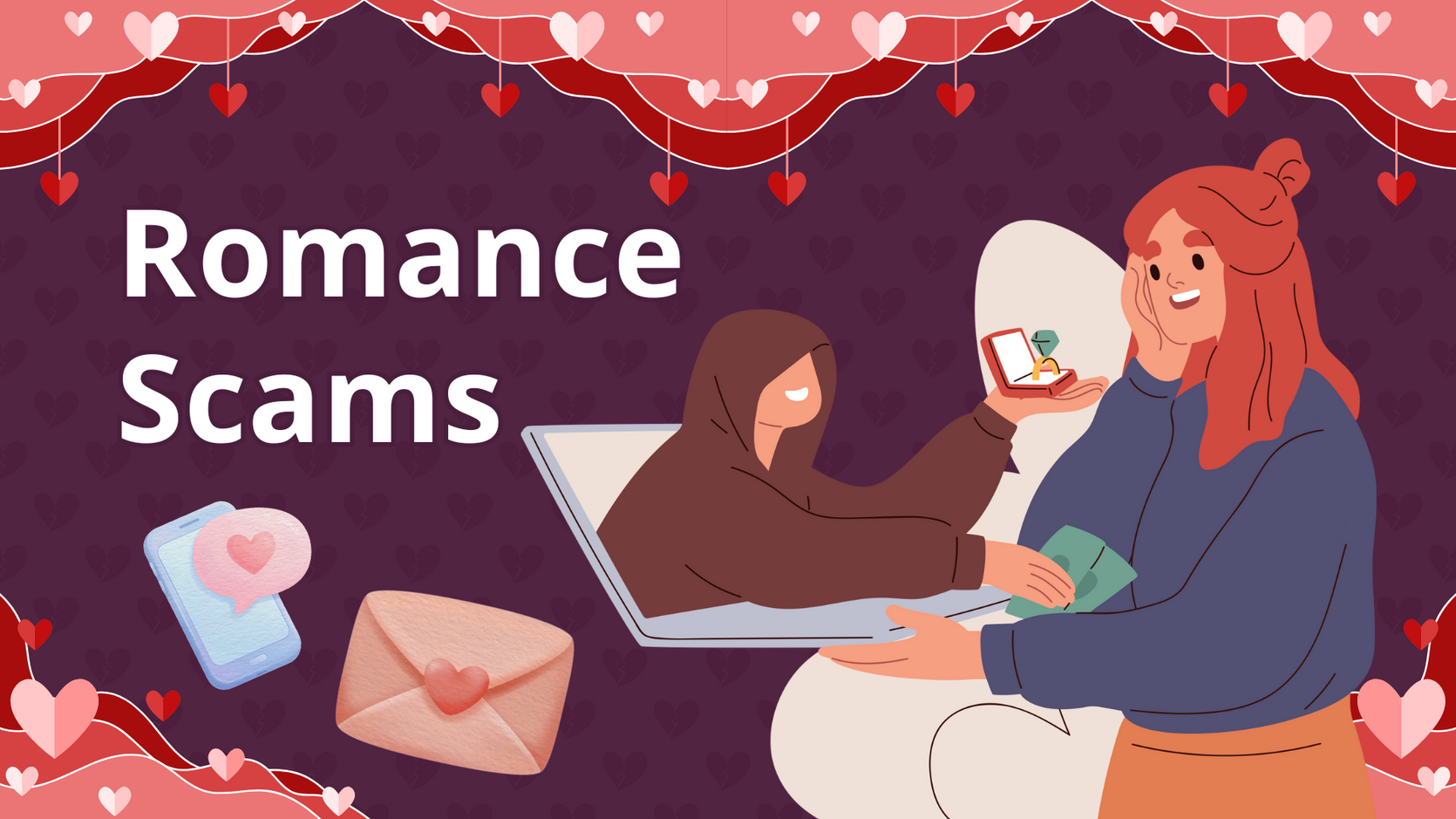
Also called the “online dating romance scam” or the “sweetheart scam,” romance scams occur when scammers manipulate victims into a close relationship and convince them to send money or assets, taking advantage of their emotional attachment.
Scammers create fake profiles online, most commonly on dating apps and social media platforms. They may use AI-generated images of conventionally attractive people or stolen photos to catfish victims. Scammers rarely agree to meet in person or engage in video calls, making excuses to avoid doing so (such as traveling, a broken camera, or serving in the military).
After they’ve successfully lured their victim, these criminals use tactics like lovebombing (“smothering” the victim in excessive affection and compliments) or making lavish promises like marriage to keep the victim invested in the relationship. They target their victims’ trust, affection, and care. The “relationship” continues to escalate — typically over a few months or longer — before the scammer begins to ask for money. Excuses may include gas money, travel tickets, or debts.
Once the victim realizes they’re being tricked, the scam usually ends there. Unfortunately, due to the emotional manipulation and betrayal of trust, victims tend to be slow to accept that there was never a real relationship.
Possible Variations of Romance Scams
Romance scams come in a few variations but tend to follow the same story.
Pig-butchering Scams
Scammers manipulate victims into expensive cryptocurrency investments, instilling a false sense of security and trust over time. When victims try to collect their “earnings,” scammers claim additional costs like “taxes” and “fees,” resulting in more total loss.
Blackmail
Scammers seek out victims with obscure explicit fantasies. Some may convince them that they will fulfill their wishes if the target pays for their travel. Other scammers engage in cybersex trafficking, coercing victims into doing explicit acts on webcam, secretly recording them, and then demanding payment to keep the videos “private.”
Pro-daters
This format is significantly different than the others, as scammers and victims often actually meet in person. However, the scammer’s goal is to manipulate their victim into spending large amounts of money in short periods of time, such as paying large fees for “drivers” or “interpreters,” who are actually accomplices to the scammer.
419 scams
The scammer convinces their victim that they need to marry so they can collect an inheritance. Typically, it’s a young woman targeting men. The scammer manipulates the victim into sending money for an in-person visit, but the scammer never actually travels.
EWhoring
Scammers use stolen or AI-generated explicit photos to impersonate content creators and sell content to victims, manipulating them into sending money for services like dates and video calls.
Red Flags
It’s important to be aware of common warning signs. If your new “significant other” does any of the following, you may be a victim of a romance scam:
- Claims to be abroad — living, working, traveling, or otherwise.
- Tries to move the relationship forward very quickly.
- Shares story details that are inconsistent or sketchy.
- Makes constant excuses to avoid video calling or in-person meetups.
- Tries to move to another communication platform, like WhatsApp or Telegram.
- Asks for money, especially in cryptocurrency or gift cards.
- Asks for money, using excuses like travel expenses and emergencies.
- Resists or argues when you ask questions.
- Asks you to open a bank account or provide your bank account details.
Risk Factors for Victims
No one is 100% immune to falling for scams, but some groups are more vulnerable than others.
Victims are often insecure, sensitive, and/or seeking companionship. They also tend to be more impulsive and susceptible to sensation-seeking behaviors.
A 2018 study found that women are more likely to be scammed than men, and middle-aged people are more likely than younger or older people to fall for these scams. However, those over 65 years old are still at significant risk. The same study also found that those who had higher education were more vulnerable, challenging the stereotype that only “stupid” people fall for these scams.
Someone I Love Got Scammed. What Should I Do?
It can be difficult to see someone you care about get scammed. Try to keep yourself calm and support your loved one as they deal with this tricky situation.
- Reassure your loved one that they are not alone, and there’s nothing to feel ashamed of.
Offer this advice:
Don’t send more messages, accept calls, or provide further payment or personal information to the scammer.
Report the scam to the police, but don’t tell the scammer you did.
Don’t let the stigma prevent you from getting help.
Share resources with them, like those provided below (options in English, Spanish/Español, and additional resources for the d/Deaf & Hard of Hearing and ASL users).
I’ve Been Scammed. What Should I Do?
Finding out you’ve been the victim of a romance scam can be heartbreaking. The upset of being betrayed by someone you trusted, combined with the stress of financial loss and the shame of being scammed, can lead to extreme emotional overload. It’s important to remember that you are not alone, and there are resources available to help.
The aftermath of a scam can feel overwhelming. Take these steps to protect yourself from further loss.
- Before anything else, cut off all contact with the scammer. Don’t send any more messages, accept calls, or provide further payment or personal information.
- Reach out to someone you trust for support and guidance.
- Keep anything and everything the scammer sent to you, such as gifts, documents, and cards. Law enforcement can use this as evidence to track the scammer and other victims.
- Contact your bank if you gave your account information over or cashed checks on the scammer’s behalf and tell them you are a victim of cybercrime. Many financial institutions can write these off and help.
- File a report with your local police department.
- File a report with the Internet Crime Complaint Center (IC3), a division of the FBI.
- Contact the attorney general’s office in your state (find your state AG here).
- Massachusetts residents can file a consumer complaint here.
Why the AGO?
The Massachusetts Attorney General’s Office (AGO) helps consumers with a variety of issues, including cryptocurrency fraud tied to romance and other scams. The AGO can deactivate scam websites, trace funds, and freeze funds. Sometimes they’re also able to seize and return lost funds. The AGO has deactivated more than 50 cryptocurrency fraud websites, filed over 30 cases against cryptocurrency fraud operations, and returned $6 million in lost funds to Massachusetts consumers.
Resources
The Massachusetts AGO offers a guide to cryptocurrency scams, including a list of scam websites reported to the AGO.
Find more resources below in English, Spanish/Español, and for the d/Deaf & Hard of Hearing and ASL users.
In English
MA RESIDENTS — File a consumer complaint with the Massachusetts AGO.
NON-MA RESIDENTS — Find the contact information for your state’s Attorney General’s Office on the National Association of Attorneys General (NAAG) site.
File a report with the Internet Crime Complaint Center (IC3), a division of the FBI.
Report a scam to the Federal Trade Commission (FTC).
TAS Tax Tip: Learn how to deduct losses on virtual currency, cryptocurrency and non-fungible tokens.
Learn how to report and handle identity theft.
“What to Know About Romance Scams,” article from the Federal Trade Commission (FTC).
Suicide & Crisis Lifeline: call or text 988, or chat online.
Call the AARP Fraud Watch Network Helpline at (877) 908-3360.
Get help with AARP Fraud Victim Support Groups.
En Español
Residentes de Massachusetts — Presente una queja de consumidor ante la oficina del fiscal general.
Residentes no de Massachusetts — Encuentre la información de contacto de la Oficina del Fiscal General de su estado en el sitio web de la Asociación Nacional de Fiscales Generales (NAAG).
Presente un informe en el Centro de Denuncias de Delitos (IC3) una división del FBI.
Reporte una estafa a la Comisión Federal de Comercio (FTC).
Consejo Fiscal TAS: Aprenda cómo deducir pérdidas en moneda virtual, criptomonedas y tokens no fungibles.
Aprenda cómo denunciar y manejar el robo de identidad.
“Lo que hay que saber sobre las estafas de romances,” artículo de la Comisión Federal de Comercio (FTC).
Línea de Prevención del Suicidio y Crisis: llama o textea 988, o chatear en línea. Extensión de llamada: Para español, marca dos.
For the d/Deaf & Hard of Hearing and ASL users
Please note that these are additional resources and contact options to specifically serve d/DHH and ASL users. These are intended to supplement what is given above in written English and Spanish to ensure more equal access, not to replace those resources.
Massachusetts residents — Contact the Massachusetts Attorney General’s Office. MassRelay users: dial 711 and connect via main number: (617) 727-2200.
Contact the Federal Communications Commission’s ASL Consumer Support Line at 844-4-FCC-ASL (844-432-2275).
Watch videos from the Internal Revenue Service's official ASL-language YouTube channel, such as a video playlist about Identity Theft (Videos in ASL, some videos also have English captions and audio).
Protecting Deaf, Hard-of-Hearing and Hearing Loss Communities from Investment Scams (Video in ASL with optional English captions and English transcript).
SEC Fireside Chat: A Video and Q&A About Red Flags of Investment Fraud Affecting the Deaf, Hard of Hearing and Hearing Loss Communities (spoken English Q&A with clearly visible ASL interpreter and optional English captions).
Suicide & Crisis Lifeline: VP/VRS: Dial 988. TTY: Dial 711, then 988. Text conversation: Text 988. You can also chat online.
Deaf Crisis Line: VP/VRS: Dial (321) 800-3323. You can also contact the DCL by web (need a webcam enabled device).