- Executive Office of Education
- Department of Early Education and Care
- Department of Elementary and Secondary Education
- Department of Higher Education
Media Contact
Jason Law, Press Secretary and Events Coordinator
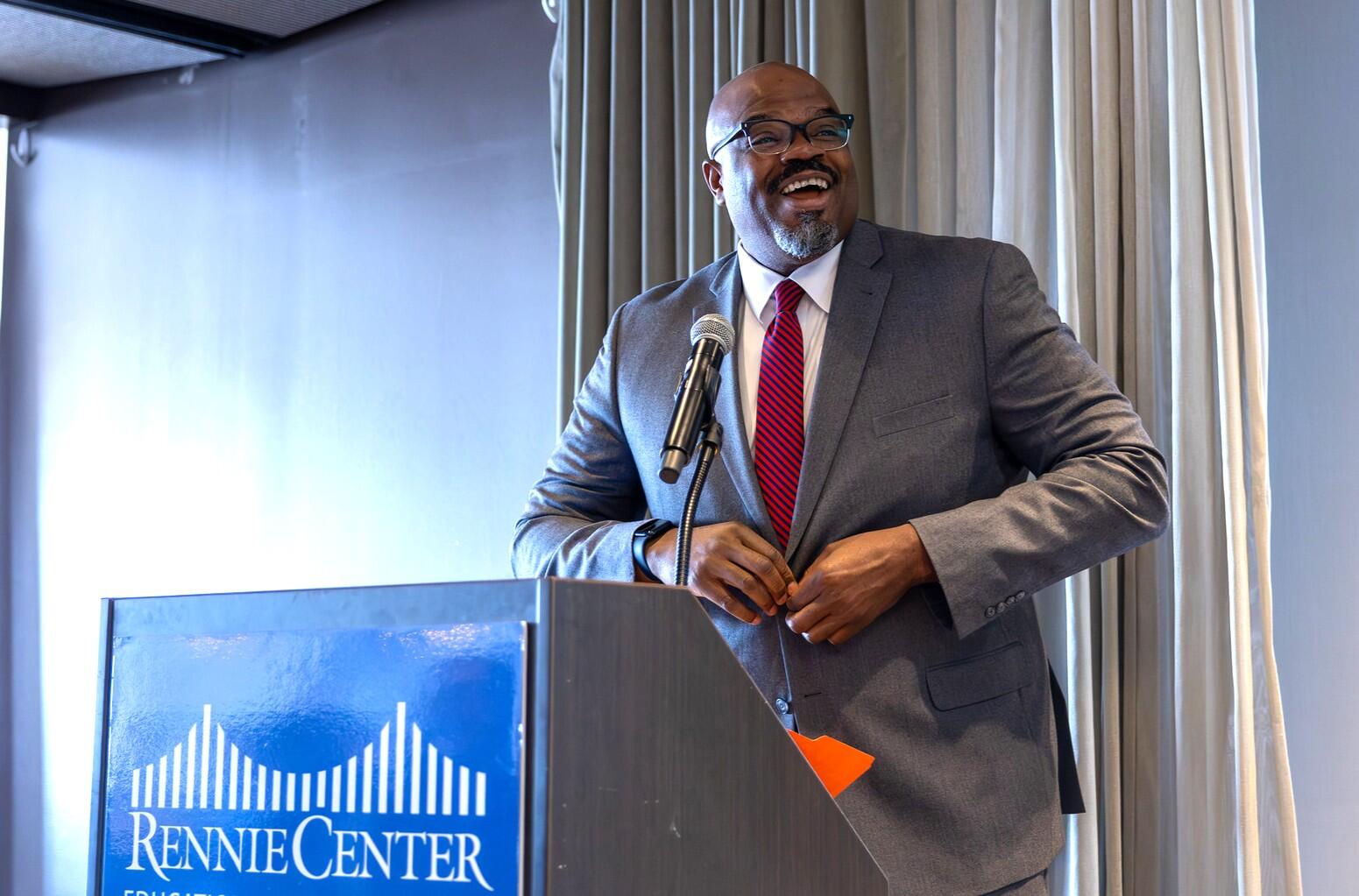
BOSTON — Dr. Patrick Tutwiler today delivered remarks on the State of Education at Rennie Center’s annual summit. Secretary Tutwiler highlighted the Healey-Driscoll Administration’s historic investments in early and higher education, detailed the K-12 Statewide Graduation Council’s recommendations for a comprehensive statewide high school graduation requirement, affirmed the administration’s values and outlined priorities for the year ahead.
“Three years ago, the Healey-Driscoll Administration hit the ground running with three organizing principles as the underpinning of our work—stabilize, heal, and transform,” said Secretary Tutwiler. “While our work is far from finished, I’m proud to report that many of our education sectors have regained stability, are showing meaningful recovery, and in some cases, are moving forward in new and innovative ways because of historic investments from the administration and our partners in the Legislature.”
Early Education and Child Care
Two years ago, Governor Maura Healey announced her ‘Gateway to Pre-k’ agenda that focuses on the three pillars that are most important for promoting affordable, accessible and equitable early education and child care. The state’s early education and child care system has grown by more than 22,000 seats since before the pandemic. This year, the administration is committed to maintaining this progress by:
- Funding the Child Care Financial Assistance (CCFA) programs at $1.2 billion to help families afford care and ensure providers are paid a fair rate regardless of where they live.
- Investing $36.95 million for universal access to high-quality pre-K through the Commonwealth Preschool Partnership Initiative (CPPI) to meet Governor Healey’s goal of delivering universal, high-quality preschool funding for four-year-olds in all Gateway Cities by the end of 2026.
- Maintaining the Commonwealth Cares for Children (C3) program at $475 million.
Early Literacy
Data shows students in Massachusetts and across the country are struggling to read on grade level by grade 3. That's why the Healey-Driscoll administration launched Literacy Launch, a multiyear strategy to promote high-quality, evidence-based reading instruction from pre-K through grade 3. This school year, we’ve awarded more than $10 million in Literacy Launch grants to 45 school districts across Massachusetts. This funding supports grants, professional development, literacy materials, coaching, and other literacy supports for early learners.
This year, the administration wants to continue this work by proposing $50 million for early literacy funding. That includes $25 million for the third year of Literacy Launch and $25 million to continue the early literacy high dosage tutoring initiative. This school year, this initiative supported 356 elementary schools across Massachusetts to introduce early intervention tutoring to their students struggling to read and write, with an emphasis on first graders. In tandem with Literacy Launch, this initiative supports early literacy tutoring services, screening assessments and foundational skills-focused tutoring services.
Local Education Funding
The Healey-Driscoll Administration recognizes school districts continue to face increased costs and high inflation. The last three years, the administration has fully funded Chapter 70 local education aid, increasing aid by $241.8 million under the Student Opportunity Act. To build on this progress and make sure that districts continue to get relief, especially regional districts and those in rural communities, the administration’s budget proposes to:
- Invest the highest amount ever into the Special Education Circuit Breaker to address the growth of both special education instructional and transportation costs, fully funding it at $802.7 million, a $127.7 increase from FY26.
- Fund education transportation reimbursement at $154.3 million, including an increase of $6 million for Regional School Transportation and an increase of $1.2 million for Non-Resident Vocational School Transportation to address the rising costs of school transportation in all districts, but particularly in rural areas.
- Include $198 million for universal free school meals, an $18 million increase over FY26.
- Provide a minimum aid rate of $75 per pupil.
- Provide $20 million in rural school aid.
Reimagining High School
The world our students are preparing for is changing faster than our high schools were designed to keep up. That’s why, three years ago, this administration set out to reimagine high school from the ground up. In 2025, more than 1 in 4 high school students—or 80,377 students—participated in a College and Career Pathway across Massachusetts. This year, we’re proposing a $53.4 million investment to support that multifaceted effort—so every Massachusetts student graduates ready for college, career, or civic life.
This funding will expand Early College designated programs to reach over 100 high schools, allowing high school students to take college classes and earn college credit at no cost to them or their families and advancing Governor Healey’s goal of enrolling 100,000 students in early-college programs by 2036. The administration has awarded 36 new early college designations over the last two years. Across Massachusetts, 78 high schools and 32 higher education institutions support more than 10,000 students in the 2025-26 school year.
Additionally, the Reimagining High School initiative will expand Innovation Career Pathways. These programs provide hands-on coursework and work opportunities in high-demand industries, such as clean energy, manufacturing, health care, and information technology. Currently, 117 high schools sustain programs, offering more than 8,500 students the chance to explore and prepare for careers in those fields.
K-12 Statewide Graduation Council
The Governor’s K-12 Statewide Graduation Council brought together educators, students, families, business leaders, employers, and community voices from across the state to determine what it should mean to graduate from high school in Massachusetts.
In December, the Graduation Council released its initial recommendations for a statewide graduation requirement. Consisting of seven elements, this package outlines the importance of coursework, offers more opportunities for students to demonstrate their learning in ways that reflect their strengths, and supports them in planning for the next chapter of their lives, whether that’s higher education or entering a career, including the trades.
At the heart of this process is our Vision of a Graduate—a inspirational outline of the skills, knowledge, and experiences every Massachusetts graduate should leave high school with. This vision goes beyond academic content--it emphasizes critical thinking, communication, problem-solving, civic engagement, and social-emotional readiness. The Vision of a Graduate reflects the aspirations we hold for all students, no matter where they live or what their background is.
Higher Education
The Healey-Driscoll Administration has significantly expanded state financial aid, making higher education more affordable and diverse, with a focus on ensuring all students can access and complete their education. The Governor’s budget proposes to maintain these historic expansions, which helped return enrollment numbers at our public colleges and universities to pre-pandemic levels. The undergraduate student headcount at the state’s system of 29 public two- and four-year colleges and universities grew 5.7 percent between 2024 and 2025. Community college enrollment growth, which is up 11.4 percent from 2024, has contributed significantly to the systemwide increase.
The Governor’s budget also includes $38 million for student SUCCESS programming at public colleges and universities, including $10 million for UMass for the first time, to help students graduate. As well as $500,000 to support food security on college campuses, and over $100 million increase in direct funding to the state’s institutions of higher education.
In November, the administration released its first earnings report, which shows five years after graduation, a college graduate from one of our public colleges and universities will make $20,000 to $30,000 more per year than their peers who do not pursue higher education. The administration also launched Go Higher, an awareness campaign to inform students of the historic financial aid available in Massachusetts.
View the full version of Secretary Tutwiler’s remarks.
###