

Massachusetts is harnessing the power of artificial intelligence (AI) to build a more responsive government. Learn about the state’s AI initiatives and get advice about using AI in government.
- This page, Artificial Intelligence at the Commonwealth, is offered by
- Executive Office of Technology Services and Security
Massachusetts AI in action
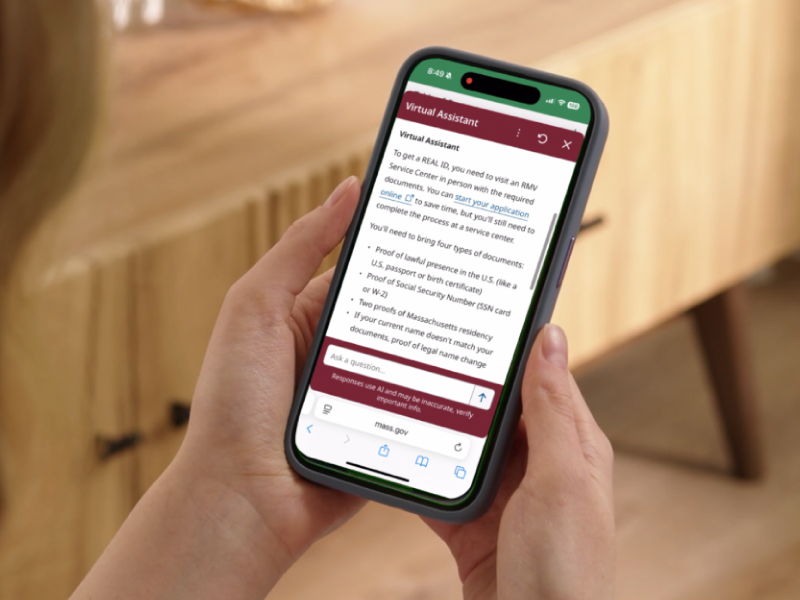
EOTSS and RMV
RMV Virtual Assistant
A virtual assistant launched in 83 days has helped 200,000+ RMV customers get timely, accurate answers to questions about licenses, registrations, and REAL ID.
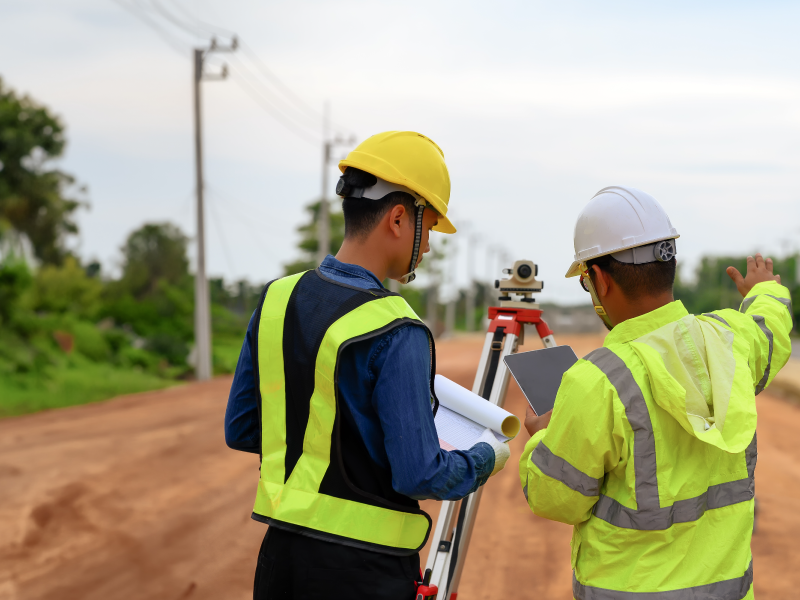
MassDOT
Highway Engineer Knowledge Agent (HEKA)
HEKA empowers Highway Division engineers to more efficiently design quicker and safer infrastructure projects for Massachusetts commuters.

Executive Office of Education
AI Curriculum in Schools
A new AI curriculum pilot will give 1,600 Massachusetts students across 30 school districts hands-on opportunities to explore the technologies shaping the future.
How Massachusetts uses AI responsibly
Artificial Intelligence (AI) is an important tool that can help the Commonwealth improve constituent services, increase efficiency, and better support our workforce to serve our residents. We are committed to using AI responsibly, ethically, and in ways that strengthen public trust. The principles below guide how we design, use, evaluate, and oversee AI systems across the Commonwealth to ensure they serve the public good.
1. Public Service First
AI is used to enhance the Commonwealth employees’ abilities to improve government services, expand capacity, and better serve our residents. Every AI system that is deployed must have clear public benefits.
2. Human Oversight and Responsibility
AI enhances human work without replacing human judgement. State employees remain accountable for their decisions supported by AI. They must review and validate AI outputs, and AI systems are designed to remain under human control. State agencies follow EOTSS' Generative AI Policy which sets clear expectations for how AI tools can be used and developed.
3. Transparency and Accountability
AI systems must operate within the rule of law and established ethical standards. We are open about how AI is used in the Commonwealth. We document decisions, monitor performance, and clearly assign responsibility. We evaluate and improve our AI systems to maintain public trust.
4. Fairness, Accessibility, and Inclusion
AI tools must support equitable public service delivery. We design and use AI to serve all residents. We continuously evaluate our systems for fairness, promote accessibility, and work to prevent discrimination or harm.
5. Workforce Empowerment
Our primary focus is to train our workforce in the use of AI, reducing uncertainty and building a resilient workforce for the future. We provide our employees training, guidance, and support so employees can use AI confidently, responsibly, and effectively. Our education and training will evolve as the technology changes to support our employees through a rapidly changing landscape.
6. Privacy and Responsible Data Stewardship
We protect the data entrusted to us by our residents. AI systems follow strict privacy, cybersecurity, and data governance standards. We limit access, safeguard sensitive information, and build privacy protections into systems from development to deployment and beyond.
7. Collaboration and Continuous Improvement
The rollout of AI tools will be iterative and collaborative. We will engage employees, agency leaders, labor partners, and technical experts to refine the systems over time. Feedback from users will directly inform improvements and responsible scaling.
Higher Education Partnerships
The Healey-Driscoll Administration is leveraging Massachusetts’ world-class education ecosystem to build partnerships that bring student talent into government. Through hands-on data and AI projects, students tackle real-world challenges while helping agencies test new tools, prototype ideas, and deliver practical solutions.
Northeastern's AI for Impact Program
Students at the Burnes Center for Social change build AI products for Commonwealth partner agencies. Projects include a secure sandbox for EOTSS, and a call center staff support tool for the EOHHS.
UMass Amherst's AI for the Commonwealth Program
EOTSS is collaborating with UMass Amherst's Center for Data Science and Artificial Intelligence and the Public Interest Technology Initiative on a program partnering students with state agencies on AI projects for social good.
Worcester Polytechnic Institute’s (WPI’s) Data Science Program
EOTSS data scientists mentor WPI’s data science graduate students who are creating cutting edge AI products and advanced analytics for use across the Commonwealth. Past projects delivered tools for creating synthetic data and leveraging AI to identify high value agency datasets.
Guidance for State teams
STATE EMPLOYEES ONLY
Explore the AI Catalog
Explore our tool catalog of approved and restricted AI products.
STATE EMPLOYEES ONLY
Get AI guidance
Access guidance and evaluation processes for new AI projects, and learn more about incorporating AI capabilities into existing or new tools.
ChatGPT for State Employees
Learn more about ChatGPT, including rollout details, support resources, the Knowledge Center, and FAQs.