
Global Accessibility Awareness Day is marked every third Thursday in May.
- This page, Global Accessibility Awareness Day (GAAD) in Massachusetts, is offered by
- Accessibility Center for Consulting, Education and Support Services
Video: Global Accessibility Awareness Day video
Skip this video Global Accessibility Awareness Day video.GAAD is dedicated to getting everyone thinking, talking, and learning about accessibility—particularly in digital spaces like websites, applications, and online services. Today, more than one billion people globally live with disabilities, making accessibility not just a technical consideration, but a critical equity issue.
Massachusetts Impact on Digital Accessibility
In Massachusetts, where 26% of the population self-identifies as having a disability, digital accessibility is core public infrastructure. Over the last few years, the state has rolled out a mix of policy changes, staffing, technical standards, and public-service redesigns aimed at making government websites, apps, forms, and online services usable for people with disabilities.
How you can get involved
Spread the word, share this page, join live trainings, live webinars, prerecorded webinars, our lunch-and-learn, and learn some new tips and tricks for accessibility.

Accessibility Training
Lunch & Learn for public service employees
Join the ACCESS Team for a Lunch & Learn about Digital Accessibility
Tips & Tricks
Digital Accessibility Techniques
Find useful tips about keyboard navigation, color contrast, and more.
GAAD in Massachusetts
Governor Healey's GAAD Proclamation
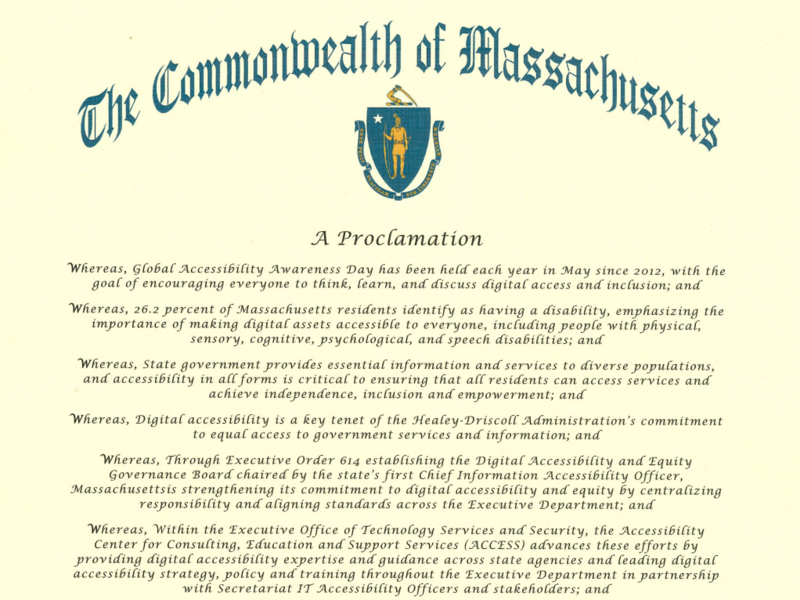
Governor Healey recognizes May 21, 2026 as Global Accessibility Awareness Day in Massachusetts
Setting statewide accessibility standards
Massachusetts adopted enterprise-wide digital accessibility standards based on WCAG 2.1 Level A and AA guidelines. Those standards apply to digital assets, state websites, digital documents, multimedia, and applications. That matters because it pushes agencies to design services that work with:
- screen readers
- keyboard-only navigation
- captioning and transcripts
- color-contrast requirements
- accessible PDFs and forms
- mobile accessibility features
Instead of each agency improvising, the state now has a common baseline.
Creating dedicated leadership, support, and training structures for agencies
In 2023, Governor Maura Healey signed Executive Order 614, which created the Digital Accessibility and Equity Governance Board, a statewide effort to coordinate accessibility policy, procurement, compliance, and strategy across agencies. The state also appointed its first-ever Chief Information Technology Accessibility Officer (CIAO) in 2024. That role is specifically focused on strengthening accessibility in digital government services and alignment across agencies.
Massachusetts is building accessibility into core procedures when purchasing new applications or renewing old ones. This brings the discussion of accessibility to the front of the process instead of trying to mitigate after something is in use or built. The strategic plan and governance board both emphasize procurement standards for software and digital vendors. In practice, that means vendors selling software to the state need to demonstrate accessibility compliance before contracts are approved and during the life of the contract.
The state also created an ACCESS team — the “Accessibility Center for Consulting, Education and Support Services.” Its job is to help agencies:
- audit websites and apps
- train employees
- test digital services
- supporting the integration of accessibility into workflows
- prepare for ADA Title II compliance
Accessibility issues are often found while testing ordinary workflows — like inaccessible PDFs, inadequate form design, or procurement decisions — not just from coding errors.
Launching a statewide accessibility strategic plan
In early 2026, Massachusetts released a formal Digital Accessibility and Equity Strategic Plan, which lays out six major goals, including:
- funding accessibility programs
- strengthening governance and compliance
- training state employees
- requiring accessible technology procurement
- designing accessible public-facing digital services
- coordinating accessibility support across agencies
Accessibility is framed as “digital equity,” meaning residents should be able to participate fully in online government services no matter what their situation is.
Why this stands out nationally
Massachusetts has become a model because it moved beyond a “make the website pass an audit” approach. The state now treats accessibility as:
- governance
- procurement policy
- staff training
- service design
- compliance infrastructure
- long-term digital equity planning
Massachusetts is actively centralizing it and making accessibility operational across government.