
This article was originally published in Massachusetts Wildlife magazine in 2026.
The night shift: On a warm summer evening, as the sky begins to darken and the first stars appear, an important shift quietly takes place overhead. Small, shadowy figures dart across the sky, twisting and turning with remarkable speed and precision. Most people never notice them. Others may catch only a quick glimpse before they disappear. Yet these nighttime hunters are hard at work, navigating the darkness and hunting prey with a sophisticated biological sonar system called echolocation, helping protect farms, forests, wetlands, and even our backyards.
Bats are among the most misunderstood animals in Massachusetts, but they are also among the most important. Every night, bats emerge to feed on insects, consuming large numbers before sunrise. A single little brown bat can eat hundreds of flying insects in one evening. Multiply that by dozens or even hundreds of bats in a colony over an entire summer, and the impact becomes clear. They help control mosquitoes, which may carry disease, as well as moths, beetles, and other insects that damage crops, forests, and gardens. This free pest-control service benefits both people and wildlife and reduces the need for pesticides, which helps municipalities, farmers, and homeowners save money and reduce the amount of chemicals released into the environment. Since bats depend on healthy habitats, clean water, and abundant insect populations, they are often considered indicators of environmental health. When bat populations decline, it may signal broader environmental problems.
Despite these benefits, bats continue to have a poor reputation. Misconceptions and fear have led many people to view bats negatively. In reality, bats are shy animals that rarely interact with people.
Bats need our help
Unfortunately, bats are facing increasing challenges that threaten their survival. Massachusetts is home to nine species of bats, ranging from the tiny eastern small-footed bat to the larger hoary bat. Eight of those species are protected under the Massachusetts Endangered Species Act, including five listed as endangered. Two species, the Indiana bat and the northern long-eared bat, are also protected under the federal Endangered Species Act. While bats have faced challenges for decades, recent declines have been especially severe.
One of the earliest threats came from widespread pesticide use. From the 1940s through the 1960s, pesticides such as DDT had major, though often overlooked, impacts on bat populations across North America by causing acute neurological poisoning and depleting insect food sources. Although the ban on DDT in 1972 allowed some populations to begin recovering, bats soon faced a new and more devastating challenge.
In 2006, wildlife biologists discovered something alarming inside a cave near Albany, New York. Bats were dying in unusually high numbers, many with a strange white fungus growing on their noses and wings. The disease, later named white-nose syndrome, spread rapidly across much of the Eastern United States, including Massachusetts. Researchers believe the fungus originated in Europe before being introduced to North America by human activity.
White-nose syndrome affects bats during hibernation, one of the most vulnerable periods in their annual life cycle. During winter, bats survive on stored fat reserves while hibernating in cold, damp caves and abandoned mines, conditions that also allow the fungus to thrive. As it spreads across exposed skin, especially on the nose and wings, infected bats wake more frequently. Every time a bat wakes, it burns valuable fat reserves it needs to survive until spring. The disease can also damage bat wings, contribute to dehydration, and weaken immune systems. Some infected bats are even forced to leave hibernation sites during winter in search of food, a behavior they rarely survive.
The impact in Massachusetts has been staggering. In the first few years after white-nose syndrome arrived, some bat populations declined by more than 99 percent. The little brown bat, once the most common and widespread species in the state, experienced one of the sharpest declines. The species that hibernate in caves and mines, the little brown bat, northern long-eared bat, tricolored bat, eastern small-footed bat, and Indiana bat, are the ones now listed as endangered in Massachusetts.
MassWildlife has taken steps to protect remaining bats. Important hibernation sites are now closed to public access to reduce disturbance, and special gates have been installed at certain abandoned mines to protect sensitive winter habitat while still allowing bats to move freely. Researchers continue searching for ways to slow or treat white-nose syndrome.
Most female bats give birth to just one pup each year, so populations can take a long time to recover from major declines. Every surviving bat matters. This is one reason summer habitat, and especially safe places for bats to raise their young, has become so important.
Summer roosts
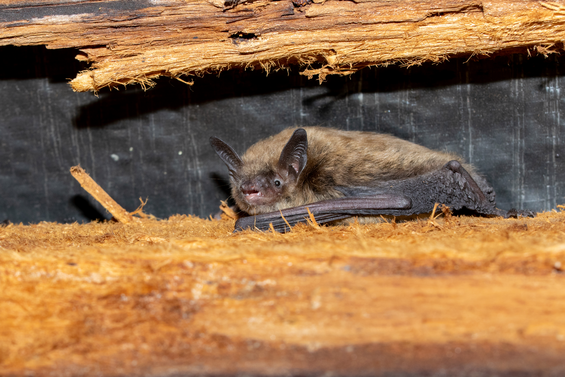
This little brown bat, part of a maternity colony at a private residence in Pepperell, is wedged tightly between layers of weathered and charred boards. These tight spaces, which are also found under bark and in tree crevices and cavities, are replicated in the design of the bat houses used by MassWildlife.
Although winter hibernation sites are critical for bat survival, so too are summer roosts that serve as maternity colonies where females gather to give birth and raise pups. These roosts must provide warm, safe conditions that allow young bats to grow quickly. Warmth is especially important because newborn bats are born hairless and cannot regulate their body temperature well.
In natural settings, bats often roost beneath loose bark, inside tree cavities, or in crevices created by aging trees. Some species also use barns, attics, sheds, and bridges. However, many natural roost sites are disappearing. Although dead and dying trees can provide valuable bat habitat, older trees are less common than they once were, and those that remain are sometimes removed for safety, development, or land management purposes. Buildings that once supported bat colonies may also be renovated or fitted with exclusion devices to prevent bats from entering. Bat houses offer a way to help address this loss of summer roosting habitat.
Not just a wooden box
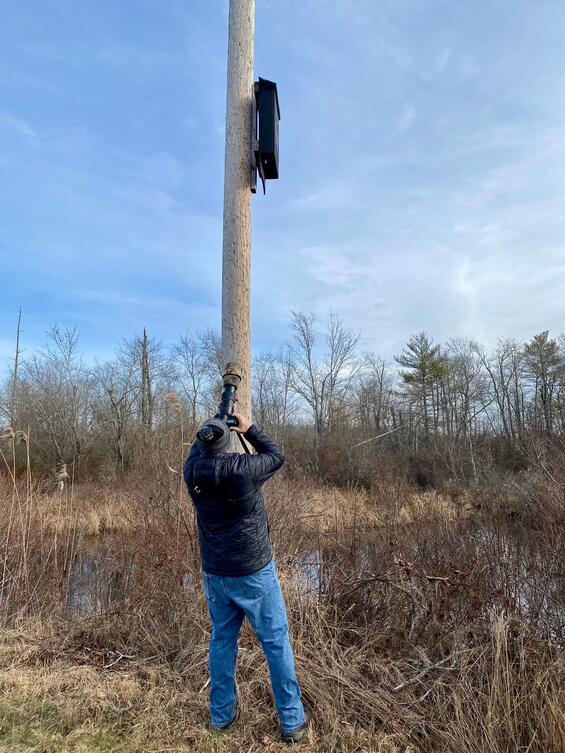
Volunteer William Marquardt using a telephoto lens to look for roosted bats inside the house he monitors at the Burrage Pond WMA in Halifax and Hanson.
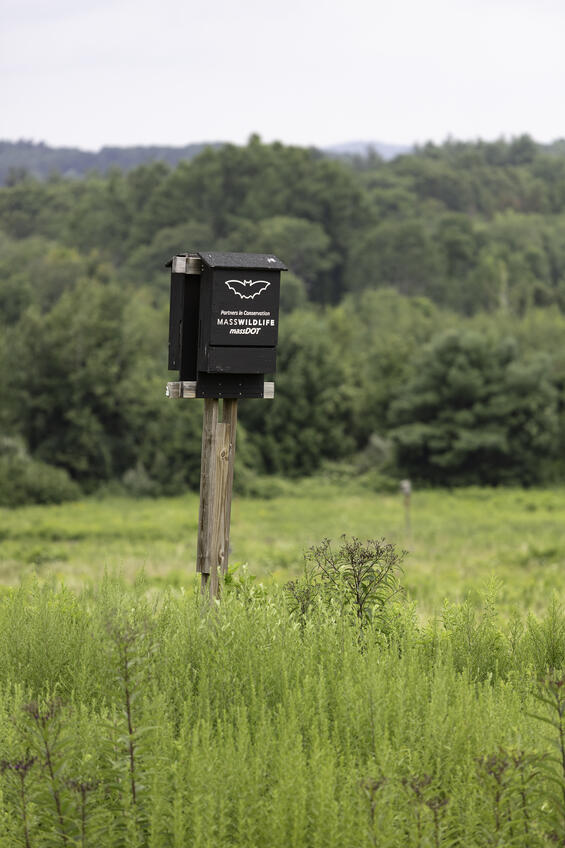
At first glance, a bat house may not seem very impressive. Most resemble a tall, narrow wooden box with thin openings along the bottom. To the untrained eye, they may look simple, but good bat houses are carefully designed with bats in mind.
Unlike birdhouses, bat houses are not open cavities. Bats prefer tight, sheltered areas that help conserve heat and protect them from predators. Inside a bat house, narrow chambers mimic the crevices bats naturally seek beneath loose bark or inside tree cavities. Roughened interior surfaces allow bats to cling comfortably, while multiple chambers give them options to move as temperatures change throughout the day.
Placement is just as important as design. Bat houses mounted on poles or buildings are generally more successful than those on trees, which often create too much shade and obstruct flight paths. In the Northeast, bat houses tend to perform best when they receive several hours of direct sunlight and are located near wetlands, ponds, streams, or other water sources where insects are abundant.
However, even when everything is done correctly, patience is important. One of the most common misconceptions about bat houses is that bats will move in immediately. Sometimes that happens, but often it does not. Bats must first discover the structure and determine whether it meets their needs. This process can take time, but when bat houses are properly designed and strategically placed, they can support colonies of dozens to hundreds of bats. And for bats in Massachusetts, where populations have not yet recovered from white-nose syndrome, every summer roost matters.
A statewide effort takes flight
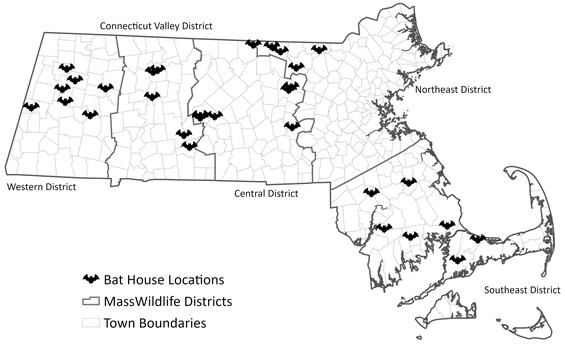
In 2020, MassWildlife launched a new initiative through a partnership with the Massachusetts Department of Transportation (MassDOT), which provided funding through its Linking Landscapes program, to increase summer roosting habitat for bats across Massachusetts while helping people better understand the important role bats play in our environment. Since then, the bat house program has grown through partnerships with state agencies, volunteers, scout groups, and community members who have helped construct, install, and monitor bat houses.
Between January and June 2020, 48 bat houses were constructed. An additional eight were later built and donated by volunteer Carl Nelson, bringing the program total to 56 bat houses. Those houses were distributed across the state and installed on MassWildlife properties, private lands, and MassDOT facilities.
Since then, the program has continued to grow. Eagle Scout service projects completed by Connor Reidt, Ari Shukla, and Edwin Brown contributed 27 additional bat houses to the program, helping increase the total number to 83. Along the way, scouts gained hands-on experience in conservation, leadership, carpentry, and bat ecology while contributing to wildlife habitat.
Today, 34 bat houses are installed on 30 MassWildlife properties across the state, including wildlife management areas, hatcheries, former game farms, and MassWildlife offices. Some locations include paired bat houses mounted back-to-back on a single post, providing double the roosting capacity.
Bat house installations now span much of Massachusetts, creating a network of potential summer roosts where bats may otherwise have limited options.
A community effort to monitor bat houses, one summer evening at a time
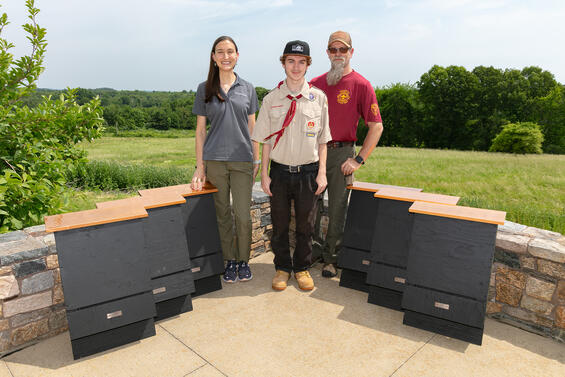
The author (left) accepts bat houses constructed by Eddie Brown, his father, and fellow scouts in Troop 31 in Rochester as part of his 2026 Eagle Scout project.
Putting bat houses on the landscape is only part of the story. Knowing whether bats are using them is just as important.
In 2021, MassWildlife launched a volunteer-based bat house monitoring program to better understand how bats were responding to these structures. Monitoring helps to answer important questions: Are bats using the houses? Which locations appear most successful? How are bats responding to these structures over time?
Each summer, volunteers visit their assigned bat houses once a month in June, July, and August. Monitoring typically takes place around sunset, when bats emerge to feed. Volunteers watch for bats exiting the house, count individuals when possible, and record observations. Even when bats are not directly observed, signs such as guano (bat feces) or urine staining beneath a house can indicate activity. Volunteers also document the condition of each structure and note maintenance needs.
What sounds simple on paper can be challenging in practice. Summer evenings in Massachusetts do not always cooperate. Mosquitoes are often abundant, and weather can complicate monitoring efforts. Yet year after year, volunteers continue showing up. In fact, over the past five years, 53 volunteers have contributed to MassWildlife’s monitoring effort. Eight dedicated volunteers have participated consistently since the program’s early years: Andrea Agostino, Robert Carruthers, Sean Corcoran, Amy Dellio, William Marquardt, Ronald Moura, Patrick Twitchell, and Victoria Wheeler. Their long-term involvement has provided valuable continuity and strengthened the program.
For many participants, monitoring becomes more than collecting data. Watching bats emerge offers a rare glimpse into wildlife behavior that most people never experience. Volunteers often describe the experience as peaceful, rewarding, and unexpectedly fascinating. Perhaps the greatest contribution volunteers make is helping turn simple observations into meaningful conservation data.
What we're learning
In 2025, at the five-year mark, MassWildlife took a close look at the data. At first glance, the results seem modest. Annual occupancy rates ranged from 6% to 16%, while additional houses showed signs of possible future use such as guano, staining, and occasional observations of bats entering or exiting houses. These observations suggest that some bat houses may be used intermittently or are being prospected for future colony use. In Year 1, 16% of monitored bat houses were occupied and another 26% showed signs of potential future occupancy. Occupancy declined to 7% in Year 2, with another 10% showing possible use, then increased to 10% in Year 3, with an additional 23% showing signs of future occupancy. In Year 4, 6% of houses were occupied and another 15% showed possible use. By Year 5, occupancy rose to 15%, while an additional 9% showed signs of future occupancy.
To someone unfamiliar with bat behavior, these numbers may seem disappointing, but to wildlife biologists, they are not surprising. Bats naturally move among multiple roost sites throughout the summer, sometimes using several locations depending on temperature, weather, or other conditions. A bat house that appears empty during one monitoring visit may be in use at other times.
It can also take time for bats to discover new roosts. In many cases, bats may not begin using a bat house until one or two years after installation. Across North America, studies suggest bat house occupancy varies widely depending on climate, habitat, design, and placement, and many houses remain unoccupied for years.
With that in mind, the results from Massachusetts are encouraging. Given the significant population declines many bat species have experienced, even modest levels of occupancy are meaningful. Steady signs of activity across many locations suggest bats are finding these structures and beginning to use them. Just as importantly, the program is helping MassWildlife understand where bats are using bat houses and how occupancy changes over time. These data help guide future bat house placement and management.
Why results vary
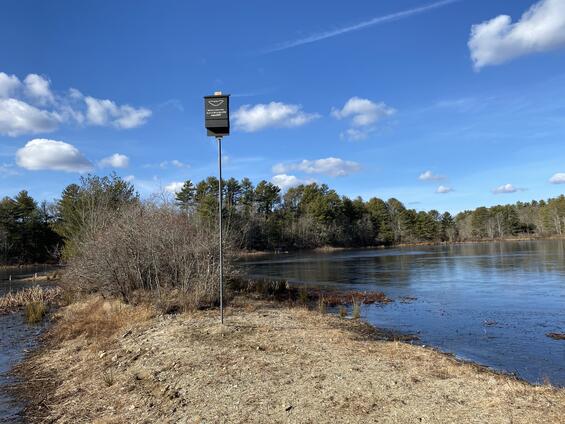
A bat house at Hartley Reservoir WMA.
Not all bat houses perform the same, and success can vary from year to year for reasons that have little to do with the house itself. Weather is a major factor. Bats rely heavily on insects, and insect populations are strongly influenced by temperature and rainfall. Wet, cool weather can reduce insect activity and affect how bats move across the landscape. For example, in 2023, Massachusetts experienced one of the wettest summers on record, which may have influenced both insect availability and bat behavior. Bat house installation timing also matters. For example, in 2024, four new bat houses were installed relatively late in the season, after bats had already emerged from hibernation and had returned to summer habitat. Bat houses installed before bats return in spring tend to have a better chance of first-year occupancy.
Monitoring effort can also affect results. Since the program relies on volunteers, weather, timing, and site accessibility can influence what is observed from year to year. During 2022, staffing limitations led to fewer follow-up communications with volunteers, resulting in some gaps in reporting. At some sites, vegetation growth can make bat houses difficult to access, particularly in areas that are not regularly mowed, limiting monitoring opportunities.
This variability highlights an important point: bat conservation is a long game. Success is not measured by one summer or one occupied house, but over years through closely examining patterns and trends.
Why bat houses still matter
Even though occupancy rates may seem modest, bat houses remain an important conservation tool. For bat species devastated by disease, every safe summer roost has value. Bat houses provide alternative habitat where natural roosts are limited and can help reduce conflicts between people and bats when colonies are excluded from buildings.
Beyond their value to bats, bat houses also help people connect with wildlife. For many volunteers, landowners, and community members involved in MassWildlife's program, they serve as visible reminders that small actions can meaningfully contribute to conservation.
For those interested in installing a bat house, the MassWildlife Bat House Guide (mass.gov/bathouses) provides information on selecting or building an appropriate design, installation recommendations, tips for encouraging occupancy, and answers to frequently asked questions.
Other ways you can help bats
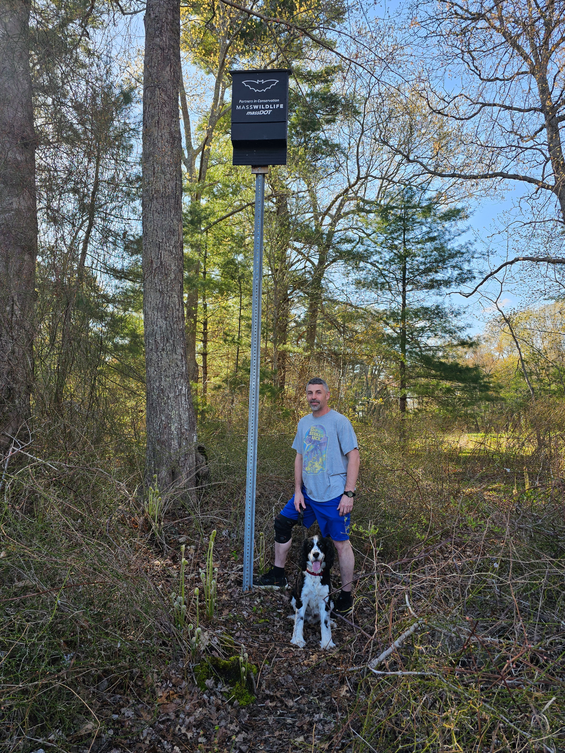
Volunteer Sean Corcoran with a bat house he monitors on the Erwin S. Wilder WMA in Norton and Taunton.
Although bat houses are one important tool, they are not the only way to help bats. Protecting natural habitat remains one of the best ways to support the recovery of bat populations. In addition to leaving older, dead and dying trees standing when safe, protecting wetlands, streams, and forest edges greatly benefits bats by helping to maintain healthy insect populations. Reducing pesticide use can also make a meaningful difference. You can also create bat-friendly landscapes by adding water features to your property, such as small ponds, to provide drinking sources, and planting native night-blooming or fragrant flowers can attract insects that bats feed on.
Education is another powerful conservation tool. Bats are often misunderstood, and helping dispel myths and fears can improve public support for bat conservation. Learning about the challenges bats face and sharing that knowledge can help others better understand why bats are both fascinating and beneficial.
If bats are found in a home, it is important to follow MassWildlife’s recommendations for humane exclusion. In Massachusetts, bat exclusions may only be conducted during specific times of year and are not allowed during summer maternity season, when flightless young may still be present.
Whether through installing a bat house, protecting habitat, reducing pesticide use, or helping others better understand bats, small actions can make a meaningful difference for species that need our help.
A future worth watching
Bats in Massachusetts continue to face all the challenges outlined in this article, but there is reason for hope.
The MassWildlife bat house program demonstrates what can happen when agencies, volunteers, conservation partners, and community members work toward a common goal. What began as a limited project to build and install bat houses has grown into a statewide effort to support bats, gather important data, and build appreciation for wildlife that too often goes unnoticed.
Progress may be slow, and success may not always look dramatic. Sometimes it is a newly occupied bat house, signs of activity beneath a structure that sat empty for years, or a volunteer seeing bats emerge for the first time. These moments illustrate that we are making a difference.
With continued monitoring, thoughtful placement, and growing public awareness, bat houses may play an increasingly important role in supporting bat populations across Massachusetts. On summer evenings, as bats take to the sky, they remind us that conservation is often built through patience, persistence, and small acts that add up over time. By giving bats a place to call home, we are working to ensure they remain present on the Massachusetts landscape for generations to come.
About the Author
Jennifer Longsdorf has worked for MassWildlife for more than 14 years and serves as the agency’s Bat Conservation Program Coordinator. She has worked on a variety of wildlife conservation and restoration projects involving many species. Currently, in addition to coordinating bat conservation, she provides agency support for wildlife rehabilitation efforts across the Commonwealth.