
Massachusetts Regional Transit Authorities
Chapter 161B of the Massachusetts General Laws established regional transit authorities (RTAs), which provide public transportation services for communities outside the reach of the Massachusetts Bay Transportation Authority’s fixed-route1 bus service area. This law defines the roles and responsibilities of these authorities and the municipalities in which they operate. Each RTA has an advisory board made up of the top elected official (e.g., selectperson or mayor) from each municipality in which it operates, one representative of the disabled commuter population2, and one representative of the local rider community. The advisory boards appoint administrators, establish bylaws, and approve budgets and changes to RTA services.
Section 53 of Chapter 6C of the General Laws makes the Rail and Transit Division of the Massachusetts Department of Transportation “responsible for overseeing, coordinating and planning all transit and rail matters throughout the commonwealth,” including intercity buses, the Massachusetts Bay Transportation Authority, and RTAs.
Currently, there is a network of 15 RTAs operating in the Commonwealth, in addition to the transit services provided by the Massachusetts Bay Transportation Authority. These RTAs serve 280 cities and towns outside the greater Boston area. RTAs are funded through a combination of state appropriations, federal grants, local government assessments, transit fares, and other sources. Although RTAs manage their own operations, they are prohibited by Section 25 of Chapter 161B of the General Laws from directly operating transit services and must therefore contract with a third-party operating company for these services.
State appropriations for the 15 RTAs for fiscal years 2023 and 2024 were $96,500,000 and $96,820,000, respectively.
The map below displays the Massachusetts Bay Transportation Authority’s service area, along with the service zones of each RTA within the cities and towns they serve, as of August 2, 2024.
Figure 1. Map of Transit Authorities in Massachusetts by RTA Service Area
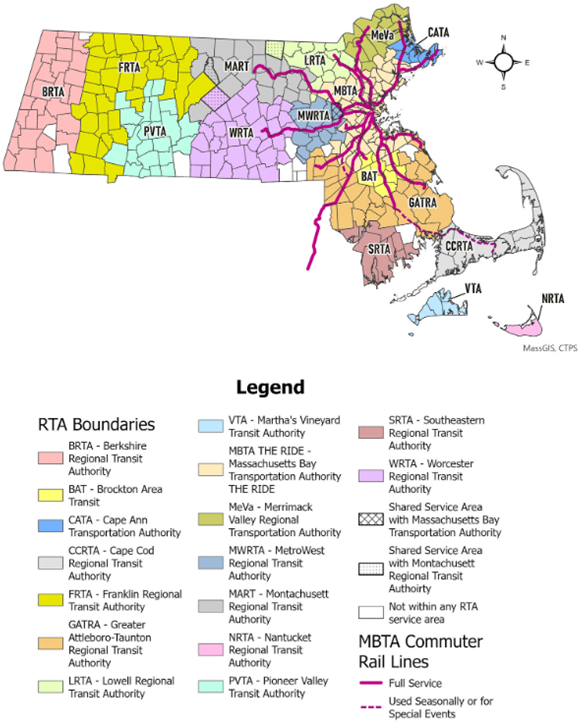
Source: The Massachusetts Department of Transportation—Rail and Transit Division (https://www.mass.gov/info-details/public-transportation-in-massachusetts)
Merrimack Valley Transit
Merrimack Valley Transit (MeVa) was established in 1974 as one of the original transit authorities created by Chapter 161B of the General Laws. According to its website,
MeVa’s service district is anchored by the Merrimack River and centered on the gateway cities of Lawrence, Haverhill, and Methuen, while also extending to the seacoast, as well as more rural and suburban [communities] further south and east of the river. MeVa carries 3.4 million riders per year on its family of local and intercity bus routes, mini MeVa paratransit, a seasonal beach bus, and future ferry service!
Table 1. Cities and Towns in MeVa’s Service Area
| Amesbury | Groveland | Methuen | North Reading |
| Andover | Haverhill | Newbury | Rowley |
| Boxford | Lawrence | Newburyport | Salisbury |
| Georgetown | Merrimac | North Andover | West Newbury |
MeVa’s operations are overseen by an advisory board that hires MeVa’s administrator and is responsible for setting fares, establishing service levels, and authorizing real estate acquisitions. MeVa’s administrator manages MeVa’s day-to-day operations.
During the audit period, MeVa contracted with DGR Management (DGR), a privately operated company, to provide transit management and operations services for its fixed-route bus and its demand-response3 transportation services provided to paratransit riders.
Under its service agreement with MeVa, DGR is responsible for overall transit operations, including scheduling transportation services, maintaining MeVa’s vehicles, and hiring and training maintenance and operational staff members. DGR operates through two subsidiaries: Merrimack Valley Area Transportation Company (MVATC), which provides fixed-route bus services, and Special Transportation Services (STS). STS provides MeVa’s paratransit services, both those that are required by the Americans with Disabilities Act (ADA) and those that are not. During the audit period, MVATC employed 128 staff members, and STS employed 32. Both MVATC and STS provide public transportation services on behalf of MeVa and are referred to throughout this report as MeVa’s contracted operating companies.
In fiscal years 2023 and 2024, MeVa received funding from a variety of sources, including fare revenue and federal, state, and local assistance. The table below shows the total income that MeVa received from each funding source during fiscal years 2023 and 2024.
Table 2. Sources of Funding for MeVa—Fiscal Years 2024 and 2025
| Type of Funding | Fiscal Year 2023 | Fiscal Year 2024 |
|---|---|---|
| Farebox Revenue* | $4,229 | $0** |
| Terminal† | 1,176,957 | 1,401,611 |
| Federal Appropriations | 10,113,108 | 5,262,928 |
| State Appropriations | 7,922,759 | 13,817,489 |
| Member Community Contributions‡ | 4,542,854 | 4,656,425 |
| Interest and Other Income | 65,964 | 425,687 |
| Total | $23,825,871 | $25,564,140 |
* MeVa’s financial statements refer to this revenue as Revenue from Transportation.
** MeVa began transitioning to a fare-free business model in March 2022; therefore, revenue was no longer collected through fareboxes on its buses in fiscal year 2024.
† Terminal revenue is revenue from parking facilities and vendor rental fees at McGovern Transportation Center, MeVa’s central bus hub, which is located in Lawrence.
‡ Member community contributions are funds that municipalities within MeVa’s service area provide to MeVa to support transit operations. These payments are funded by mandatory assessments that the Commonwealth levies against cities and towns served by MeVa.
MeVa Ridership Information
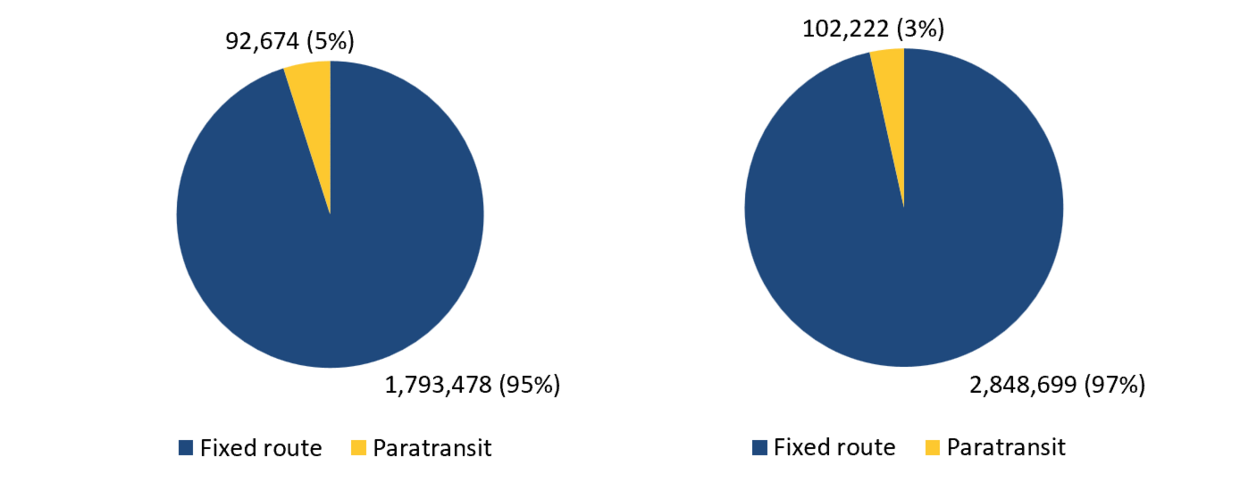
Based on information provided by MeVa officials, the charts below summarize MeVa’s ridership information for fiscal years 2023 and 2024.
Figure 2. MeVa Total Ridership for Fiscal Years 2023 (Left) and 2024 (Right)
ADA–Required Paratransit Services
The ADA of 1990 recognized that some individuals’ disabilities prevent them from using a fixed-route transit system. Section 37(F) of Title 49 of the Code of Federal Regulations (CFR), which covers transportation and related stipulations of the ADA, states,
Each public entity operating a fixed route system shall provide paratransit or other special service to individuals with disabilities that is comparable to the level of service provided to individuals without disabilities who use the fixed route system.
The above regulation also establishes minimum levels of service that RTAs must provide for ADA-required paratransit services.
ADA Paratransit Complaints
ADA paratransit complaints are complaints related to ADA-required paratransit services. According to 49 CFR 27.13, transportation programs that receive federal funding must adopt complaint procedures and designate a responsible employee to coordinate these procedures.
ADA paratransit complaints, which can be submitted by riders or members of the general public, can be made to MeVa’s main office via telephone, email, traditional mail, or in-person means. All complaints are documented by employees of one of MeVa’s contracted operating companies using an Incident/Complaint form, which was designed by MeVa and includes information provided by the complainant.
The employees of MeVa’s contracted operating companies who receive and document complaints are required to forward Incident/Complaint forms to MVATC’s assistant general manager and general manager. Within 24 hours of the complaint being filed, MVATC’s office coordinator is required to inform the complainant that the complaint is being reviewed. STS’s ADA coordinator examines all complaints to determine which ones are ADA paratransit complaints. MVATC’s office coordinator, MVATC’s assistant general manager, and STS’s director of paratransit operations then investigate the complaint by reviewing various records related to it, including security video footage, if it is available. After this review, they determine whether further action is warranted. MVATC’s assistant general manager provides a response to the complainant by telephone, email, or traditional mail, informing them of the outcome of the complaint review. MVATC’s assistant general manager documents the date of the response and the outcome of the complaint on the Incident/Complaint form.
During our prior audit (Audit No. 2022-0496-3A), we found that MeVa did not follow required procedures for processing ADA paratransit complaints. Specifically, in some cases, complainants did not receive acknowledgments of their complaints within 24 hours, and MeVa employees did not always document follow-up responses to complainants.
Safety Training Program
According to 49 CFR 673.29(a)(1),
A transit agency must establish and implement a comprehensive safety training program that includes de-escalation training, safety concern identification and reporting training, and refresher training for all operations transit workers and transit workers directly responsible for safety in the transit agency’s public transportation system. The training program must include refresher training, as necessary.
According to 49 CFR 673, each transit agency must have a safety management system (SMS), which is a documented, agency-wide system of policies and procedures to manage safety risks. The purpose of an SMS is to ensure that all employees have the knowledge they need to safely carry out their duties. The regulation requires an SMS to include four elements. One of these four required elements is safety promotion, which involves both training employees and regularly sharing updates regarding safety information to support an SMS within a transit agency’s operations.
MeVa has a safety training program for all employees and contractors whose duties directly affect the safety of the public transportation system. The program applies to a wide range of positions, including agency leadership, managers, supervisors, and contracted operating company employees. Training requirements are tailored to each employee’s safety-related responsibilities and are delivered through a combination of classroom instruction and hands-on, job-specific training. MeVa’s training programs are outlined below.
Newly Hired Employee Safety Training
MeVa’s Public Transportation Agency Safety Plan requires that all newly hired employees complete safety training as part of their onboarding process. Completion of newly hired employee safety training is documented in an employee’s personnel file. This training familiarizes employees with the agency’s SMS, including safety policies and hazard reporting procedures. Newly hired drivers receive additional instruction covering operational rules, workplace conduct, and labor-related requirements. Driver training also includes behind-the-wheel instruction, route familiarization, and performance evaluations conducted under the supervision of training staff members and experienced drivers. Employees are not allowed to independently perform safety-sensitive duties (e.g., operating a vehicle or performing vehicle maintenance) until they demonstrate adequate knowledge of and proficiency in those duties.
De-escalation Training
MeVa’s Public Transportation Agency Safety Plan requires employees whose roles involve direct interaction with the public to complete de-escalation training as part of their onboarding curriculum. Completion of this training is documented in their personnel file. Employees required to complete this training include drivers, supervisors, dispatchers, reservationists, and customer service employees. This de‑escalation training is intended to equip employees with the skills needed to effectively manage conflicts, particularly in situations that may pose an increased risk of confrontations or assaults, and provide a safer environment for both employees and passengers. According to MeVa officials, de-escalation training was first provided to employees in July 2023. After that, it was incorporated into the standard training process for newly hired employees.
Refresher Training
To reinforce safety practices, MeVa’s Public Transportation Agency Safety Plan requires refresher trainings to be provided quarterly, and as needed throughout the year, based on specific safety issues that arise. Employees of MeVa’s contracted operating companies who attend safety refresher trainings sign an attendance log at each safety refresher training session.
Drivers may also receive refresher training as part of the process of returning to work following long-term leave or suspension, or following preventable accidents (see the “Disciplinary Retraining” section below for more information). These refresher trainings are offered both as personalized trainings tailored to employees’ needs and as generalized, preventative trainings based on operational needs and safety concerns.
Disciplinary Retraining
The “Progressive Discipline Policy” for both MVATC and STS requires employees to be retrained when they are involved in a preventable accident. Under this policy, a preventable accident is defined as one in which the driver did not do everything reasonable to prevent the accident. The Safety Review Committee4 determines whether an accident was considered preventable.
The table below details retraining requirements based on the number of preventable accidents an employee is involved in within a one-year period.
Table 3. Retraining Requirements Following Preventable Accidents
Occurrence Disciplinary Action Retraining Requirement 1 Written warning 1 hour 2 One-day suspension 2 hours 3 Five-day suspension 8 hours 4 Termination N/A
| Date published: | May 5, 2026 |
|---|