
Massachusetts Regional Transit Authorities
Chapter 161B of the Massachusetts General Laws established regional transit authorities (RTAs), which provide public transportation services for communities outside the Massachusetts Bay Transportation Authority’s fixed-route1 bus service area. This law defines the roles and responsibilities of these authorities and the municipalities in which they operate. Each RTA has an advisory board made up of the top elected official (e.g., selectperson or mayor) from each municipality in which it operates, one representative of the disabled commuter population,2 and one representative of the local rider community. The advisory boards appoint administrators, establish bylaws, and approve budgets and changes to RTA services.
Section 53 of Chapter 6C of the General Laws makes the Rail and Transit Division of the Massachusetts Department of Transportation “responsible for overseeing, coordinating and planning all transit and rail matters throughout the commonwealth,” including intercity buses, the Massachusetts Bay Transportation Authority, and RTAs.
Currently, there is a network of 15 RTAs operating in the Commonwealth, in addition to the transit services provided by the Massachusetts Bay Transportation Authority. These RTAs serve a total of 280 cities and towns outside the greater Boston area. RTAs are funded through a combination of state appropriations, federal grants, local governments, transit fares, and other sources. Although RTAs manage their own operations, they are prohibited by Section 25 of Chapter 161B of the General Laws from directly operating transit services and must therefore contract with a third-party operating company for these services.
State appropriations for the 15 RTAs for fiscal years 2023 and 2024 were $96,500,000 and $96,820,000, respectively.
The map below displays the Massachusetts Bay Transportation Authority’s service area, along with the service zones of each RTA within the cities and towns they serve, as of August 2, 2024.
Figure 1. Map of Transit Authorities in Massachusetts by RTA Service Area
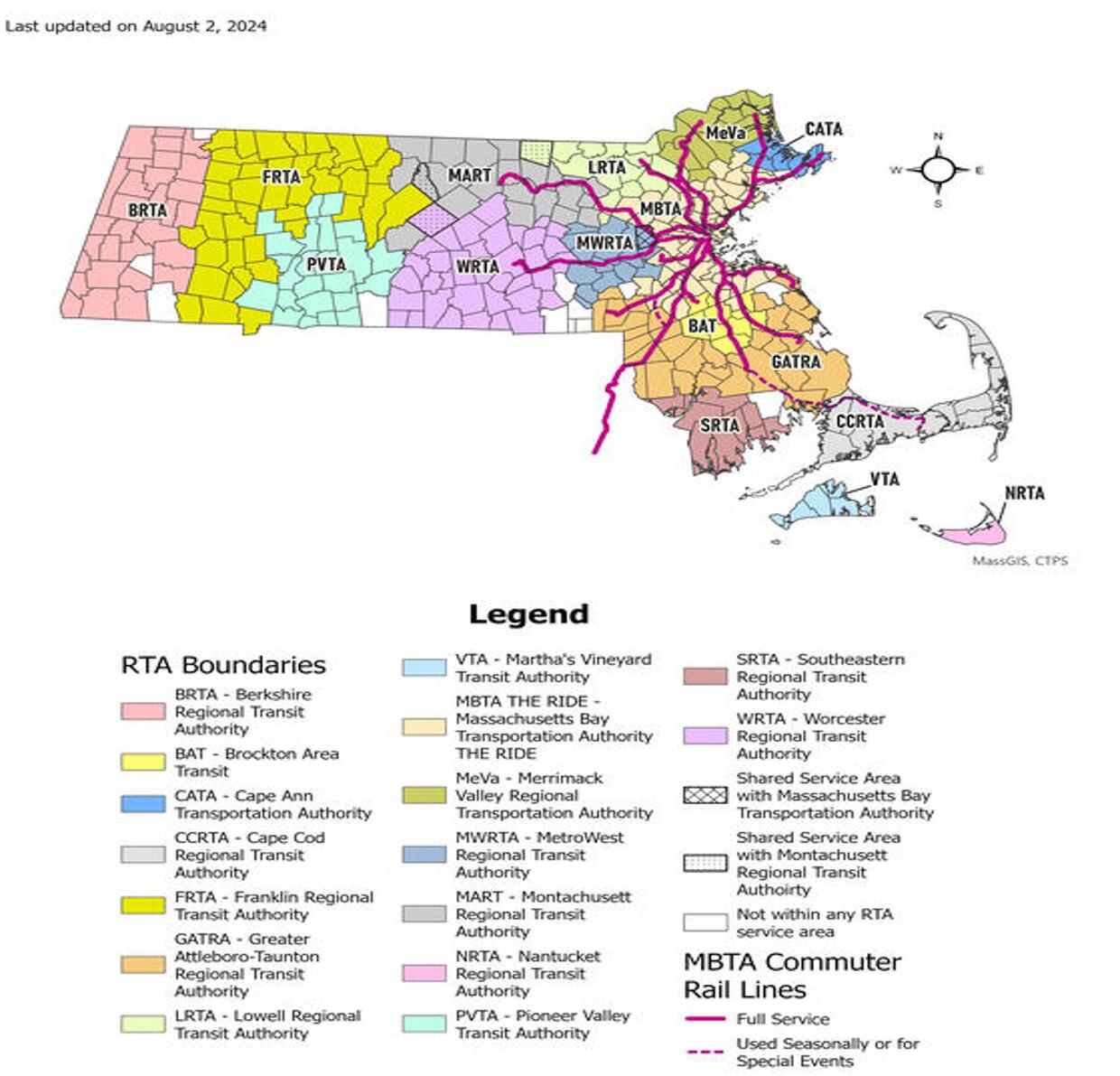
Source: Massachusetts Department of Transportation—Rail and Transit Division (https://www.mass.gov/info-details/public-transportation-in-massachusetts)
Pioneer Valley Transit Authority
The Pioneer Valley Transit Authority (PVTA) was established in 1974 by Chapter 161B of the General Laws and is overseen by the Rail and Transit Division of the Massachusetts Department of Transportation.
According to PVTA’s website, it “is committed to providing the highest quality of convenient and accessible public transportation service that meets the needs of our customers in an efficient, cost-effective manner.”
PVTA is the largest RTA in Massachusetts based on geographical size and covers a service area of 627 square miles, consisting of 24 communities.
Table 1. Cities and Towns in PVTA’s Service Area
| Agawam | Hampden | South Hadley |
| Amherst | Holyoke | Springfield |
| Belchertown | Leverett | Sunderland |
| Chicopee | Longmeadow | Ware |
| East Longmeadow | Ludlow | West Springfield |
| Easthampton | Northampton | Westfield |
| Granby | Palmer | Wilbraham |
| Hadley | Pelham | Williamsburg |
During the audit period, PVTA contracted with two privately operated companies to provide fixed-route transportation services: DGR Management, which operates two subsidiaries for PVTA—Springfield Area Transit Company and Valley Area Transit Company (SATCo/VATCo)—and University of Massachusetts Transit Services (UMTS). SATCo/VATCo serves the greater Springfield and Pioneer Valley communities, while UMTS serves the student population of the University of Massachusetts Amherst and riders in surrounding communities.
PVTA’s operations are overseen by an advisory board that hires PVTA’s administrator and is responsible for setting fares, establishing service levels, and authorizing real estate acquisitions. PVTA’s administrator manages PVTA’s day-to-day operations.
As of June 30, 2024, PVTA had 34 employees, SATCo/VATCo had 317 employees, and UMTS had 434 employees.
PVTA Funding Sources
In fiscal years 2023 and 2024, PVTA received revenue from various sources, including fares and federal, state, and local assistance. Table 2 below shows PVTA’s total income during fiscal years 2023 and 2024.
Table 2. Sources of Funding for PVTA—Fiscal Years 2023 and 2024
| Type of Funding | Fiscal Year 2023 | Fiscal Year 2024 |
|---|---|---|
| Farebox Revenue | $6,274,786 | $5,158,710 |
| State and Local Grants | 36,764,577 | 48,269,884 |
| Federal Grants* | 12,362,682 | 8,387,239 |
| Interest and Other Income | 1,310,211 | 1,245,805 |
| Total | $56,712,256 | $63,061,638 |
* Federal Grants include all funding in the federal and state assistance line item, as stated in PVTA’s financial reports.
PVTA Ridership Information
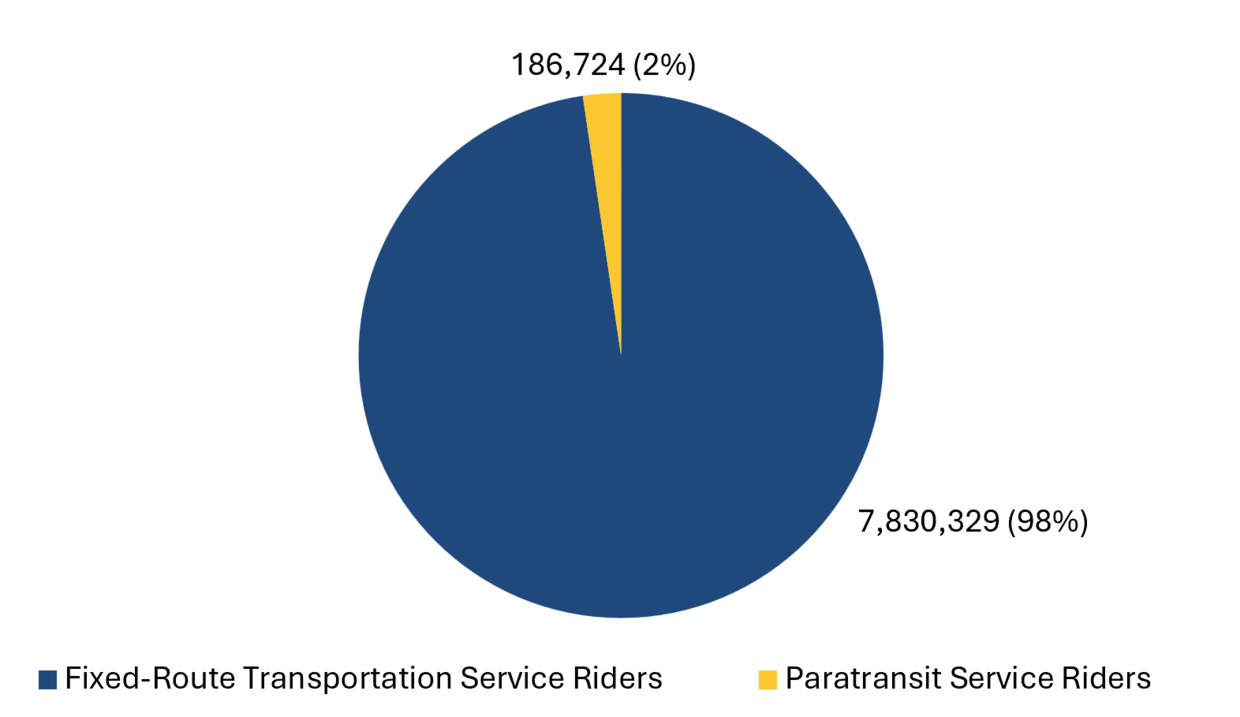
Figure 2 and Figure 3 below summarize PVTA’s ridership information for fiscal years 2023 and 2024.
Figure 2. PVTA Total Ridership for Fiscal Year 2023*
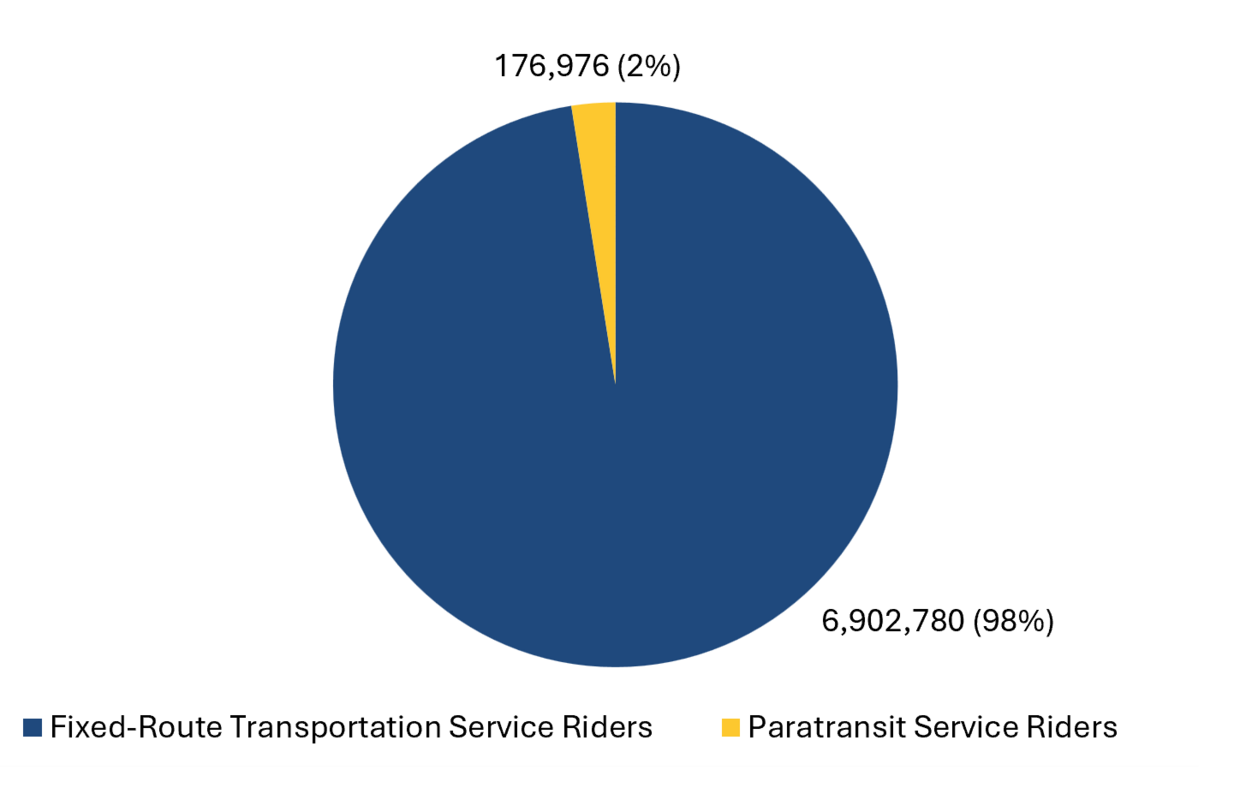
* Regarding paratransit services, the Americans with Disabilities Act of 1990 recognized that some individuals’ disabilities prevent them from using fixed-route transportation services. Section 37(F) of Title 49 of the Code of Federal Regulations, which covers the transportation and related stipulations of this act, states, “Each public entity operating a fixed route system shall provide paratransit or other special service to individuals with disabilities that is comparable to the level of service provided to individuals without disabilities who use the fixed route system.”
Figure 3. PVTA Total Ridership for Fiscal Year 2024
Battery Electric Buses
Before the audit period, PVTA purchased some of its battery electric buses (BEBs) with funds from the federal Congestion Mitigation and Air Quality Improvement Program in an effort to improve local air quality and support traffic relief on roads. PVTA purchased its other BEBs with funds from low- or no‑emission grants from the Federal Transit Administration (FTA) under the Urbanized Area Formula Funding program3 and the Low or No Emission Grant program.4 As of June 30, 2025, PVTA owned 23 BEBs produced by two manufacturers, Proterra and New Flyer.
Like many other RTAs in the Commonwealth, PVTA set a goal to transition to a fully electric fleet. According to the state Task Force on RTA Performance and Funding’s5 2019 report, A Vision for the Future of Massachusetts’ Regional Transit Authorities, “Public transit agencies should be leading the state towards this goal by phasing out diesel and other emitting fuels and committing to fully electric bus fleets by 2035.”
Safety Hazard Mitigation
Section 673.25 of Title 49 of the Code of Federal Regulations (CFR) mandates that PVTA, as an RTA, identify potential safety hazards and document a policy describing the process and methods it uses to mitigate identified safety hazards. PVTA must complete a safety hazard assessment, which it documents in a risk assessment matrix,6 to evaluate the likelihood and severity of all identified hazards. Based on the safety hazard assessment findings, PVTA’s contracted operating companies develop hazard mitigation plans, which are documented on PVTA’s Hazard Mitigation Action Worksheets.7 Additionally, according to 49 CFR 673.25,
A transit agency must consider, as a source for hazard identification . . . data and information provided by oversight authorities, including but not limited to FTA, the State, or as applicable, the State Safety Oversight Agency having jurisdiction [in this case, the Massachusetts Department of Transportation].
Electrical Safety Training
To reduce hazards from high-voltage exposure, PVTA’s contracted operating companies have electrical safety policies. The SATCo/VATCo “Electrical Safety Plan,” which UMTS also follows, outlines the hazards associated with working around high-voltage equipment and vehicles.
The SATCo/VATCo “Electrical Safety Plan” details the training requirements that PVTA has for qualified maintenance employees (whom PVTA calls qualified workers), who are contracted employees working on or near exposed high-voltage electrical components. PVTA provides specified training to these qualified workers to decrease negative outcomes by educating them on accident prevention and how to properly respond if anyone comes into contact with high voltage. This training, which is completed every three years, covers electrical safety standards established by the National Fire Protection Association’s 70E (Standard for Electrical Safety in the Workplace)8 and specialized instructions on BEBs offered by the two manufacturers of PVTA’s BEBs. Employees also receive training in CPR, first aid, and bloodborne pathogens that is mandated by SATCo/VATCo’s “Electrical Safety Plan,” which is completed every two years.
Preventative Maintenance for BEBs
Part of PVTA’s safety hazard mitigation strategy includes preventative maintenance of all its vehicles. FTA’s transit asset management policy requires PVTA, as an RTA, to ensure that its vehicles are maintained to meet or exceed their expected longevity of 14 years. In a memorandum of understanding with FTA, PVTA established a transit asset management plan to keep its vehicles operational beyond their expected 14-year lifespan.
According to PVTA’s transit asset management plan, every vehicle in the fleet undergoes a preventative maintenance program and thorough safety inspections at predetermined mileage milestones. To monitor the maintenance of PVTA’s BEBs, SATCo/VATCo and UMTS use enterprise asset management (EAM) software to track and report on vehicle mileage, fuel9 and fluid consumption, work order processing, vehicle history, fleet and vehicle information, parts use, and inventory. SATCo/VATCo’s and UMTS’s EAM software operate independently of one another.
BEBs are subject to a preventative maintenance schedule based on increments of 6,000 miles, and SATCo/VATCo’s “Vehicle Maintenance Plan” requires that each inspection be completed within 600 miles10 below or above each increment of this mileage schedule. During these inspections, underbody lubrication, front suspension, and air filters are replaced. Water filters and power steering filters are also replaced every 12,000 miles. Additionally, SATCo/VATCo and UMTS mechanics inspect the high-voltage electrical components for all BEBs undergoing preventative maintenance. PVTA uses hardcopy checklists for all BEB inspections, and the information from these checklists is entered into the EAM software by maintenance forepersons for SATCo/VATCo and UMTS.
Once a BEB is due for preventative maintenance, an inspector from the Maintenance Department of one of PVTA’s contracted operating companies conducts the necessary checks and maintenance procedures outlined on the preventative maintenance checklist. The mechanics on duty identify and record any major issues for repair, and the BEB is removed from service until the issues are addressed.
Preventative maintenance also includes inspecting any defects that BEB drivers encounter daily. This is done on a defect card, which BEB drivers receive and which remains with the vehicle until the BEB driver returns the BEB to its designated garage at the end of each day. If a BEB driver encounters any operational issues during the day, they note these issues on that day’s defect card. At the end of BEB drivers’ shifts, the maintenance foreperson collects that day’s defect cards. If an issue is noted on a defect card, then the maintenance foreperson assesses the issue and, if necessary, removes the BEB from service until the issue has been addressed.
PVTA’s contracted operating companies (SATCo/VATCo and UMTS) have the option to run exception reports daily. Exception reports list all buses in the fleet that have been temporarily removed from service or require preventative maintenance based on either mileage or scheduled maintenance dates. The contracted operating companies also create interval reports on a weekly and monthly basis. These interval reports provide an overview of the preventative maintenance activities conducted on all buses, detailing the specific services performed. PVTA officials can use these interval reports to assess compliance with preventative maintenance standards and evaluate the operational safety of PVTA’s fleet.
| Date published: | July 1, 2026 |
|---|