
Section 5G of Chapter 29 of the General Laws
Section 5G of Chapter 29 of the General Laws, established in Fiscal Year (FY) 2011, implemented a threshold to cap the amount of capital gains tax revenue that can be used for the state’s operating budget and depositing any collections over that threshold to the Stabilization Fund, the Pension Liability Fund, and the State Retiree Benefits Trust Fund.
The threshold was first proposed by Governor Deval Patrick, in light of significant capital gains declines caused by the Great Recession. After collections nearly doubled between FY 2004 and FY 2008, they declined from $2.2 B in FY 2008 to $554 M in FY 2009, contributing significantly to the state’s budget shortfall. Because the tax applies to increased asset value at the time of sale, capital gains collections have historically been volatile and particularly susceptible to economic downturns.
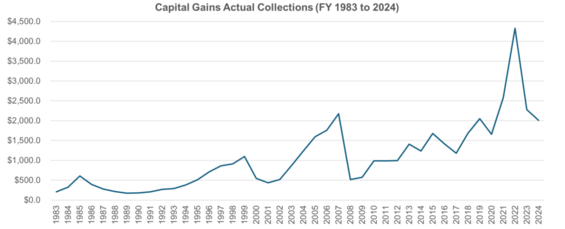
Line chart showing Massachusetts capital gains actual collections from FY 1983 to FY 2024, with volatile annual changes and a sharp peak in FY 2022 before declining through FY 2024.
Specifically, the policy inserted through Section 5G of Chapter 29 created a $1 B threshold for excess capital gains to be used in the budget. Beginning in FY 2014, the threshold has been adjusted annually to reflect the average annual rate of growth in United States gross domestic product (GDP) over the preceding 5 years based on the most recently available data published by the Bureau of Economic Analysis in the United States Department of Commerce.
Section 5G of Chapter 29 also specifies that any collections in excess of the threshold are distributed as follows:
- 90% to the Commonwealth Stabilization Fund
- 5% to the Pension Liability Fund
- 5% to the State Retiree Benefits Trust Fund
Commonwealth Stabilization Fund
Massachusetts established a Stabilization Fund in 1986 as a part of a larger fiscal reform package. Originally, the funding mechanism for the fund was limited to portions of year-end surpluses and interest earnings. The fund was created to help the state weather unanticipated fiscal challenges. More specifically, Section 2H of Chapter 29 of the Massachusetts General Laws, the fund’s enabling statute, allows for the use of the fund:
- to make up any difference between actual state revenues and allowable state revenues in any fiscal year in which actual revenues fall below the allowable amount;
- to replace the state and local loss of federal funds; or
- for any event which threatens the health, safety or welfare of the people or the fiscal stability of the commonwealth or any of its political subdivisions.
The statute further articulates that such events may include “a substantial decline in economic indicators which result in severe reductions in state revenues or state financial assistance to local governmental units, or court ordered or otherwise mandated assumptions by the commonwealth of programs or costs of programs previously borne by local governmental units.”
Over the course of time, several additional means of capitalizing the Stabilization Fund have been adopted:
- Excess Capital Gains
As noted above, in FY 2011, Section 5G of Chapter 29 dedicated 90% of any excess capital gains to the fund - Casino Gaming Revenue
10% of casino gaming tax revenue is dedicated to the fund via an expanded gaming law in 2011 - Abandoned Property
75% of net abandoned property revenue growth over the prior year is transferred to the fund - Certain Tax Collections
Tax judgments and settlements over $10 M that exceed the previous 5-year average and a portion of withholding income from Lottery prizes are dedicated to the fund
Since its implementation in FY 2011, Section 5G’s excess capital gains policy has contributed to nearly 75% of the Stabilization Fund’s growth. Year-end budget surpluses have been the second-highest mechanism for supporting the fund; however, those instances are naturally inconsistent, as said surpluses have recently been diverted to support unexpected spending needs. For example, during the COVID-19 pandemic, the state deposited surplus revenues into a Transitional Escrow Fund to support economic recovery and public health supports. This fund has continued to be used to support unanticipated spending needs outside of the normal operating budget development process.