
About bogs
Bogs form through a slow transformation that can take thousands of years. A variety of plants began to colonize the margins and shallows of the depression, including grasses; sedges; shrubs; and mosses, particularly the remarkable genus, Sphagnum. Unlike most plants, sphagnum moss possesses a chemical superpower: As it grows, it absorbs minerals from the water and releases hydrogen ions in return, steadily acidifying everything around it. The acidity can become so intense that bog water sometimes rivals vinegar in its pH. This acidification triggers a cascade of consequences. The oxygen-poor, acidic water inhibits the bacteria and fungi that normally decompose dead plants. Without these decomposers, fallen moss and organic material from dead sedges, dwarf shrubs, and other plants accumulates year after year, century after century, building into thick deposits of peat. This partially decayed plant material acts like an enormous sponge, holding water and creating a saturated, floating mat that can be many feet thick. In some bogs, this mat becomes so substantial that trees can root in it.
But the acidic, waterlogged conditions that define bogs also create a severe nutritional crisis. The same acidity that preserves peat also locks up essential nutrients, particularly nitrogen and phosphorus, making them largely unavailable to plants. For most species, a bog is essentially a wet desert, surrounded and supported by water yet desperately poor in the chemical building blocks of life. This extreme environment has driven some of the most remarkable evolutionary adaptations found anywhere in Massachusetts.
Survival strategies
The plants that thrive in bogs have evolved ingenious solutions to the nutrient-poverty problem. Many belong to the heath family, Ericaceae, a group that includes blueberries, cranberries, and the laurels. These plants forge partnerships with specialized fungi called mycorrhizae that colonize their roots. The fungal threads spread through the peat, acting as extensions of the root system, capturing scarce nutrients and delivering them to the plant in exchange for sugars produced through photosynthesis. This symbiotic relationship is so crucial that many bog plants, including orchids, simply cannot survive without their fungal partners. Other bog residents have taken a more dramatic path: They have become carnivores. When nitrogen and phosphorus are locked away in the soil, why not capture them from insects instead? Pitcher plants and sundews supplement their diet by trapping and digesting hapless arthropods, extracting the nutrients their roots cannot find. Studies suggest that these plants may derive between a quarter and half of their nitrogen from prey, a remarkable evolutionary pivot. The harsh conditions also favor plants with evergreen leaves. In these nutrient-poor environments, holding onto leaves year-round is more economical than growing new ones each spring. The leathery, waxy leaves of sheep, mountain, and bog laurels are built to last, persisting through winter and allowing the plants to photosynthesize whenever conditions permit.
Conservation and safety
The floating peat mat that makes bogs so fascinating also makes them extraordinarily vulnerable. The surface vegetation is thin and easily damaged, and foot traffic can quickly create lasting scars in the landscape. Bog plants, adapted to extreme conditions, grow slowly—a sundew crushed by a careless boot may take years to recover, if it survives at all. The peat itself, accumulated over millennia, can be compacted and degraded by repeated trampling, disrupting the hydrology that sustains the entire system. There is also the matter of safety. A bog's surface can be deceptively unstable, and what appears to be solid ground may belittle more than a thin mat of vegetation over deep water or saturated peat. Without proper pathways, visitors risk breaking through the surface or becoming mired in the quaking substrate. For these reasons, most publicly accessible bogs in Massachusetts feature elevated wooden boardwalks that protect both the ecosystem and the people who come to experience it. So, when you visit a bog, always stay on designated paths. Resist the temptation to venture onto the mat, no matter how firm it appears. The plants beneath your feet are survivors of extreme conditions, but they may not survive us.
Bog plants of Massachusetts
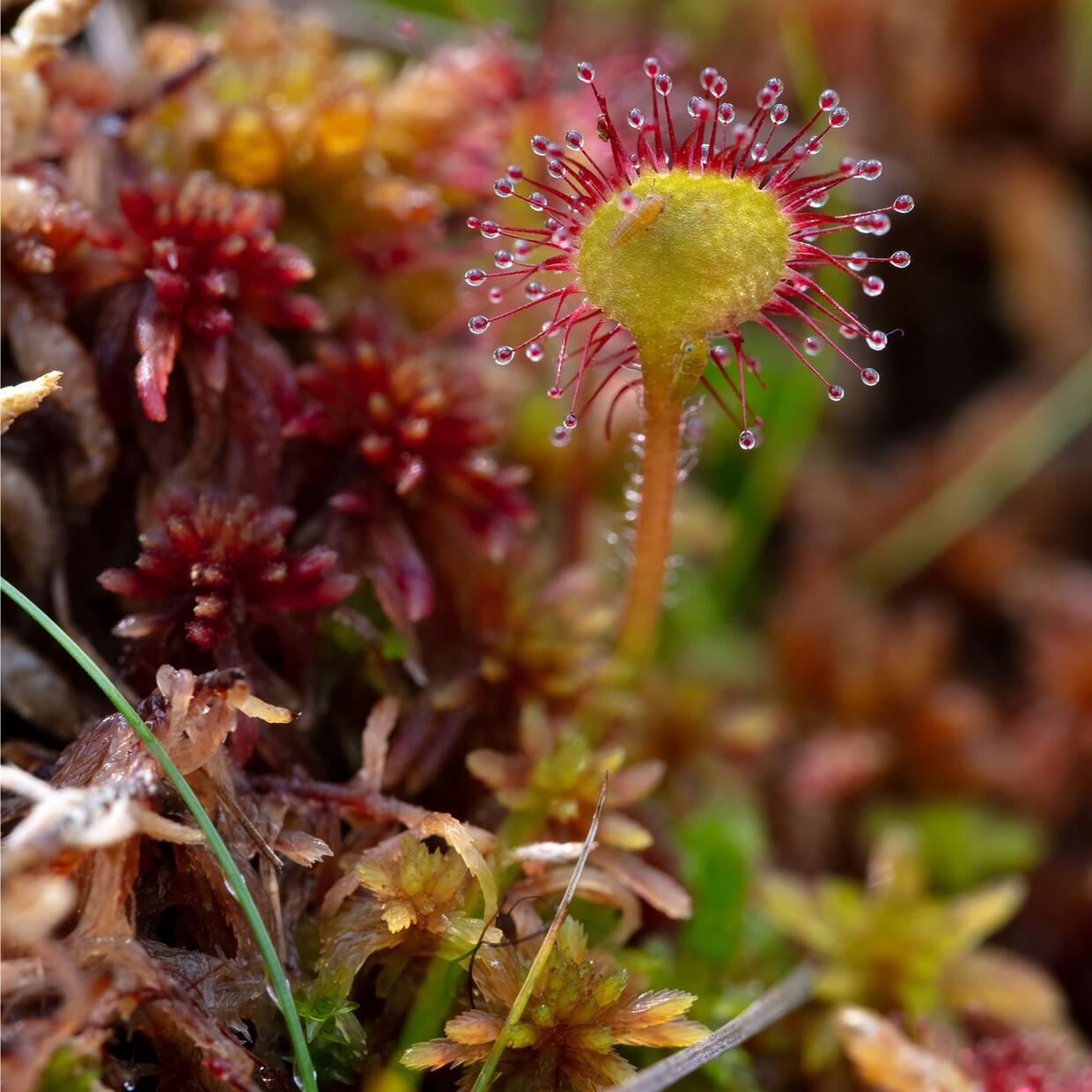
Round-leaved sundew (Drosera rotundifolia)
Round-leaved sundew
Where the purple pitcher plant waits passively for prey, the round-leaved sundew actively captures it. This diminutive carnivore, easily overlooked at just a few inches tall, forms a ground-hugging rosette of circular leaves covered in red, gland-tipped hairs. Each hair secretes a drop of sticky, glistening mucilage that resembles dew but is actually a deadly adhesive loaded with sugars to attract insects.When a small insect lands on a leaf, it becomes instantly stuck. Then the sundew's remarkable mechanism activates: the tentacle-like hairs slowly curl inward, bringing more sticky droplets into contact with the struggling prey. Eventually the entire leaf may fold around the victim like a fist. Enzymes secreted by the glands digest the insect's soft tissues, and the leaf absorbs nitrogen, phosphorus, and other nutrients directly through its surface. After several days, the leaf unfolds, releasing the insect’s dried exoskeleton to the wind and resetting the trap for another victim. Studies of sundews in nutrient-poor habitats suggest they may derive 25 to 50 percent of their nitrogen from carnivory—a substantial supplement to what their roots can scavenge from the peat. The reliance on insects is highest in the most nutrient-starved, open bog environments, where every meal matters.
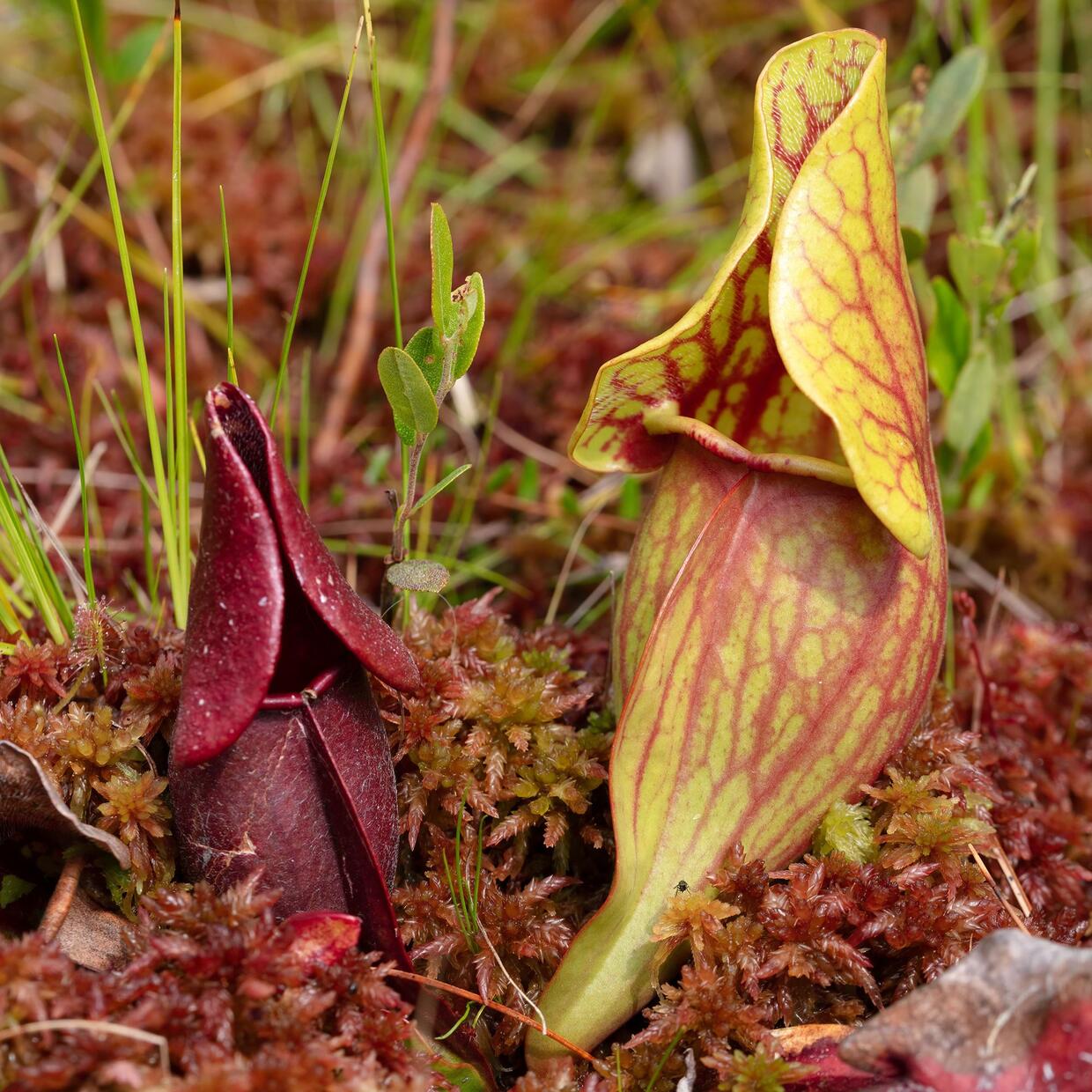
Purple pitcher plant (Sarracenia purpurea)
Purple pitcher plant
Perhaps no bog plant captures the imagination quite like the purple pitcher plant. Its modified leaves form elegant, trumpet-shaped traps adorned with crimson veins and a flared hood. These pitchers are not merely decorative—they are sophisticated killing devices. The plant lures insects with nectar secreted along the pitcher rim and with the deep purple coloration that some insects find irresistible. Once an insect lands and ventures inside, downward-pointing hairs and slippery surfaces make escape nearly impossible. The victim tumbles into rainwater pooled at the pitcher's base, where it drowns. But the pitcher plant does not digest its prey alone. A miniature ecosystem develops inside each pitcher: mosquito larvae, midge larvae, and other arthropods take up residence in the water, feeding on the decomposing insects and helping to break down the prey into nutrients the plant can absorb through specialized cells in the pitcher walls. It is carnivory through community, a partnership between plant and scavengers. The pitcher plant’s flowers, held high above the pitchers on tall stalks, ensure that pollinators need not risk becoming prey. Bees visiting the nodding, burgundy blooms remain safe from the deadly leaves below. Remarkably, one specialist insect, the pitcher plant fly (Fletcherimyia fletcheri), has evolved to live its larval stage in the very fluid that drowns other insects, feeding on the decomposing remains while somehow avoiding the plant's digestive processes. These flies then pollinate the flowers, completing a relationship so intertwined it borders on symbiosis.
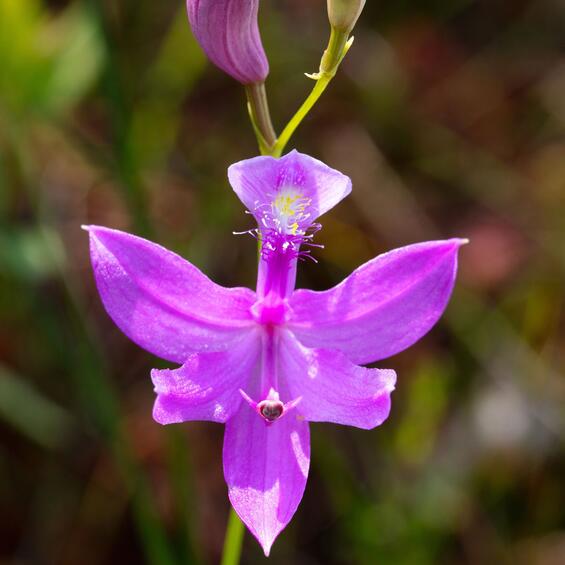
Grass pink orchid (Calopogon tuberosus)
Grass pink orchid
If you explore a bog in June or July, you might encounter a slender stalk rising from the sphagnum, topped with several magenta blooms. This is the grass pink orchid, one of the bog's most exquisite residents. Unlike most orchids, whose flowers twist during development to display the lip petal at the bottom, grass pink flowers do not rotate—the lip petal appears at the top, adorned with a bright yellow and orange "beard" of hairlike structures. This unusual orientation is key to the orchid's pollination strategy, and its deception. The yellow beard resembles pollen, attracting inexperienced bumblebees and other bees in search of a meal. When a bee of sufficient weight lands on the hinged lip, the petal swings downward like a trapdoor, dumping the bee backward onto the flower's column, where the pollen-bearing anthers press against the insect's back. The bee, having received no nectar reward for its trouble, eventually flies off to the next flower, where it may deposit the pollen it unwittingly carries. This system works only on naive bees that have not yet learned the trick. Once a bee has been fooled several times without finding nectar, it learns to avoid grass pink flowers, searching instead for more reliable food sources. The orchid's survival depends on a steady supply of inexperienced pollinators, a strategy that works best in habitats with robust bee populations and limited competition from more generous flowers.
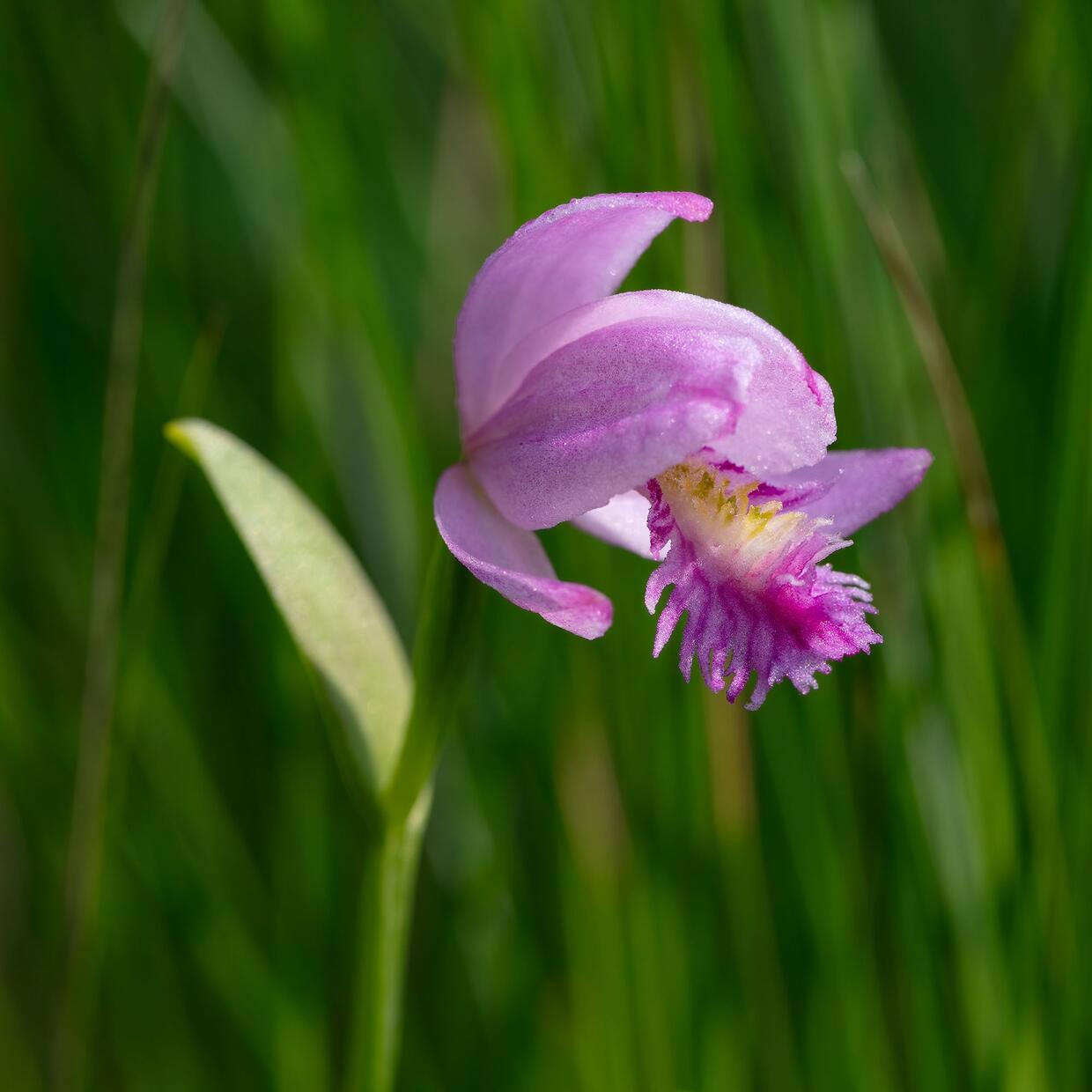
Rose pogonia (Pogonia ophioglossoides)
Rose pogonia
The rose pogonia is another orchid gem, though it takes a different approach to attracting pollinators. A single slender stem rises from the bog, bearing a solitary pink flower (or, rarely, two or three) at its summit. The flower displays the typical orchid architecture: three sepals and two petals frame a showy lip petal that is fringed with dark pink or purple hairs and adorned with yellow or crimson markings along its center. Unlike many orchids, rose pogonia flowers are fragrant, releasing a sweet scent on warm days. The fragrance is part of an elaborate ruse. Like the grass pink, rose pogonia offers no nectar to its visitors, the flowers are deceptive, promising a reward they do not provide. Bumblebees, particularly species like Bombus borealis and Bombus fervidus, visit the flowers, attracted by scent and color, and probe for nectar that does not exist. In the process, they contact the flower’s pollen masses and may transfer pollen to the next pogonia they visit. The deception works because individual bees do not specialize on rose pogonias; they visit many flower species, and the occasional unrewarding bloom is tolerated in a landscape of more generous plants. Rose pogonia colonies may bloom over an extended period from June through August, with individual plants flowering at different times. This staggered blooming helps maintain the deception—there are always a few fresh flowers to attract naive bees, even as experienced pollinators learn to avoid older blooms.
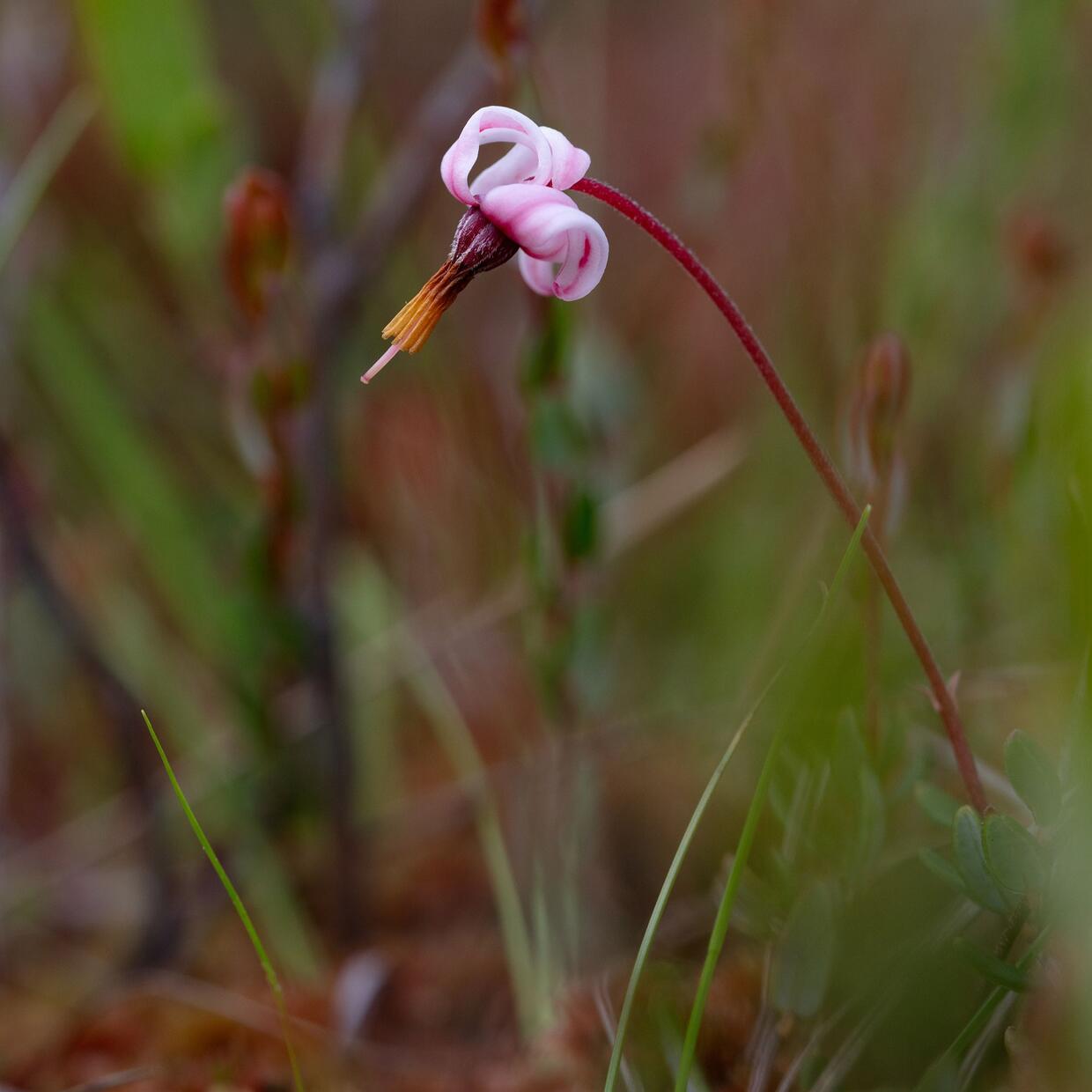
Small cranberry (Vaccinium oxycoccos)
Small cranberry
The small cranberry is a prostrate, vine-like shrub that creeps along the surface of sphagnum moss, rooting where its slender stems touch the peat. Its tiny, evergreen leaves have distinctive rolled margins, giving them a narrow appearance, and its flowers are unmistakable: deep pink petals sharply bent backward, with protruding stamens that give the bloom the appearance of a shooting star or a tiny rocket. This cranberry, like sheep laurel, depends on mycorrhizal partnerships to survive in acidic peat. The fungal associations improve nutrient uptake and growth rates in soils where most plants would struggle. The plant can also spread vegetatively through layering, sending down new roots wherever a stem contacts the moss, creating interconnected mats that stabilize the bog surface. While technically self-pollinating, bog cranberry relies heavily on insect visitors, and particularly native bumblebees, to achieve good seed production. Research has shown that when insects are excluded, the plants produce virtually no seeds. The flowers are adapted for buzz pollination: bees vibrate their flight muscles while clinging to the bloom, shaking pollen loose from tiny porous openings at the tips of the anthers. The resulting red berries are edible, though smaller and more tart than their cultivated cousin, large cranberry (Vaccinium macrocarpon), which is native to New England and also grows in wild bogs.
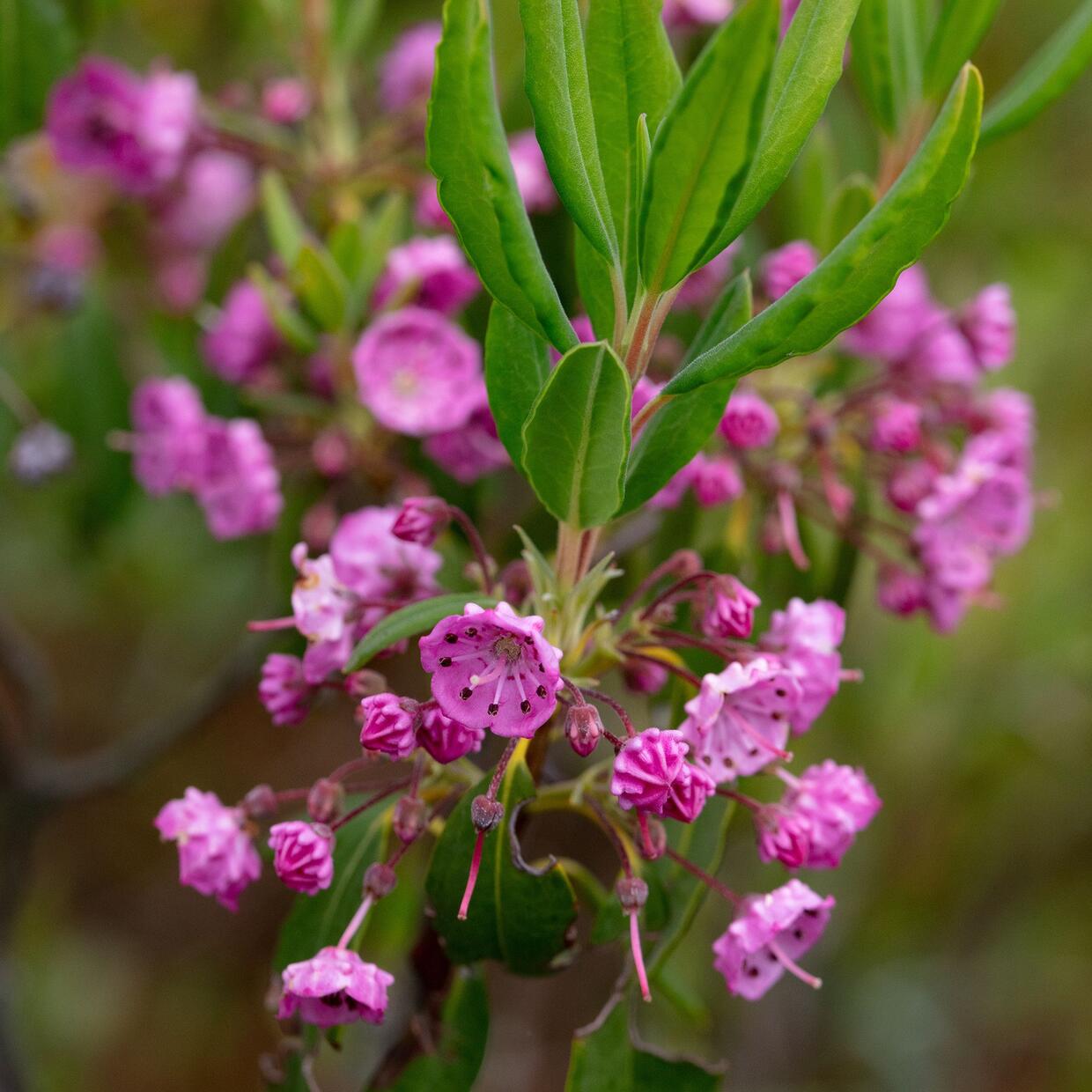
Sheep laurel (Kalmia angustifolia)
Sheep laurel
Sheep laurel is a low evergreen shrub that thrives in the acidic soils of bogs and wetlands, typically growing one to three feet tall. A member of the heath family, it shares the mycorrhizal strategy common to bog plants, partnering with fungi to extract nutrients from the reluctant peat. Its tough, leathery leaves persist year-round, and in early summer the plant produces clusters of deep crimson-pink flowers that brighten the bog landscape. Each flower is saucer-shaped with five shallow lobes and a clever mechanism for pollen dispersal. The ten stamens are initially held under tension, with their anthers tucked into small pockets in the petals. When a bee lands and pushes against the flower, the stamens spring free, dusting the visitor with pollen, a catapult mechanism like that of its close relative, mountain laurel. Sheep laurel attracts a variety of pollinators, including bees and butterflies. It also serves as a larval host plant for the laurel sphinx moth (Sphinx kalmiae), a large hawk moth whose very scientific name honors this plant; a distinction it shares with its close relative, mountain laurel. Despite these beneficial relationships with insects, the plant produces toxic compounds called grayanotoxins that protect it from browsing herbivores.
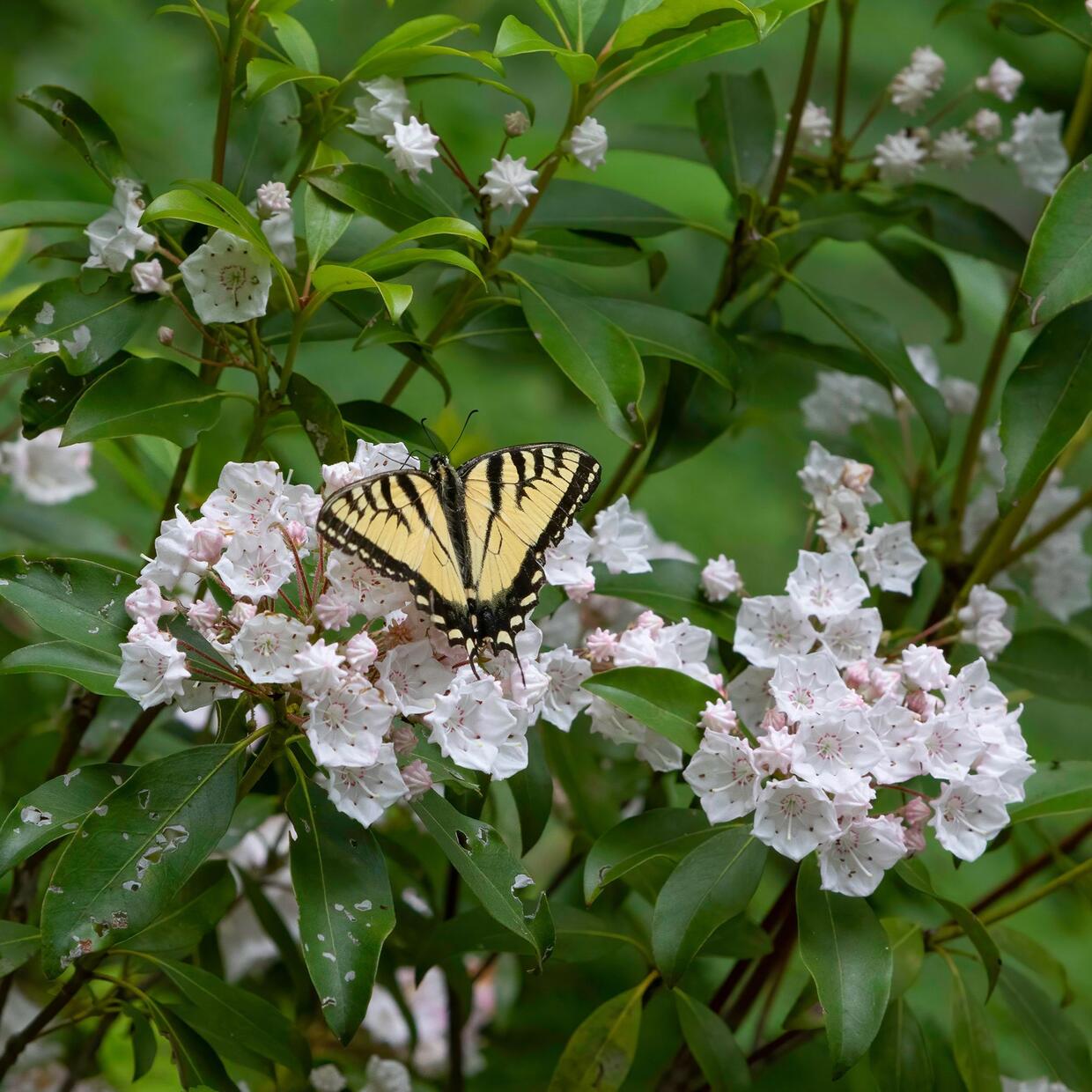
A tiger swallowtail butterfly (Papilio glaucus) nectoring on mountain laurel (Kalmia latifolia)
Mountain laurel
Mountain laurel, the larger cousin of sheep laurel, grows as an evergreen shrub reaching heights of 10 to 30 feet, often forming dense thickets at the edges of bogs and on surrounding uplands. Its glossy, elliptic leaves are larger and showier than those of sheep laurel, and in late spring the plant produces spectacular clusters of flowers ranging from white to pale pink. The flowers display an intricate architecture. Each bloom is pentagonal, with five petals fused into a shallow bowl. Ten stamens arch over the center, their anthers initially held in tension within small pockets in the petals. This creates a loaded spring: when a bee or other pollinator lands and disturbs the flower, the stamens snap forward, striking the visitor and coating it with pollen. Once triggered, the flower cannot reset. It is a single-use mechanism, but remarkably effective. Bees, moths, butterflies, and occasional hummingbirds serve as pollinators; the flower stems are coated with sticky secretions that exclude crawling insects, ensuring that only flying visitors, those capable of transferring pollen between plants, receive the reward. Like its smaller relative, mountain laurel contains toxic compounds throughout its tissues, deterring herbivores while remaining a valuable nectar source for beneficial insects. As noted above, it also shares with sheep laurel the distinction of serving as a larval host for the laurel sphinx moth.
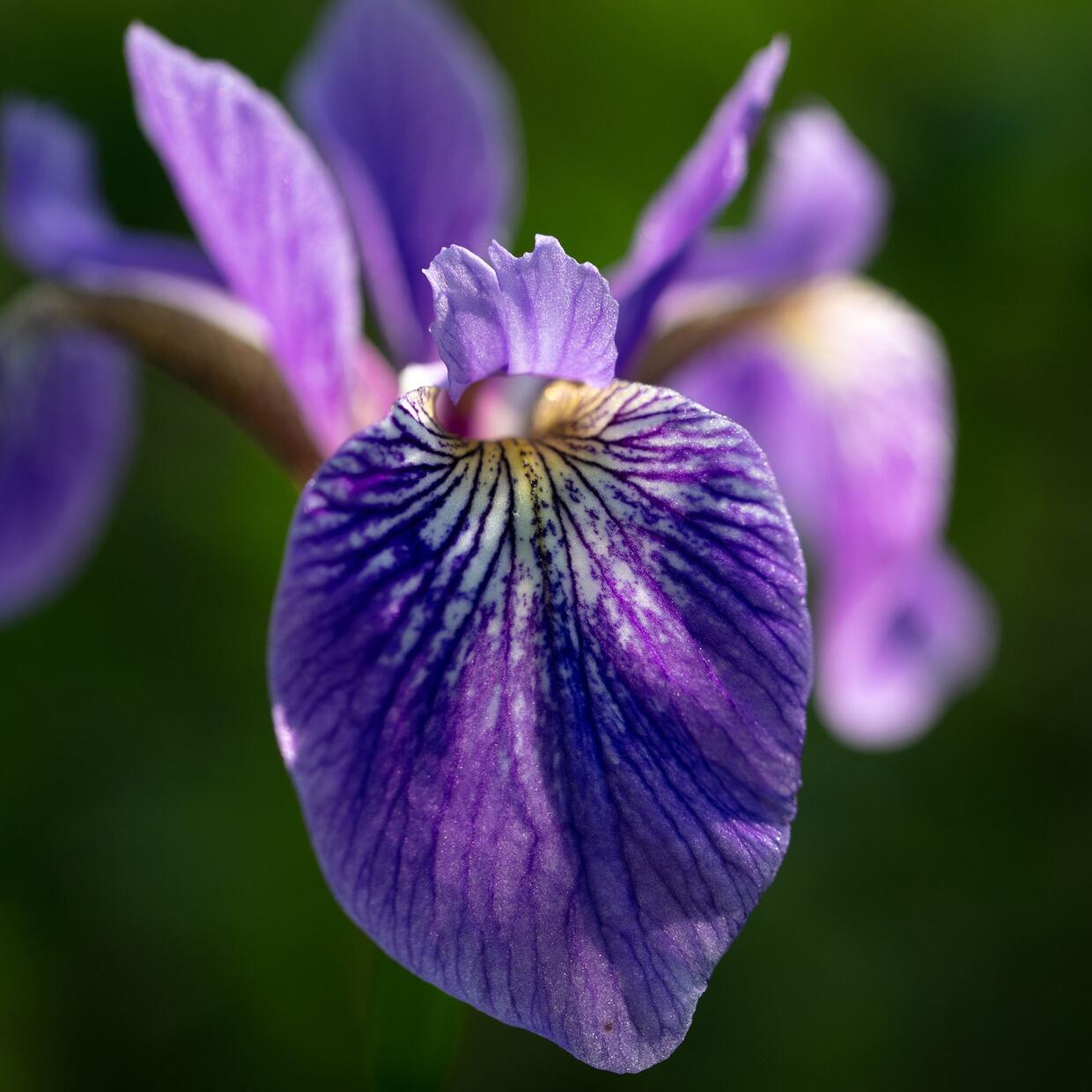
Northern blue flag (Iris versicolor)
Northern blue flag
Along the margins of bogs, where the floating peat mat meets open water or saturated soil, the Northern blue flag iris unfurls its sword-shaped leaves and elegant purple blooms. This robust perennial grows from creeping rhizomes, spreading slowly to form clumps that help stabilize the bog edge. The flowers, reaching up to four inches across, display the classic iris form: three drooping sepals called "falls" and three upright petals called "standards." The falls serve as landing platforms for pollinators, and their bold purple veining leads visitors toward the nectar glands at the flower's center. A bright yellow blotch surrounded by white further guides bees to the reward. Bumblebees are the primary pollinators, though ruby-throated hummingbirds, skippers, and other short-tongued bees also visit the blooms. The iris's architecture ensures that a visiting bee contacts the stigma before reaching the anthers, promoting cross-pollination. Blue flag is found in bogs, fens, marshes, and along shorelines, and almost always found in saturated soils or shallow water. Its extensive root system plays a role in wetland function, helping to filter water and stabilize sediments. In restoration projects, blue flag is often planted to re-establish native wetland vegetation and provide habitat for pollinators.
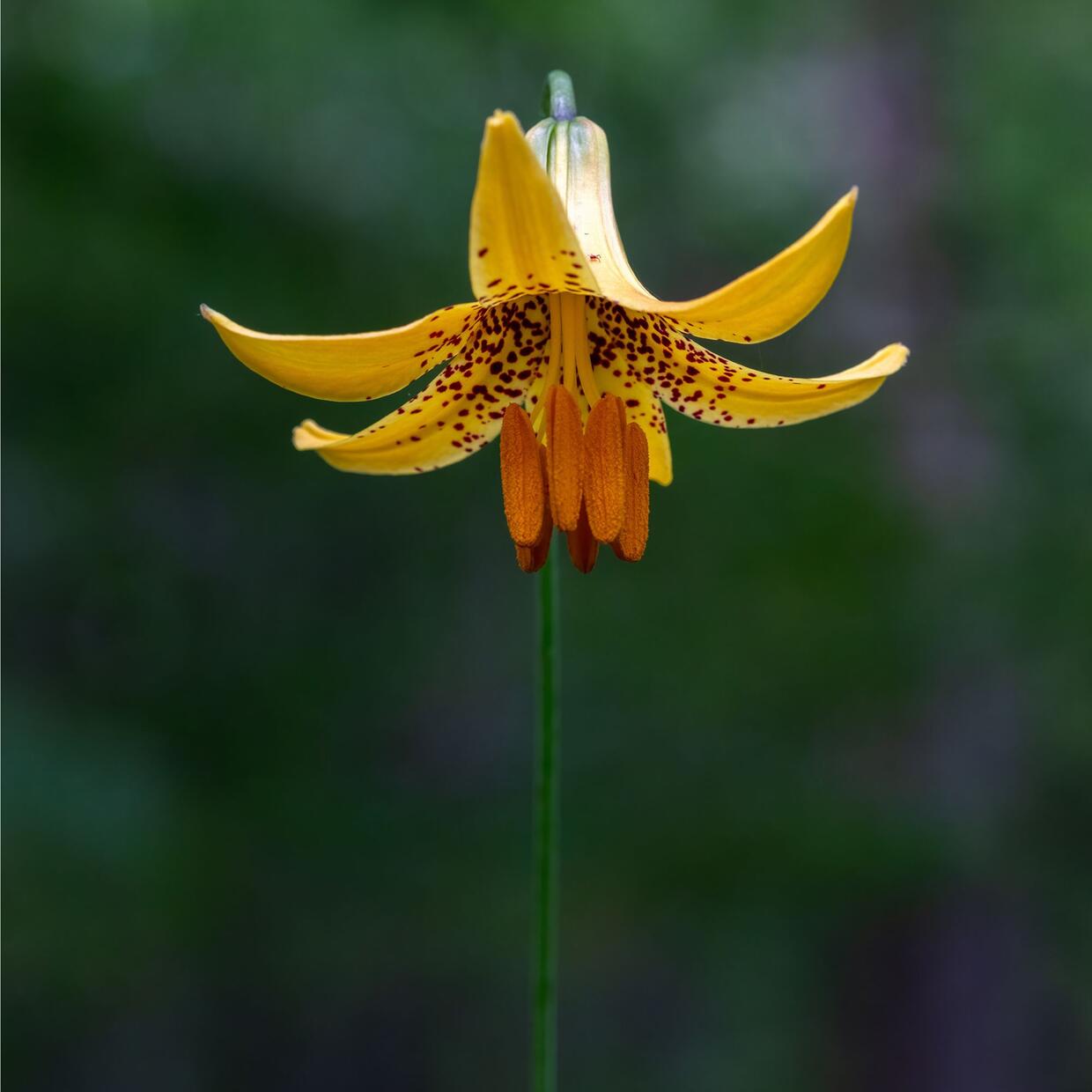
Canada lily (Lilium canadense)
Canada lily
Where conditions are slightly less acidic and somewhat richer in nutrients, at the bog margins; in nearby wet meadows; or along streams, the Canada lily lifts its spectacular flowers above the surrounding vegetation. Growing from a bulb, this native perennial sends up a smooth stem that can reach six feet tall, with leaves arranged in elegant whorls around the stem. At the summit, the plant produces one to seventeen nodding, bell-shaped flowers in shades of yellow to orange, each adorned with chocolate-brown spots near its center. The Canada lily is primarily pollinated by ruby-throated hummingbirds, which hover beneath the pendant blooms to sip nectar from the flower's base. The downward orientation protects the nectar from rain and makes it accessible primarily to hummingbirds, whose hovering ability gives them exclusive access. Large butterflies, including great spangled fritillaries and various swallowtails, may also visit the flowers, using their long tongues to probe for nectar while their wings inadvertently brush against the pollen-laden anthers. Though not a true bog specialist, the Canada lily is often found near bog margins.