

Overview
Partners in the City of Boston have been collaborating for over two years to conduct cross-sector stakeholder workshops that bring together partners from criminal justice, treatment, recovery, crisis, healthcare and homelessness systems.
Initiated by the Trial Court’s Massachusetts Community Justice Project, the Boston Community Justice Project consists of a workshop planning group, Steering Committee and multiple subcommittees.
Six workshops have been held in the city to date. These events use the Sequential Intercept Model as a framework to collectively identify local resources and gaps in services, and create an action plan to enhance collaboration and reduce the risk of justice-involvement and recidivism for people with addiction and/or mental illness.
The Boston Community Justice Project has benefited from the leadership and guidance of Judge Kathy Coffey (BMC West Roxbury Division) and collaboration of Judge John McDonald (BMC East Boston) and Judge David Weingarten (BMC Roxbury).
The Steering Committee was developed after the first workshop, meets quarterly, and includes representatives from Boston Municipal Court, Boston Police Department, Boston Office of Recovery Services, Gavin Foundation, Committee for Public Counsel Services, Massachusetts Organization for Addiction Recovery (MOAR), Suffolk Sheriff’s Office, Suffolk Office of Community Corrections, Suffolk District Attorney’s Office, Boston EMS, Arbour Hospital, Pine Street Inn, Rosie’s Place, Boston Emergency Services Team (BEST), East Boston Neighborhood Health Center, NAMI Mass, Boston Public Health Commission’s PAATHS Program and Homeless Services, Community Resources for Justice and Developmental Disability Services. The Steering Committee is co-chaired by Jenna Savage, Deputy Director of the Office of Research and Development for the Boston Police Department and Christina Miller, Assistant Clinical Professor of the Prosecutors Program for Suffolk Law School.
Subcommittees were developed to target priorities identified during Community Justice Workshops. Subcommittees/workgroups include: Model Training, Information Sharing, Peer Support, Timely Access to Treatment, Housing, Law Enforcement Co-Response and the Section 35 Pilot Program through BMC West Roxbury. The group is currently undergoing a strategic planning process, following the sixth citywide mapping workshop, to reevaluate and realign efforts with community partners.
Workshops were conducted in the following locations:
- BMC South Boston, Dorchester, West Roxbury, and RoxburyDivisions: May 2016
- BMC Central and Charlestown Divisions: December 2016
- MassachusettsAvenue – Melnea Cass Blvd Region: March/April 2017
- Commercial Sexual Exploitation in Boston: October 2017
- BMC East Boston Division: March/April2017
- Citywide: November 2018
Sequential Intercept Model
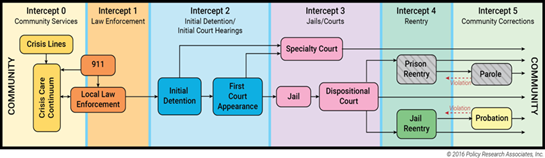
Description of the Sequential Intercept Model
The Sequential Intercept Model (SIM) details how individuals with mental and substance use disorders come into contact with and move through the criminal justice system.
The SIM helps communities identify resources and gaps in services at each intercept and develop local strategic action plans. The SIM mapping process brings together leaders and different agencies and systems to work together to identify strategies to divert people with mental and substance use disorders away from the justice system into treatment.
Learn more about the SIM at Substance Abuse and Mental Health Services Association.
Intercept 0: Community Services
Involves opportunities to divert people into local crisis care services. Resources are available without requiring people in crisis to call 911, but sometimes 911 and law enforcement are the only resources available. Connects people with treatment or services instead of arresting or charging them with a crime.
Intercept 1: Law Enforcement
Involves diversion performed by law enforcement and other emergency service providers who respond to people with mental and substance use disorders. Allows people to be diverted to treatment instead of being arrested or booked into jail.
Intercept 2: Initial Court Hearings/Initial Detention
Involves diversion to community-based treatment by jail clinicians, social workers, or court officials during jail intake, booking, or initial hearing.
Intercept 3: Jails/Courts
Involves diversion to community-based services through jail or court processes and programs after a person has been booked into jail. Includes services that prevent the worsening of a person’s illness during their stay in jail or prison.
Intercept 4: ReEntry
Involves supported reentry back into the community after jail or prison to reduce further justice involve of people with mental and substance use disorders. Involves reentry coordinators, peer support staff, or community in-reach to link people with proper mental health and substance use treatment services.
Intercept 5: Community Corrections
Involves community-based criminal justice supervision with added supports for people with mental and substance use disorders to prevent violations or offenses that may result in another jail or prison stay.
Boston Community Justice Workshop: Gap Summary
| Gap | South Boston, Roxbury, West, Roxbury, Dorchester - 5/2016 | Central Charlestown - 12/2016 | Mass and Cass - 3/2017 | Commercial Sexual Exploitation - 10/2017 | East Boston & Winthrop - 3/2018 | Citywide - 11/2018 |
|---|---|---|---|---|---|---|
| Information Sharing | Yes (T5) | Yes (T5) | Yes (T5) | Yes | Yes | Yes |
| Training/Resources for Law Enforcement (including Co-Responders) | Yes (T5) | Yes | Yes (T5) | Yes (T5) | Yes (T5) | Yes (T5) |
| Peer Support | Yes (T5) | Yes | Yes | Yes (T5) | Yes (T5) | Yes (T5) |
| Screening/Assessment | Yes | No | Yes | Yes | Yes | XX |
| Training (other than law enforcement) | Yes (T5) | Yes | No | Yes (T5) | No | Yes |
| Timely Access to Treatment | Yes (T5) | XX | No | No | Yes (T5) | Yes |
| Comprehensive case management (including post-crisis and post-Section 35) | No | Yes | Yes (T5) | No | Yes (T5) | Yes (T5) |
| Medication Assisted Treatment (methadone/buprenorphine) during incarceration | No | Yes | Yes | No | Yes | Yes |
| Working with people living with MI/SUD | No | Yes | Yes (T5) | No | Yes (T5) | Yes (T5) |
| In-reach/Reentry services | Yes | No | Yes (T5) | No | Yes (T5) | Yes (T5) |
| Insurance Issues | No | Yes (T5) | Yes (T5) | No | No | Yes |
| Coalition/Task Force | Yes (T5) | No | No | Yes (T5) | No | Yes (T5) |
| Housing/Homelessness | No | Yes (T5) | Yes (T5) | No | No | No |
| Specialty Courts | No | Yes | No | Yes | No | Yes |
| Probation capacity | No | No | Yes | Yes | No | No |
| Pre-arraignment diversion | No | No | No | Yes (T5) | No | Yes |
| Pre-trial treatment (for held and released persons) | No | Yes | No | No | No | No |
| Street level outreach | No | No | No | No | Yes (T5) | No |
| Transportation | No | No | Yes | No | No | No |
| Family engagement/support | No | Yes | No | No | No | No |
| Treatment for 18-24 | No | Yes | No | No | No | No |
| Geographical approach to services and referrals | No | No | Yes (T5) | No | No | No |
| Medication Access | No | No | Yes | No | No | Yes |
| Fees related to probation/programming | No | No | Yes | No | No | No |
| Bar advocate access to social workers | No | No | Yes | No | No | Yes |
| Formal communication/referral system within Boston Police to HT Unit | No | No | No | Yes | No | No |
| Treatment navigation/evaluation at first court appearance | No | No | No | No | Yes | Yes |
| Naloxone (Narcan) on release from incarceration | No | No | No | No | Yes | No |
| Restorative Justice program | No | No | No | No | No | Yes |
| Underutilization of Suffolk OCC | No | No | No | No | No | Yes |
| Capacity to address criminogenic risk factors in community treatment providers | No | No | No | No | No | Yes |
Yes (T5) = Among top 5 priorities
City of Boston Sequential Intercept Map
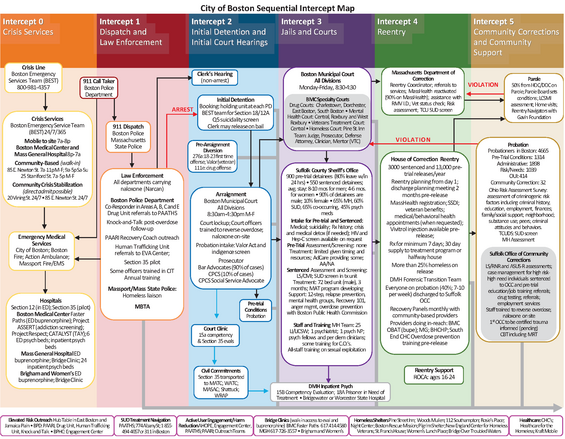
Description of the City of Boston's Sequential Intercept Model
Intercept 0: Crisis Services
Crisis Line
Boston Emergency Services Team (BEST): 800-981-4357
Crisis Services
Boston Emergency Service Team (BEST): Available 24 hours a day, 7 days a week.
Mobile to Site 7a-8p
- Boston Medical Center
- Mass General Hospital (8pm to 7am)
Community-Based (walk-in)
85 E. Newton St.
Hours:
- Monday thru Friday, 7am to 11pm
- Saturday and Sunday, 9am to 5pm
25 Staniford St.
Hours:
- Monday thru Friday, 7am to 5pm
Community Crisis Stabilization (direct admit possible)
20 Vining St. 24/7
Hours: 24 hours a day, 7 days a week.
85 E. Newton St.
Hours: 24 hours a day, 7 days a week.
Emergency Medical Services
• City of Boston
• Boston Fire
• Action Ambulance
• Massport Fire/EMS
Hospitals
These hospitals offer both Section 12 and Section 35 involuntary psychiatric hold services, in addition to specialized programs for treating mental health and substance use disorders.
Boston Medical Center
- Faster Paths to Treatment (Buprenorphine treatment)
- Project ASSERT (addiction screening)
- Project Respect
- CATALYST (TAY)
Mass General Hospital
- Emergency Department (Buprenorphine treatment)
- Bridge Clinic
Brigham and Women’s
- Emergency Department (Buprenorphine treatment)
- Dushku-Palandjian Bridge Clinic
Intercept 1: Dispatch and Law Enforcement
911 Call Taker
Boston Police Department
911 Dispatch
- Boston Police
- Massachusetts State Police
Law Enforcement
All departments carrying naloxone (Narcan)
Boston Police Department
- Co-Responder in Areas A, B, C, and E
- Drug Unit referrals to PAATHS
- Knock-and-Talk post-overdose follow-up
- PAARIRecovery Coach outreach
- Human Trafficking Unit referrals to EVA Center
- Section 35 pilot
- Some officers training in CIT Annual training
Massport/Mass State Police
- Homeless liaison
MBTA
Intercept 2: Initial Detention and Initial Court Hearings
Clerk's Hearing (non-arrest)
Initial Detention
- Booking: holding unit at each Police Department
- Best team for Section 18/12A
- Q5 suicidality screen
- Clerk may release on bail
Pre-Arraignment Diversion
- 276a: 18-23 first time offence; Valor (veteran) 111e: drug offence
Arraignment
Boston Municipal Court
- All Division Hours:
- Monday through Friday, 8:30am - 4:30pm
Court lockup
Court officers training to reverse overdose; naloxone on site
Probation intake
Valor Act and indigence screen
Prosecutor
- Bar Advocated (90% of cases)
- CPCS (10% of cases)
- CPCS Social Service Advocate
Pre-trial Conditions
Probation
Court Clinic
15a competency & Section 35 evals
Civil Commitments
- Section 35 transported to MATC
- WATC
- MASAC
- Shattuck
- WRAP
Intercept 3: Jail and Courts
Boston Municipal Court
- All Division Hours:
- Monday through Friday, 8:30am - 4:30pm
- BMC Specialty Courts
- Drug Courts: Charlestown, Dorchester, East Boston, South Boston
- Mental Health Court: Central, Roxbury and West Roxbury
- Veterans Treatment Court: Central
- Homeless Court: Pine Street Inn
- Team: Judge, Prosecutor, Defense Attorney, Clinician, mentor (VTC)
Suffolk County Sherri's Office
- 900 pre-trial detainees (80% leave within 24 hours)
- 550 sentences detainees
- Average stay: 8-10 months for men; 4-6 months for women
- 90% of detainees are male; 10% female
- 65% MH, 60% SUD, 65% co-occurring, 45% psych meds
Intake for Pre-trial and Sentences
- Medical; suicidality; Rx history; crisis and medical detox (if needed); HIV and Hep-C screen available on request.
- Pre-Trial Assessment/Screening: none
- Treatment: limited given timing and resources; AdCare providing some; AA/NA
- Sentence Assessment and Screening
- LS/CMI; SUD screen in tx unit
- Treatment: 72 bed unit (male), 3 months; MAT program developing
- Support: 12-step, relapse prevention, mental health groups, Recovery 101, anger management, overdose prevention with Boston Public Health Commission
- LS/CMI; SUD screen in tx unit
Staff and training MH Team
- 25 LI/LICSW; 1 psychiatrist; 1 psych NP; psych fellows and per diem clinicians; some training for CO's.
- All-staff training on sexual exploitation.
DMH Inpatient Psych
- 15B Competency Evaluation; 18A Prisoner in Need of Treatment
- Bridgewater or Worcester State Hospital
Intercept 4: Reentry
Massachusetts Department of Correction
- Reentry Coordination; referrals to services; MassHealth reactivated (90% on MassHealth); assistance with RMV I.D.; Vet status check; Risk assessment; TCU SUD screen
House of Correction Reentry
- 3,000 sentences and 13,000 pre-trial releases/year
- Reentry planning from day 1; discharge planning meeting 2 months pre-release
- MassHealth registration; SSDI; veteran benefits; medical/behavioral health appointments (when requested); Vivitrol injection available pre-release
- Rx for minimum 7days; 30 day supply to treatment program or halfway house
- More than 25% homeless on release
- DMH Forensic Transition Team
- Everyone on probation (40%; 7-10 per week) discharged to Suffolk OCC
- Recovery Panels monthly with community-based providers.
- Providers doing in-reach: BMC OBAT (bupe); MG; BHCHP; South End CHC Overdose prevention training pre-release
Reentry Support
ROCA: ages 16-24
Intercept 5: Community Corrections and Community Support
Parole
- 50% from HOC/DOC on Parole; Parole Board sets conditions; LCSMI assessment; Homevisits; Reentry Navigators with Gavin Foundation
Probation
- Probationers in Boston: 4665
- Pre-Trial Conditions: 1314
- Administrative: 1898
- Risk/Needs: 1039
- OUI: 414
- Community Correction: 32
- Ohio Risk Assessment Survey:
- Assessment of criminogenic risk factors including criminal history; education, employment, finances; family/social support; neighborhood; substance use; peers; criminal attitudes and behaviors.
- TCUDS: SUD screen
- MH Assessment
Suffolk Office of Community Corrections
- LS/RNR and ASUS-R assessments
- Case management for risk-high need individuals sentences to OCC and pre-trial education/job training referrals; drug testing; referrals; employment services
- Staff trained to reverse overdose; naloxone on site
- 1st OCC to be certified trauma informed (pending)
- CBT including MRT
| Date published: | April 1, 2019 |
|---|---|
| Last updated: | March 6, 2026 |